Best Crawl Space Dehumidifier Accessories for Drainage, Leak Alerts, and Humidity Monitoring
Introduction
A crawl space dehumidifier can help control damp air, musty odors, and moisture conditions below the home, but the dehumidifier itself is only one part of the setup. If it cannot drain properly, if a hose comes loose, if the condensate pump overflows, or if humidity is not being monitored in the far corners of the crawl space, moisture problems can continue even after the unit is installed.
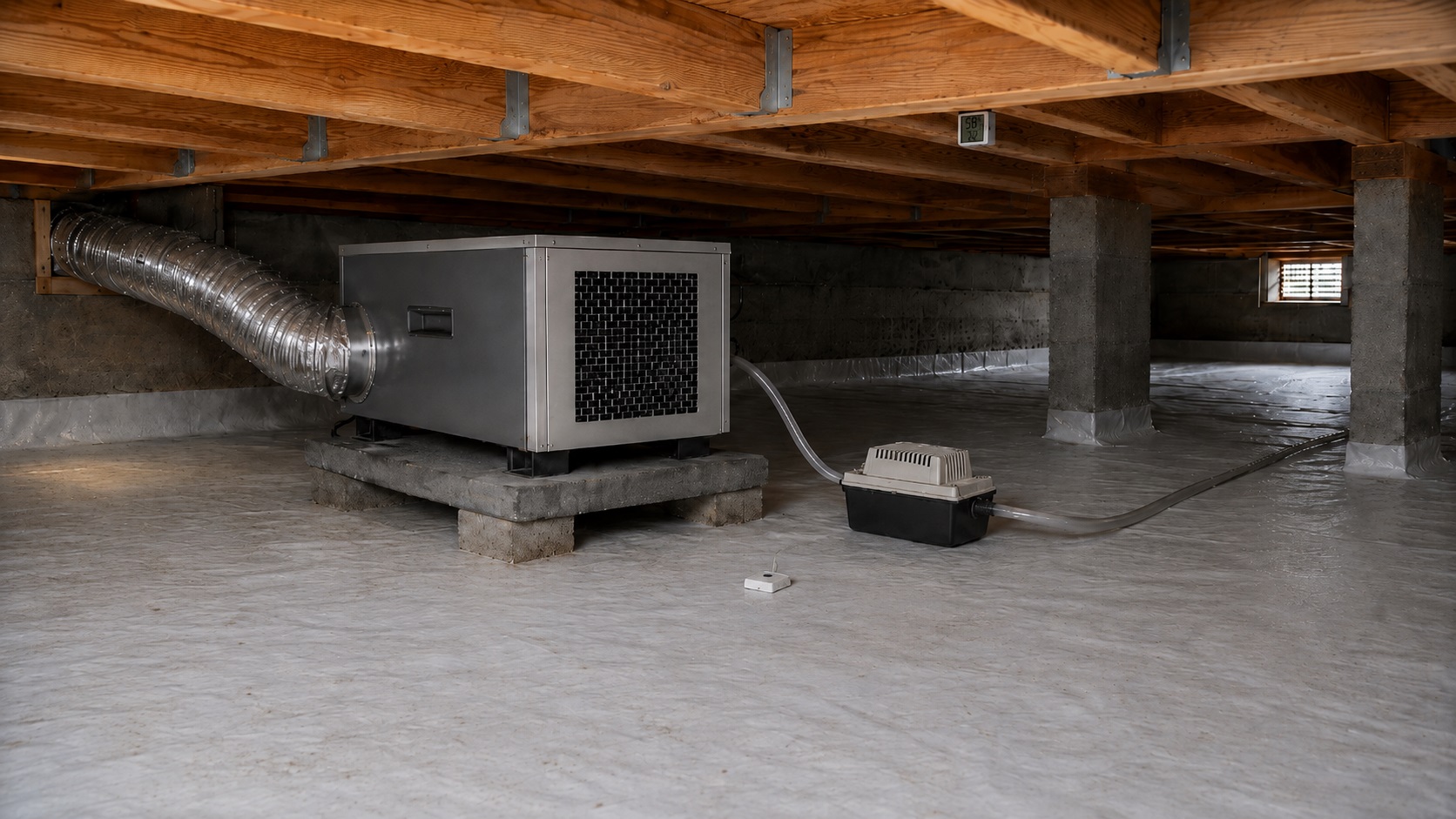
That is why choosing the best crawl space dehumidifier accessories matters. The right accessories help support the system around the dehumidifier. A condensate pump can move water when gravity drainage will not work. A leak detector can alert you if water appears near the unit or pump. A humidity monitor can show whether the crawl space is actually drying out. Ducting may also help compatible crawl space dehumidifiers move air through long or divided spaces.
This guide focuses on practical accessories that help with crawl space dehumidifier drainage, monitoring, leak alerts, airflow support, and maintenance. For choosing the dehumidifier itself, see our guide on how to choose and use a dehumidifier effectively. For broader moisture troubleshooting, see our sitewide guide on how to find, fix, and prevent moisture problems in homes.
If you are still trying to confirm whether the area below your home has an active moisture problem, start with our guide to signs of moisture in crawl spaces before buying accessories.
As an Amazon Associate, this site earns from qualifying purchases. This does not affect the price you pay. Our recommendations are based on research, product reliability, and real-world usability in moisture-prone environments.
Quick Picks Summary
- Best Overall Condensate Pump: Little Giant VCMA-20ULST Condensate Removal Pump
- Best Compact Condensate Pump: Little Giant VCMA-15ULST Condensate Removal Pump
- Best Leak Alert Accessory: Govee WiFi Water Leak Detector 3 Pack
- Best Long-Range Leak Detection System: YoLink Water Leak Starter Kit with Hub and 4 Leak Sensors
- Best Smart Humidity Monitoring Accessory: Govee Hygrometer Thermometer 3Pack H5100
- Best Budget Humidity Monitor: ThermoPro / TempPro TP50 Digital Hygrometer Indoor Thermometer
- Best for Ductable Crawl Space Dehumidifiers: VIVOSUN 6 Inch Flexible Aluminum Ducting with Stainless Steel Clamps
Note: This guide focuses on accessories with the best mix of crawl space relevance, homeowner usefulness, and stronger Amazon listing support. More technical or model-specific items, such as overflow switches and replacement filters, are better treated as optional add-ons rather than main picks.
Before buying, check your dehumidifier manual for drain outlet size, pump requirements, duct compatibility, clearance needs, and any manufacturer-specific installation guidance.
Product Reviews
Best Overall Condensate Pump — Little Giant VCMA-20ULST Condensate Removal Pump
The Little Giant VCMA-20ULST is the strongest overall accessory in this guide because drainage is one of the most important parts of a crawl space dehumidifier installation. Many crawl spaces do not have a convenient floor drain next to the unit. If the drain point is higher than the dehumidifier or farther away than a simple gravity hose can handle, a condensate pump becomes one of the most important pieces of the system.
This pump is useful when you want the dehumidifier to run continuously without depending on a water bucket. That matters in crawl spaces because access is often inconvenient. If a bucket fills and the dehumidifier shuts off, humidity can rise again before the homeowner notices.
The VCMA-20ULST is a good fit for crawl space setups where water needs to be moved up and away from the dehumidifier to a safe drain location. It is not a fix for standing water, poor exterior drainage, or a failed vapor barrier, but it can make the dehumidifier’s water removal much more practical.
Key Features
- Automatic condensate removal for dehumidifiers, HVAC equipment, and similar drainage needs
- Designed to move collected water to a higher or more distant drain point
- Useful for crawl spaces where gravity drainage is not realistic
- Includes overflow detection support when installed correctly
- Good fit for long-term crawl space dehumidifier setups
Pros
- ✔ Helps a crawl space dehumidifier drain without relying on a bucket
- ✔ Strong choice when the drain point is not below the dehumidifier
- ✔ Useful for harder-to-access crawl spaces
- ✔ Well-suited for homeowners building a more dependable moisture-control setup
Cons
- ✖ Requires power near the installation area
- ✖ Drain tubing still needs to be routed correctly
- ✖ Requires occasional inspection and cleaning
- ✖ Does not solve the source of crawl space water intrusion
Best For
- Crawl spaces where the dehumidifier must drain uphill
- Homeowners who do not want to empty a collection bucket
- Long-term crawl space dehumidifier installations
- Dehumidifier setups where drainage reliability is the biggest concern
Check the Little Giant VCMA-20ULST Condensate Removal Pump on Amazon to see current availability.
Best Compact Condensate Pump — Little Giant VCMA-15ULST Condensate Removal Pump
The Little Giant VCMA-15ULST is a compact condensate pump for homeowners who need pumped drainage but do not necessarily need the larger VCMA-20ULST. It makes sense for smaller crawl spaces, lighter residential dehumidifier setups, and installations where the drain route is not especially demanding.
This pump solves the same basic problem as the larger model: it helps move water away from the dehumidifier when gravity drainage is not enough. The difference is that it is better suited to more modest setups. If the dehumidifier is removing a lot of water or the drain route requires a significant lift, the larger pump may be the safer choice.
For crawl spaces with recurring dampness, remember that drainage from the dehumidifier is only one part of the moisture-control system. If humidity keeps returning, review the larger causes in why moisture problems keep returning.
Key Features
- Compact automatic condensate pump for residential dehumidifier drainage
- Designed for lower-to-moderate condensate removal needs
- Useful where a basic drain hose cannot slope downward to a drain
- Can help reduce manual bucket emptying
- Smaller footprint than many larger condensate pump options
Pros
- ✔ Good compact option for smaller crawl space setups
- ✔ Helps keep the dehumidifier running without bucket interruptions
- ✔ Useful when gravity drainage is not available
- ✔ Less bulky than larger pump options
Cons
- ✖ Not ideal for every high-lift drainage route
- ✖ May not be the best choice for heavy condensate loads
- ✖ Still requires careful tubing placement
- ✖ Needs periodic inspection like any condensate pump
Best For
- Smaller crawl space dehumidifier installations
- Moderate drainage needs
- Homeowners who want a compact pump instead of a larger unit
- Setups where the drain route is not especially long or difficult
Check the Little Giant VCMA-15ULST Condensate Removal Pump on Amazon to see current availability.
Best Leak Alert Accessory — Govee WiFi Water Leak Detector 3 Pack
The Govee WiFi Water Leak Detector 3 Pack is a practical accessory because many crawl space dehumidifier problems show up as water where it should not be. A drain hose can come loose. A condensate pump reservoir can overflow. A tubing connection can drip. A discharge line can clog or kink. If the crawl space is rarely checked, those failures can continue unnoticed.
Leak sensors do not prevent every leak, and they do not replace correct drainage. Their main value is early warning. You can place one near the condensate pump, one near the dehumidifier base, and one under or near a hose connection. That gives you a better chance of catching a drainage problem before it spreads across the vapor barrier or reaches framing, insulation, or stored items.
This is one of the most useful crawl space dehumidifier accessories for homeowners who want peace of mind after installing a pump or continuous drain. It is also useful in homes where crawl space access is difficult or unpleasant.
Key Features
- Three leak sensors for monitoring multiple risk points
- WiFi-connected alerts through the app
- Audible alarm for local warning
- Useful near condensate pumps, drain hoses, and low spots
- Can help identify failures before they become larger moisture problems
Pros
- ✔ Very useful around dehumidifier drainage systems
- ✔ Three sensors provide better coverage than a single alarm
- ✔ App alerts are helpful when the crawl space is not checked often
- ✔ Good fit near pump reservoirs and hose connections
Cons
- ✖ Requires usable WiFi coverage near the crawl space
- ✖ Does not shut off the dehumidifier or pump by itself
- ✖ Sensors must be placed where water is likely to appear
- ✖ Batteries and app connection should be checked periodically
Best For
- Homeowners using a condensate pump or drain hose
- Crawl spaces that are not inspected frequently
- Detecting drainage failures near the dehumidifier
- Adding basic smart leak alerts to a moisture-control setup
Check the Govee WiFi Water Leak Detector 3 Pack on Amazon to see current availability.
Best Long-Range Leak Detection System — YoLink Water Leak Starter Kit with Hub and 4 Leak Sensors
The YoLink Water Leak Starter Kit is the better leak detection choice for larger crawl spaces, detached areas, weak WiFi conditions, or homes where a basic WiFi sensor may not stay connected. Crawl spaces can be difficult for wireless devices because the sensors may sit below the floor, behind insulation, near ductwork, or far from the router.
This kit gives you four leak sensors and a hub-based system, which makes it more serious than a single standalone water alarm. You can monitor the dehumidifier, pump, drain route, and another known risk area. For example, one sensor could sit near the condensate pump, one near the dehumidifier, one near the lowest part of the crawl space, and one near plumbing that passes through the space.
The main reason not to choose this system is simplicity. If you have a small crawl space with good WiFi and only need one or two sensors, the Govee leak detector may be enough. But for longer-range monitoring, YoLink is the stronger crawl space option. If your crawl space is small and your WiFi signal is reliable near the access area, this kit may be more than you need.
Key Features
- Hub-based leak detection system with four sensors
- Designed for long-range smart home monitoring
- Useful where standard WiFi sensors may be unreliable
- Good for monitoring multiple crawl space risk areas
- Can support a broader leak detection system around the home
Pros
- ✔ Better suited for large or hard-to-reach crawl spaces
- ✔ Four sensors provide broad coverage
- ✔ Stronger option when WiFi-only devices struggle
- ✔ Useful for dehumidifier, pump, hose, and plumbing risk points
Cons
- ✖ More setup than a simple leak alarm
- ✖ May be more system than a small crawl space needs
- ✖ Requires use of the YoLink hub and app ecosystem
- ✖ Amazon may occasionally flag some kit versions for higher-than-typical pricing
Best For
- Large crawl spaces
- Homes with weak WiFi near the crawl space
- Homeowners who want several leak sensors around one moisture-control system
- Dehumidifier setups that are difficult to inspect regularly
Best Smart Humidity Monitoring Accessory — Govee Hygrometer Thermometer 3Pack H5100
The Govee Hygrometer Thermometer 3Pack H5100 is useful because a crawl space dehumidifier should be judged by results, not just by whether the unit turns on. The important question is whether the crawl space humidity is actually staying under control over time.
A three-sensor system is helpful because crawl spaces often have uneven moisture conditions. One area may dry quickly near the dehumidifier, while a far corner, plumbing area, foundation wall, or crawl space door stays more humid. Multiple sensors help you see whether the dehumidifier is controlling the whole space or only improving conditions near the unit.
This is especially helpful after installation, after heavy rain, during seasonal humidity changes, or when adjusting dehumidifier settings. For more help interpreting readings, see how to test indoor humidity levels.
Key Features
- Three humidity and temperature sensors
- App-based viewing for easier monitoring
- Useful for tracking humidity in different crawl space zones
- Can help reveal areas that stay damp after the dehumidifier runs
- Good accessory for checking long-term moisture patterns
Pros
- ✔ Helps confirm whether the dehumidifier is actually improving conditions
- ✔ More useful than a single reading in larger crawl spaces
- ✔ Good for tracking humidity trends over time
- ✔ Can help identify damp corners or poor air mixing
Cons
- ✖ Wireless range can vary depending on floor structure and crawl space layout
- ✖ Does not reduce humidity by itself
- ✖ Sensor placement affects how useful the readings are
- ✖ Batteries and app connection should be checked periodically
Best For
- Monitoring humidity in multiple crawl space zones
- Encapsulated or semi-encapsulated crawl spaces
- Homeowners who want to confirm the dehumidifier is working over time
- Tracking humidity changes after rain or seasonal weather shifts
Check the Govee Hygrometer Thermometer 3Pack H5100 on Amazon to see current availability.
Best Budget Humidity Monitor — ThermoPro / TempPro TP50 Digital Hygrometer Indoor Thermometer
The ThermoPro / TempPro TP50 is a simple humidity monitor for homeowners who want a basic reading without using an app, hub, or multi-sensor system. It is not as advanced as a smart hygrometer setup, but it can still be useful for checking crawl space humidity near an access point, in an adjacent basement, or near the dehumidifier when you are inspecting the space.
This is a good accessory for homeowners who are still learning what normal and abnormal humidity levels look like. It gives you a quick reference point so you are not relying only on how the crawl space smells or feels. That matters because a crawl space can begin trending damp before visible mold, wood damage, or insulation problems appear.
For a large crawl space, the TP50 is best as a simple spot-check tool rather than your only monitor. If the space is divided, hard to access, or prone to recurring dampness, a multi-sensor system gives you better information.
Key Features
- Simple digital humidity and temperature display
- No app, WiFi, or hub required
- Useful for spot-checking humidity conditions
- Compact design for basic placement near access areas
- Simple option for homeowners who want basic humidity readings without app setup
Pros
- ✔ Easy to use
- ✔ Good budget humidity reference tool
- ✔ No smart home setup required
- ✔ Helpful for quick checks during maintenance visits
Cons
- ✖ No remote alerts
- ✖ Only monitors one location
- ✖ Not ideal as the only monitor in a large crawl space
- ✖ Requires someone to physically check the display
Best For
- Budget users who want a basic humidity monitor
- Spot-checking crawl space or nearby basement humidity
- Simple maintenance checks
- Homeowners who do not need app alerts
Best for Ductable Crawl Space Dehumidifiers — VIVOSUN 6 Inch Flexible Aluminum Ducting with Stainless Steel Clamps
The VIVOSUN 6 Inch Flexible Aluminum Ducting is a useful accessory only in the right situation. Some crawl space dehumidifiers are designed to accept ducting so they can pull damp air from one area or discharge drier air into another area. In a long, narrow, or divided crawl space, that can help the dehumidifier affect more than just the air immediately around the unit.
This is not a universal accessory. Do not add ducting to a dehumidifier unless the unit is designed for it. Improvised ducting can restrict airflow, reduce performance, and make the dehumidifier work harder. Before buying ducting, check the dehumidifier manual for duct size, maximum duct length, and intake or supply connection instructions.
For homeowners deciding whether airflow or dehumidification is the better approach, read when to use a dehumidifier vs ventilation. In many crawl spaces, outdoor ventilation can make humidity worse during damp weather, so the right solution depends on the conditions.
Key Features
- Flexible 6-inch aluminum ducting
- Includes stainless steel clamps on the selected listing
- Useful for compatible ductable crawl space dehumidifiers
- Can help route air through long or awkward crawl spaces
- Flexible design is easier to place than rigid ducting in tight areas
Pros
- ✔ Helpful for compatible ducted crawl space dehumidifier setups
- ✔ Can improve air distribution in some layouts
- ✔ Flexible design works well in tight crawl space conditions
- ✔ Clamps help secure connections when installed correctly
Cons
- ✖ Not compatible with every dehumidifier
- ✖ Poor duct routing can restrict airflow
- ✖ Should not be used to hide a deeper moisture-source problem
- ✖ Requires checking the dehumidifier manual before installation
Best For
- Ductable crawl space dehumidifiers
- Long or divided crawl spaces
- Installations where air needs to be moved from one section to another
- Homeowners following manufacturer ducting guidance
Product Comparison Table
| Product | Category Label | Best Use Case | Key Strengths | Main Limitation | Amazon Link |
|---|---|---|---|---|---|
| Little Giant VCMA-20ULST Condensate Removal Pump | Best Overall Condensate Pump | Crawl spaces where the dehumidifier must drain uphill or away from the unit | Strong drainage support, automatic operation, overflow detection support | Requires proper power, tubing, and discharge routing | View on Amazon |
| Little Giant VCMA-15ULST Condensate Removal Pump | Best Compact Condensate Pump | Smaller residential crawl space drainage setups | Compact size, automatic condensate removal, useful for modest drainage needs | Not ideal for every high-lift or heavy-condensate situation | View on Amazon |
| Govee WiFi Water Leak Detector 3 Pack | Best Leak Alert Accessory | Monitoring the area around a pump, drain hose, or dehumidifier | Multiple sensors, app alerts, audible warning | Needs usable WiFi coverage near the crawl space | View on Amazon |
| YoLink Water Leak Starter Kit with Hub and 4 Leak Sensors | Best Long-Range Leak Detection System | Large crawl spaces or weak WiFi areas | Long-range monitoring, hub-based system, four sensors | More setup than a simple leak alarm | View on Amazon |
| Govee Hygrometer Thermometer 3Pack H5100 | Best Smart Humidity Monitoring Accessory | Tracking humidity in multiple crawl space zones | Three sensors, app viewing, useful for trend monitoring | Wireless range can vary by crawl space layout | View on Amazon |
| ThermoPro / TempPro TP50 Digital Hygrometer Indoor Thermometer | Best Budget Humidity Monitor | Simple humidity spot checks | Easy to use, no app required, low-complexity monitoring | No remote alerts or multi-zone tracking | View on Amazon |
| VIVOSUN 6 Inch Flexible Aluminum Ducting with Stainless Steel Clamps | Best for Ductable Crawl Space Dehumidifiers | Ductable crawl space dehumidifiers | Flexible ducting, clamps included, useful for air routing | Only appropriate for compatible dehumidifiers | View on Amazon |
Buying Guide: How to Choose the Right Crawl Space Dehumidifier Accessories
The best crawl space dehumidifier accessories depend on the weak point in your moisture-control setup. Do not start by buying every accessory. Start by asking what can fail: drainage, monitoring, leak detection, airflow, or maintenance.
If the Dehumidifier Cannot Drain by Gravity
Start with a condensate pump. Gravity drainage only works when the hose can slope downward the entire way to a safe drain. If the drain is higher than the dehumidifier, a regular hose will not move water properly. In that situation, a condensate pump is usually more important than a smart sensor or humidity monitor.
Choose the Little Giant VCMA-20ULST if you want the stronger all-around pump option. Choose the VCMA-15ULST if the installation is smaller and less demanding.
If You Are Worried About Hose, Pump, or Overflow Problems
Choose leak detectors. This is especially important if the crawl space is hard to access. A leak detector near the pump or hose connection can alert you when water appears where it should not. This does not stop the leak automatically, but it can help you respond before the problem spreads.
The Govee kit is a good practical option for many homeowners. The YoLink kit makes more sense when the crawl space is large or WiFi coverage is poor.
If You Do Not Know Whether the Dehumidifier Is Actually Working
Choose humidity monitoring. A dehumidifier display may only reflect conditions near the unit. A separate hygrometer helps you see whether the rest of the crawl space is improving. For larger spaces, multiple sensors are usually more useful than one device.
For a full explanation of humidity testing, see how to test indoor humidity levels.
If the Crawl Space Has Uneven Air Movement
Consider ducting only if the dehumidifier supports it. Ducting can be helpful in long, narrow, or divided crawl spaces, but it is not a universal solution. Check the dehumidifier manual before adding ducts. If the unit is not designed for ducting, do not force it.
If You Still Need the Dehumidifier Itself
This guide is about accessories, not the main dehumidifier unit. If you are still choosing the dehumidifier, read our guide to the best crawl space dehumidifiers. The right accessories work best when they support a properly sized, properly placed unit.
Setup and Usage Advice
Place the dehumidifier on a stable surface according to the manufacturer’s instructions. Crawl spaces are often uneven, and poor placement can affect drainage, airflow, and service access. Keep the intake and discharge areas clear so the unit is not fighting restricted airflow.
If you use a condensate pump, place it so water can flow from the dehumidifier into the pump reservoir without kinks or loose connections. Route the discharge tube to a safe drain point. Avoid areas where tubing can be crushed, pulled loose, damaged by pests, or exposed to freezing conditions.
Place leak sensors where water would appear first. Good locations include beside the condensate pump, under a hose connection, near the dehumidifier base, and in low areas where water would collect. Do not put every sensor in one spot unless that is truly the only risk area.
For humidity monitors, avoid placing every sensor directly beside the dehumidifier. One sensor near the unit is useful, but another should be placed farther away to show whether the entire crawl space is improving. If one area stays damp, that may point to poor air movement, ground moisture, exterior water entry, plumbing leaks, or vapor barrier problems.
If you use ducting, keep the run as short and smooth as practical. Long, crushed, sagging, or sharply bent duct runs can reduce airflow. Ducting should help the dehumidifier move air, not make the unit work harder.
Common Mistakes to Avoid
Assuming a Dehumidifier Fixes Every Crawl Space Moisture Problem
A dehumidifier controls airborne moisture. It does not fix standing water, foundation drainage problems, plumbing leaks, a missing vapor barrier, or exterior water intrusion. If water keeps entering the crawl space, the source still needs to be corrected.
Using a Drain Hose When a Pump Is Needed
A gravity drain hose cannot push water uphill. If the drain route does not slope downward, a condensate pump is usually needed. Trying to make a gravity hose work in the wrong layout can lead to shutdowns, leaks, or standing water around the unit.
Putting Leak Sensors Where Water Will Not Reach Them
Leak sensors only work if water touches them. Place them near likely failure points, not just where they are easiest to install.
Only Checking Humidity Near the Dehumidifier
The area around the dehumidifier may be drier than the far end of the crawl space. Use multiple readings if the space is large, divided, or known to have damp corners.
Adding Ducting to a Non-Ductable Dehumidifier
Ducting should only be used with compatible units. Poorly planned ducting can restrict airflow and reduce performance.
Ignoring Maintenance
Pumps, drain tubing, filters, and sensors all need periodic checks. A clogged pump reservoir, kinked hose, dead sensor battery, or dirty dehumidifier filter can reduce the effectiveness of the whole setup. For routine care, see how to maintain a dehumidifier.
FAQ About the Best Crawl Space Dehumidifiers
Do I need a condensate pump for a crawl space dehumidifier?
You need a condensate pump if the dehumidifier cannot drain by gravity to a safe location. If the drain point is higher than the dehumidifier or the hose route cannot slope downward, a pump is usually the practical solution.
Can I use a regular drain hose in a crawl space?
Yes, if the hose can run downhill the entire way to a safe drain. If the hose has to run uphill or across an awkward route, a regular gravity drain hose may not work correctly.
Where should leak sensors go near a crawl space dehumidifier?
Place sensors near the condensate pump, under hose connections, beside the dehumidifier, and in low spots where water would collect first. If you have multiple sensors, spread them across the most likely failure points.
Is one humidity monitor enough for a crawl space?
One monitor is better than guessing, but multiple sensors are more useful in larger crawl spaces. Humidity can vary from one area to another, especially in long, divided, or partially sealed spaces.
Should a crawl space humidity monitor have app alerts?
App alerts are useful if you do not enter the crawl space often. A basic hygrometer works for spot checks, but smart monitoring is better for tracking changes without physically checking the space every time.
Does ducting make every crawl space dehumidifier work better?
No. Ducting only helps if the dehumidifier is designed for ducted intake or supply. If the unit does not support ducting, adding ducts can restrict airflow and reduce performance.
Will these accessories prevent mold?
No accessory can guarantee mold prevention. These products can support drainage, leak alerts, humidity monitoring, and airflow, but mold prevention still depends on controlling moisture sources and keeping the crawl space dry over time.
What crawl space dehumidifier accessory should I buy first?
If drainage is the problem, buy a condensate pump first. If drainage already works, add leak sensors and humidity monitoring. If the crawl space has uneven air movement and the dehumidifier supports ducting, then consider ducting.
Conclusion
The best crawl space dehumidifier accessories are not random add-ons; they are the parts that help the system drain reliably, warn you about failures, and show whether humidity is actually improving. If your dehumidifier cannot drain by gravity, the Little Giant VCMA-20ULST Condensate Removal Pump is the strongest overall pump choice. For smaller or less demanding drainage setups, the Little Giant VCMA-15ULST Condensate Removal Pump is the better compact option.
If you are mainly worried about leaks, pump overflow, or hose failure, the Govee WiFi Water Leak Detector 3 Pack is a practical alert accessory for most homes. For larger crawl spaces or weaker signal areas, the YoLink Water Leak Starter Kit with Hub and 4 Leak Sensors is the stronger long-range option.
If your main goal is to see whether the crawl space is actually drying out, the Govee Hygrometer Thermometer 3Pack H5100 is the best smart humidity monitoring accessory, while the ThermoPro / TempPro TP50 Digital Hygrometer Indoor Thermometer is the best simple budget monitor. If your dehumidifier supports ducting, the VIVOSUN 6 Inch Flexible Aluminum Ducting with Stainless Steel Clamps can help route air through compatible crawl space setups.
Used correctly, these accessories can make a crawl space dehumidifier system easier to drain, easier to monitor, and less likely to fail unnoticed. They do not replace proper crawl space repair, drainage correction, or vapor barrier work, but they can make a good dehumidifier installation more dependable.