
How to Inspect Roof Shingles After High Winds
After high winds, inspect roof shingles from safe locations for missing, shifted, lifted, creased, folded, torn, or no-longer-flat shingles. These conditions can allow wind-driven rain to get beneath the roof covering, even if the roof still looks mostly intact from the ground.
The goal is not to perform a full professional roof inspection yourself. The goal is to recognize warning signs, document what you can see safely, check for early moisture clues, and know when the roof needs professional evaluation. High winds can loosen shingles, break seals, disturb roof edges, and expose vulnerable areas to water.
Post-wind shingle inspection matters because damaged shingles are part of the broader group of roofing material failures that lead to leaks. Once shingles no longer lie flat or stay sealed, the roof may stop shedding water the way it should.
Catching wind damage early can also help prevent moisture problems in homes before lifted shingles turn into attic dampness, wet insulation, ceiling stains, or hidden water damage.
Start With Safety Before Inspecting Roof Shingles
Do not climb onto the roof after high winds. Storm-damaged roofs can have loose shingles, slick surfaces, damaged edges, unstable debris, and hidden weak spots. Even a roof that looks dry from the ground may be unsafe to walk on.
Wait until the weather is calm before inspecting anything. Avoid checking during active wind, rain, lightning, or while debris is still moving. Also stay away from fallen power lines, broken tree limbs, unstable fences, damaged gutters, or hanging roof materials.
Use safe viewing methods instead:
- Walk around the home from ground level.
- Use binoculars or phone camera zoom.
- Look from upper windows only if they are safe and easy to access.
- Check the yard for shingles, tabs, ridge caps, or roof debris.
- Look at gutters, downspouts, and roof edges from the ground.
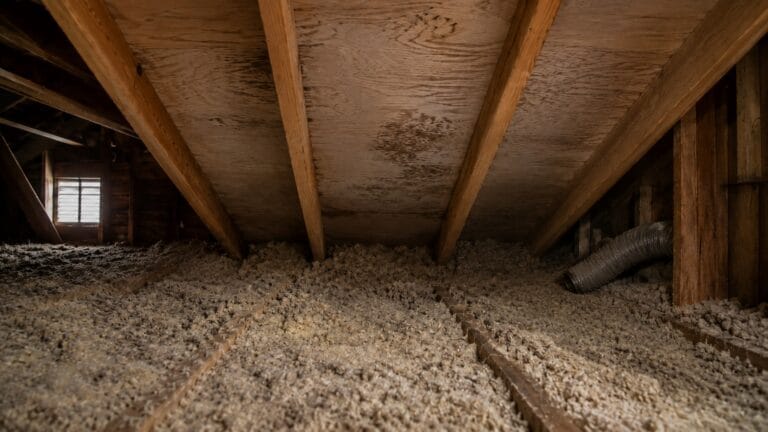
- Check the attic if access is safe, stable, and well-lit.
You are looking for visible changes, not touching or testing shingles by hand. Do not pull on shingles, lift tabs, climb ladders in poor conditions, or walk on the roof to “see how bad it is.” If signs suggest wind damage, a qualified roofer should handle the roof-surface inspection and any temporary stabilization needed before the next storm.
If you are unsure what wind damage looks like before starting, compare your observations with the main signs of wind damage on roofs. That can help you recognize what the inspection is trying to find.
Walk Around the Home and Look for Fallen Roof Materials
The easiest place to begin is the ground. High winds often leave clues around the home before you can clearly see damage on the roof. Walk the property slowly and look near downspouts, garden beds, walkways, patios, driveways, shrubs, and areas below roof edges.
Look for:
- Whole shingles in the yard.
- Broken shingle tabs.
- Ridge cap pieces.
- Small pieces of asphalt roofing.
- Metal flashing fragments.
- Vent caps or plastic vent pieces.
- Roofing nails or fasteners.
- Sudden piles of granules near downspouts.
If you find roofing materials on the ground, do not assume they came from the roof area directly above that spot. Wind can carry lightweight shingles or broken tabs across the yard. A piece found near the driveway may have come from the rear slope, a ridge, or even a neighbor’s roof. Still, any matching roof material near your home after a windstorm is a warning sign.
Take photos of what you find before moving it. Include a wider photo showing where the material landed and a close photo showing the material itself. If you later call a roofer, these photos can help explain what happened and when.
Check Roof Slopes for Missing or Shifted Shingles
After checking the yard, step back and compare the visible roof slopes from several angles. Do not only look at the front of the house. Wind direction matters, and one side of the roof may take much more damage than another.
A useful pattern is to compare the wind-facing slope, the opposite slope, and roof corners separately instead of scanning the roof as one surface.
Look for areas where the shingle pattern has changed. Missing shingles may appear as dark patches, exposed underlayment, visible roof decking, broken rows, or gaps in the normal shingle layout. Shifted shingles may look out of line compared with the rows around them.
Pay attention to:
- Dark rectangular patches where shingles are missing.
- Uneven shingle rows.
- Shingles that look displaced or slid out of position.
- Exposed underlayment or sheathing.
- Missing shingles near roof edges.
- Missing ridge or hip cap shingles.
- Sections that look different from the rest of the roof after the storm.
Missing shingles are one of the clearest signs that the roof may be exposed to water. Underlayment may provide temporary protection, but it is not meant to be the permanent outer roof surface. If rain reaches exposed areas repeatedly, moisture can move into the roof deck, attic, insulation, or ceiling materials.
Shifted shingles are also important. A shingle that moved out of place may no longer overlap properly with the shingles around it. Even a small shift can create a place where wind-driven rain can move beneath the roof covering.
Look for Lifted, Creased, Folded, or Torn Shingles
High winds do not always remove shingles completely. Sometimes they lift the shingle tab, bend it backward, crease it, tear an edge, or fold a corner. These signs may be more subtle than missing shingles, but they can still create leak risk.
From the ground, lifted or damaged shingles may look like raised edges, uneven shadow lines, ruffled areas, or tabs that no longer lie flat. A creased shingle may show a line where the tab bent. A folded shingle may look like one corner or section has flipped or curled sharply after the storm.
Look for:
- Raised shingle tabs.
- Folded corners.
- Crease lines across shingles.
- Torn shingle edges.
- Tabs that appear loose or lifted.
- Shingles that seem to flap during later wind.
- Small missing portions of shingles.
These signs are stronger wind-damage clues than ordinary old curling. Old curling usually develops gradually and may affect many shingles in a weathered pattern. Wind damage is more likely when the change appears suddenly after high winds and includes creasing, folding, tearing, displacement, or missing pieces.
A lifted or creased shingle may settle back down after the storm, but that does not always mean it is fine. The seal may be broken, the tab may be weakened, or the shingle may lift again during the next windy rain. This is why subtle shingle movement can become hidden wind damage that leads to roof leaks.
Check Shingle Seal and Wind Movement Clues
Many asphalt shingles rely on seal strips to help hold tabs in place. If the seal is weak, broken, aged, contaminated, or disturbed by high winds, the tab may lift more easily during future storms.
You should not test shingle seals by pulling on the roof. That is unsafe for homeowners and can cause additional damage. Instead, look for visible clues that shingles may no longer be holding properly.
Possible seal or wind-movement clues include:
- Several tabs raised in the same area.
- Shingles that appear loose compared with surrounding shingles.
- Rows that look ruffled or uneven after wind.
- Shingles that repeatedly lift during later gusts.
- Tabs that lie flatter in some areas but raised in others.
- Lifted shingles near roof edges, ridges, hips, or valleys.
Not every unsealed shingle is recent wind damage. A shingle may fail to seal because of age, improper installation, dust, debris, cold-weather installation, lack of heat activation, old repairs, or manufacturing issues. Wind damage is more likely when the shingle also shows fresh creasing, folding, tearing, missing pieces, or sudden movement after a storm.
These clues matter because wind can weaken the bond that keeps shingles flat. For the fuller explanation of that failure pattern, see how wind damage weakens roof seals.
Inspect Roof Edges, Ridges, Hips, and Valleys From Safe Areas
Wind damage often appears first in exposed areas. Roof edges, corners, ridges, hips, and valleys are more vulnerable because they handle uplift, directional wind pressure, concentrated runoff, or roof transitions. You can often see these areas from the ground, across the yard, or from safe upper windows.
Roof Edges and Eaves
Start with the lower roof edges near gutters and eaves. Wind can get under the first rows of shingles, lift starter strips, move drip edge, or loosen shingles near the gutter line. Damage here can let water reach the roof edge, fascia, soffit, or wall system.
Look for missing edge shingles, lifted lower rows, gaps along the gutter line, bent drip edge, loose gutter sections, or roof materials hanging over the edge. These signs should be evaluated before the next heavy rain.
Rake Edges and Roof Corners
Rake edges run along the sloped sides of the roof. Roof corners often receive strong wind pressure. Missing shingles, raised tabs, torn corners, or exposed underlayment near rake edges may indicate that wind got beneath the roof covering.
Because corners and edges are exposed, even small movement can worsen during future wind. If shingles near these areas no longer line up properly, document the condition and call for evaluation if the damage appears fresh.
Ridge Caps
Ridge caps protect the peak of the roof. They are exposed to wind from several directions and can loosen, crack, fold, or blow off. Missing ridge cap shingles may expose the ridge line, and damaged ridge materials can allow wind-driven rain to enter near the top of the attic.
If your roof has a ridge vent, look for displaced cap shingles, uneven ridge lines, broken vent pieces, or raised sections. Do not climb up to check it directly. A damaged ridge can be difficult to see clearly from one angle, so compare views from multiple safe locations.
Hip Caps
Hip caps cover outside roof corners where two roof planes meet. Like ridge caps, they are vulnerable to wind uplift. Damage may show as missing cap shingles, shifted pieces, broken edges, or uneven lines along the hip.
Hip damage can create a hidden leak path because water may enter under the cap and travel down either roof plane. If you see cap pieces in the yard or uneven hip lines after a windstorm, treat that as a warning sign.
Valleys
Valleys carry concentrated water. Wind can lift nearby shingles, move debris into the valley, or loosen valley flashing. Damage here matters because even a small opening near a valley can be exposed to a large amount of rainwater.
From safe viewpoints, look for missing shingles near valleys, raised shingle edges, debris forced under shingles, loose metal, or areas where the valley line looks disturbed. If a ceiling stain appears below or near a valley after wind-driven rain, that area needs prompt evaluation.
Look at Gutters, Downspouts, and Ground-Level Clues
Gutters and downspouts can confirm what you saw during the ground-level walkaround. Look below downspout exits, along gutter lines, and under roof edges for fresh roof debris or sudden granule buildup.
Look for:
- Fresh shingle granules near downspouts.
- Additional shingle tabs or broken shingle pieces collected near drainage paths.
- Ridge cap fragments.
- Roofing nails or fasteners.
- Loose gutter sections.
- Bent gutter hangers or gutter guards.
- Damaged drip edge or fascia trim.
- Debris caught under roof edges.
Granules alone do not prove wind damage. Older shingles can shed granules gradually, and heavy rain can wash old granules out of gutters. The concern is stronger when granule buildup appears suddenly after high winds and is paired with missing shingles, lifted tabs, torn materials, or interior moisture.
Gutter-line damage can also point to roof-edge problems. If gutters pulled away, drip edge shifted, or fascia trim loosened during the storm, water may no longer drain properly at the edge of the roof. That can increase the risk of moisture entering soffits, fascia boards, or wall areas below the roof edge.
Check the Attic and Interior for Moisture After Wind
A roof shingle inspection after high winds should not stop outside. Wind damage becomes more urgent when there are moisture signs inside the attic or living space. A roof may look only slightly disturbed from the ground while water is already entering under lifted shingles, loose ridge caps, damaged edges, or shifted roof details.
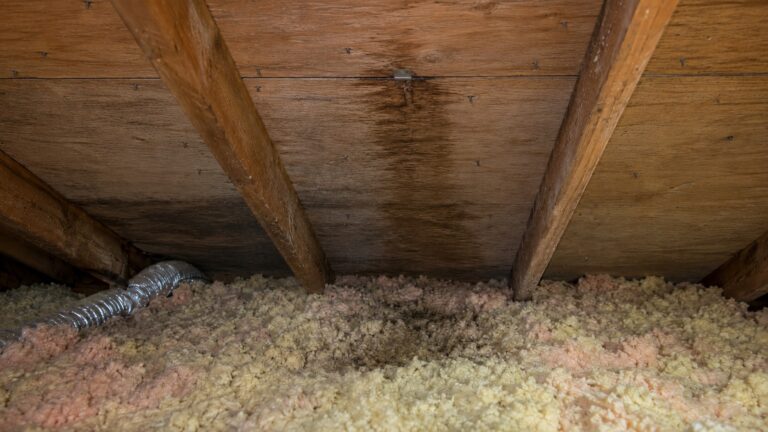
If your attic is safely accessible, check it after wind-driven rain. Use stable access, good lighting, and caution around insulation, wiring, nails, and low-clearance areas. If attic access is unsafe, skip this step and call a professional instead.
Look for:
- Damp attic insulation below roof slopes.
- Dark stains on roof decking.
- Water marks around roof nails.
- Damp rafters or framing members.
- Musty odor after storms.
- Moisture near valleys, vents, chimneys, skylights, or roof edges.
- Light showing through gaps where it should not.
Attic moisture can appear before a ceiling stain forms inside the living space. Insulation may absorb water and hide the leak temporarily. That is why damp insulation after high winds should not be ignored, even if the rooms below still look dry.
Inside the home, look for ceiling stains, bubbling paint, damp drywall, new discoloration, or stains near upper exterior walls. If these appear after wind-driven rain, compare them with the broader signs of roof leaks inside the house. The visible stain may not be directly below the damaged shingle because water can travel along hidden roof paths.
If moisture is present but the entry point is unclear, the next step may be to detect hidden roof leaks rather than guessing from the stain location alone. Wind-driven leaks often follow underlayment, rafters, nail holes, valleys, or insulation before they appear indoors.
Document What You See Before Calling a Roofer
Good documentation helps you explain the problem clearly. It also helps you compare whether the condition changes after the next storm. You do not need perfect photos. You need safe, useful records that show what you found and when you found it.
Document these details:
- The date and approximate time of the high-wind event.
- Which side of the house seemed most affected.
- Where shingles, tabs, or roof pieces were found on the ground.
- Which roof slopes appear missing, lifted, or disturbed.
- Any gutter, downspout, drip edge, fascia, or roof-edge damage.
- Any attic moisture, ceiling stains, or musty odors.
- Whether moisture appeared during wind-driven rain or afterward.
Use ground-level photos, zoomed-in photos, and wider context photos. For example, take one photo showing a shingle tab on the ground and another showing where it was found relative to the house. If you see a ceiling stain, photograph the stain and note whether it appeared after high winds or wind-driven rain.
Do not remove or disturb damaged roofing materials on the roof. Do not pull shingles, lift tabs, or attempt temporary repairs unless you are qualified and conditions are safe. Moving materials can make the damage harder to evaluate and may create more water-entry risk.
Documentation is especially useful when the damage is subtle. A lifted tab may not look severe in one photo, but if it worsens after the next storm, your records can show that the problem is progressing.
When Inspection Findings Need Professional Evaluation
A homeowner-safe inspection is useful, but it has limits. Some shingle damage cannot be confirmed from the ground. Seal failure, brittle shingles, loosened fasteners, damaged underlayment, roof deck moisture, and small tears may require closer evaluation by a qualified roofer.
Call for professional evaluation when you find:
- Missing shingles or missing ridge caps.
- Lifted, folded, creased, or torn shingles.
- Visible exposed underlayment or decking.
- Roof pieces in the yard after high winds.
- Loose or shifted shingles across several areas.
- Damaged roof edges, ridges, hips, or valleys.
- Loose flashing, vents, pipe boots, or ridge vent components.
- Damp attic insulation or fresh roof-deck staining.
- Ceiling stains after wind-driven rain.
- Leaks that appear only during windy storms.
Professional evaluation is also important when the roof is older, brittle, steep, high, complex, or difficult to view safely from the ground. A roofer can determine whether shingles are only cosmetically disturbed or whether they have lost their ability to resist wind and shed water.
If the damage is widespread, exposes roof layers, affects multiple slopes, or appears on an older roof, compare your findings with the warning signs for when wind damage requires roof replacement before assuming a small repair will be enough.
If moisture is already visible, do not wait for repeated leaks. Repeated wetting can damage insulation, decking, drywall, and framing. At that point, the issue is no longer just wind-damaged shingles; it may also involve water damage from roof leaks.
When you are deciding whether the situation has moved beyond basic observation, use the warning signs for when to hire a roofing contractor for moisture problems. Missing shingles, lifted materials, exposed roof layers, and moisture after high winds are all strong reasons to get the roof evaluated.
What Not to Do During a Post-Wind Shingle Inspection
A post-wind inspection should reduce risk, not create more of it.
Avoid these mistakes:
- Do not climb onto a storm-damaged roof.
- Do not pull on shingles to test whether they are sealed.
- Do not walk on brittle, lifted, wet, or steep roofing materials.
- Do not ignore roof pieces found in the yard.
- Do not assume lifted shingles are fine just because they settled back down.
- Do not rely only on the front roof slope.
- Do not dismiss attic moisture because there is no ceiling stain yet.
- Do not wait through repeated storms if water is already entering.
The safest approach is to observe, document, and escalate when the findings suggest roof movement or moisture entry. Early evaluation can help prevent roof leak damage before wind-related shingle problems spread into the roof deck, attic insulation, ceilings, or wall cavities.
FAQ About Inspecting Roof Shingles After High Winds
Can I inspect roof shingles from the ground?
Yes. You can identify many warning signs from the ground, including missing shingles, roof pieces in the yard, lifted-looking tabs, damaged ridge caps, shifted roof edges, loose gutters, and visible exposed areas. Use binoculars or camera zoom if needed. Do not climb onto a storm-damaged roof.
What is the safest way to check for wind damage?
The safest approach is to wait until weather is calm, walk around the home from the ground, look for fallen roof materials, compare roof slopes, check gutters and downspouts, and inspect accessible attic areas if safe. Call a professional when shingles appear missing, lifted, creased, folded, torn, shifted, or paired with attic or ceiling moisture.
How do I know if shingles lifted after wind?
Lifted shingles may look raised, uneven, ruffled, or separated from nearby shingles. You may see shadow lines, folded corners, creases, torn tabs, or rows that no longer lie flat. A lifted shingle is more concerning when it appears suddenly after high winds or is paired with leaks.
Should I check the attic after high winds?
Yes, if attic access is safe. Look for damp insulation, roof-deck stains, water marks around nails, damp rafters, musty odors, or moisture near valleys and roof penetrations. Attic moisture can appear before a ceiling stain becomes visible in the living space.
Are unsealed shingles always wind damage?
No. Shingles may be unsealed because of age, poor installation, dust, debris, old repairs, or lack of proper heat activation. Wind damage is more likely when unsealed shingles also show fresh creases, folds, tears, missing pieces, lifted tabs, or movement after a windstorm.
What should I photograph after a windstorm?
Photograph roof pieces found on the ground, missing or lifted-looking roof areas, damaged gutters, loose flashing, disturbed roof edges, ceiling stains, attic moisture, and downspout granules. Take both close-up photos and wider photos that show location and context.
When should I call a roofer after high winds?
Call a roofer when shingles are missing, lifted, folded, creased, torn, or shifted; when underlayment is exposed; when roof pieces are in the yard; or when attic or ceiling moisture appears after wind-driven rain. Professional evaluation is especially important on steep, high, older, or complex roofs.
Final Post-Wind Roof Inspection Step
After high winds, the safest approach is simple: inspect from the ground and attic, document missing or lifted shingles, watch for moisture after wind-driven rain, and call a qualified roofer when the roof covering appears moved, exposed, torn, creased, or no longer flat. Do not climb onto the roof or pull shingles by hand to confirm damage.
Key Takeaways
- Inspect roof shingles after high winds from safe locations only.
- Do not climb onto a storm-damaged roof or pull on shingles by hand.
- Look for missing, shifted, lifted, creased, folded, torn, or no-longer-flat shingles.
- Check the yard for shingles, tabs, ridge cap pieces, vent fragments, and roof debris.
- Compare all visible roof slopes because wind damage may affect one side more than another.
- Pay close attention to roof edges, ridges, hips, valleys, gutters, and penetrations.
- Check the attic if safe, especially after wind-driven rain.
- Damp insulation, roof-deck stains, ceiling spots, and musty odors after high winds are moisture warning signs.
- Document findings with photos, dates, and locations before calling a roofer.
- Professional evaluation is important when shingles are missing, lifted, torn, creased, exposed, or paired with moisture signs.

One Comment
Comments are closed.