
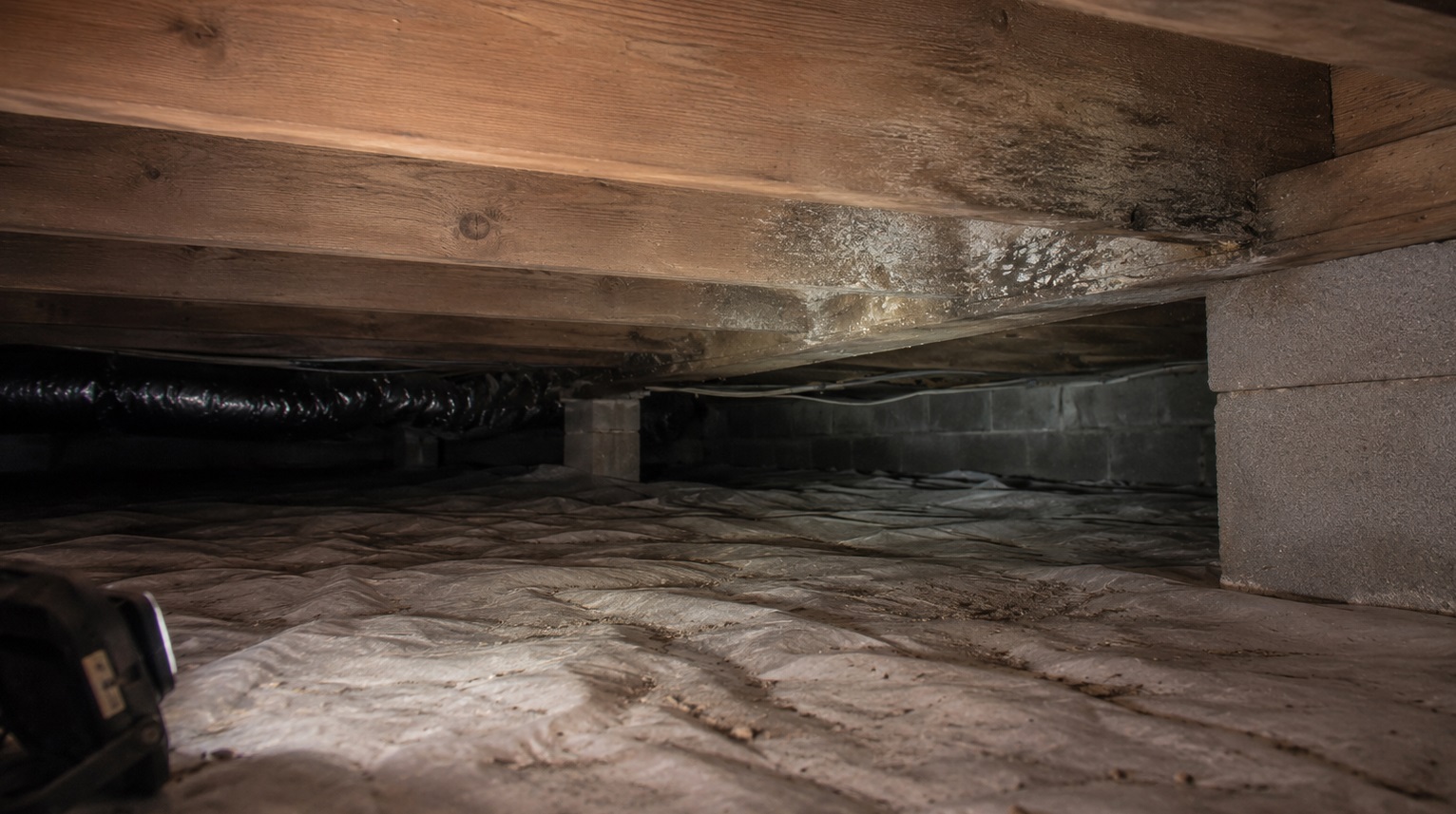
Signs of Mold Growth in Crawl Spaces
Crawl space mold often shows up first as a musty smell inside the home, small spot clusters on joists, fuzzy or powdery growth on wood, dark staining, or mold on insulation backing. Because crawl spaces are dark, enclosed, and exposed to ground moisture, mold can develop for months before the growth is obvious.
This article focuses on the signs that mold may already be growing in a crawl space: musty odors, spot clusters on wood, fuzzy or powdery growth, staining, insulation damage, and odors moving into the living area. If you are still trying to confirm whether the crawl space is damp enough to support mold, start with this guide on how to find hidden moisture in different areas of your home.
Why Crawl Space Mold Often Goes Unnoticed
Crawl space mold is easy to miss because the area is rarely inspected and often stays damp even when it does not look wet from the entry opening. Wood framing, insulation backing, soil, and vapor barrier edges can hold moisture long enough for mold to begin growing.
Symptoms may also appear inside the home before mold is visible below. A musty odor near floor level, stale indoor air, or recurring smell after rain can point back to conditions under the floor system.
If you have already noticed damp materials, condensation, or moisture stains, compare those clues with the symptoms in signs of moisture in crawl spaces.
Common Signs of Mold Growth in Crawl Spaces
The most useful crawl space mold signs are specific: where the growth appears, what texture it has, how the staining spreads, and whether odors are moving into the living space. Start by checking wood framing, insulation backing, foundation edges, plumbing areas, and stored organic debris.
Musty Odors Rising Into Living Spaces
One of the earliest and most noticeable signs of crawl space mold is a persistent musty smell inside the home. This odor is often strongest near floor level or in rooms located directly above the crawl space. Many homeowners first notice the smell during humid weather or after periods of rain.
Mold-related odor is usually earthy, damp, or stale. It often lingers after normal cleaning and may become stronger during humid weather because air movement can carry odor through floor gaps, duct leaks, plumbing openings, and other penetrations.
If a musty odor continues for days or weeks, especially when humidity rises, inspect the crawl space rather than assuming the smell is only from carpet, pets, or indoor humidity. Persistent odor near floor level is one of the strongest non-visual clues that mold may be active below the home.
Visible Mold on Wood Framing
Wood framing components, such as floor joists and beams, are among the most common locations where mold appears. These materials naturally absorb moisture and provide an ideal surface for mold growth when humidity remains elevated.
Mold on wood typically begins as small scattered spots. Over time, these spots may expand into larger patches or streak-like patterns along the grain of the wood. Early mold growth often appears thin and powdery, while advanced mold may become thicker or fuzzy in texture.
Common locations to check include:
- The underside of floor joists
- Areas near foundation walls
- Sections close to crawl space vents
- Wood surfaces near plumbing pipes
If mold is visible on wood framing, it is usually a sign that moisture exposure has been ongoing for some time. In addition to identifying mold itself, it is helpful to determine whether moisture sources are still active. For deeper evaluation techniques, see how to detect hidden moisture in crawl spaces.
White, Green, or Black Surface Growth
Mold in crawl spaces appears in a variety of colors depending on the surface conditions and growth stage. White mold is particularly common on wood framing and insulation surfaces. It often appears as thin, powdery patches or fuzzy clusters.
Green or black mold may also appear in crawl spaces, especially where moisture levels are consistently high. These darker mold types typically form in patchy clusters rather than smooth sheets. The presence of multiple colors in one area usually indicates that moisture has remained for an extended period.
It is important to understand that mold color alone does not determine how dangerous the mold is. Instead, the size of the affected area and the duration of moisture exposure are more meaningful indicators of risk.
Do not rely on color alone. White deposits on masonry may be mineral efflorescence rather than mold, while dark staining on wood may be old water staining, dirt, or fungal growth. Texture, spread pattern, odor, and moisture conditions matter more than color by itself.
Discoloration or Staining Patterns on Materials
Mold growth often creates visible staining patterns on surfaces even before colonies become thick enough to notice clearly. These stains may appear as darkened patches, irregular spots, or shadow-like discoloration across wood or insulation surfaces.
Unlike water stains alone, mold-related discoloration often spreads outward in uneven shapes. The edges of mold stains may appear soft or feathered rather than sharply defined. This pattern helps distinguish mold from simple moisture staining.
Staining on wood framing is especially important to monitor. If discoloration continues to spread or appears in multiple locations, mold growth is likely active. Reviewing the broader progression patterns discussed in why mold forms in crawl spaces can help clarify how moisture conditions lead to expanding growth.
Mold on Insulation Surfaces
Insulation installed in crawl spaces frequently develops mold when moisture levels remain high. Mold typically forms on the paper backing of fiberglass insulation rather than the fiberglass itself. This paper layer provides an organic surface that supports mold growth.
Common signs of mold on insulation include:
- Dark spotting on insulation backing
- White or gray powdery buildup
- Insulation sagging or pulling away from joists
- Visible dampness on insulation surfaces
When insulation becomes wet or mold-covered, it can lose insulating value, hold moisture against nearby wood, and become difficult to evaluate safely. Moldy insulation is also a warning sign that moisture has reached more than one crawl space material.
Damp, Fuzzy, or Slimy Material Surfaces
In advanced moisture conditions, some surfaces may feel damp or slightly slimy to the touch. This usually indicates that mold growth is actively feeding on moisture-rich materials. While not always visible as thick colonies, these areas often support rapid mold expansion.
Materials most likely to show this symptom include:
- Wood surfaces near standing water
- Cardboard or debris stored in crawl spaces
- Organic materials such as paper or fabric
- Wood framing near plumbing leaks
If surfaces remain damp for extended periods, mold growth typically follows. In situations where water exposure has already occurred, reviewing how to dry crawl spaces after moisture exposure may help prevent mold from spreading further.
Early Warning Signs of Crawl Space Mold
Early crawl space mold usually appears as faint odor, small spot clusters, or localized staining near damp areas. These signs often show up around foundation walls, vent openings, plumbing penetrations, insulation edges, and shaded wood surfaces before large colonies form.
Faint Musty Smells That Appear Occasionally
One of the earliest signs of mold growth is a faint musty odor that appears intermittently. This smell may be noticeable during humid weather or after rainfall, then fade when conditions become drier.
At this stage, mold colonies may still be small and hidden from view. The odor occurs because mold releases gases during growth, even when visible colonies have not yet spread widely.
If these odors appear repeatedly, especially in rooms above the crawl space, treat them as a reason to inspect below the floor rather than assuming the smell is only from the room itself.
Small Spot Clusters on Wood Surfaces
Early mold growth often appears as tiny, isolated spots on wood framing. These spots may be white, gray, or slightly darker than the surrounding wood surface.
Typical characteristics include:
- Small dots scattered across joists
- Light powdery residue
- Patchy growth near moisture-prone areas
- Growth concentrated near foundation walls
These early colonies may remain stable for weeks or months before spreading further. However, if moisture remains present, these spots will usually expand into larger mold patches.
Localized Discoloration Around Moisture Sources
Localized staining around pipes, vents, or foundation walls can indicate the beginning of mold growth. These stains may appear darker than surrounding materials and often form in irregular shapes.
Early discoloration is frequently confused with simple water staining. However, mold-related staining typically spreads gradually and develops soft or uneven edges. This difference helps distinguish mold growth from moisture marks alone.
Moderate Signs of Expanding Mold Growth
Moderate crawl space mold is usually easier to recognize because the growth is no longer isolated to a few spots. It may spread across multiple joists, insulation sections, foundation edges, or stored materials.
Spreading Mold Patches Across Structural Wood
Moderate mold growth typically appears as expanding patches across joists, beams, and subfloor materials. Instead of isolated dots, colonies begin forming connected areas that stretch along wood grain patterns.
Common signs include:
- Larger visible mold patches
- Multiple growth locations across framing
- Increasing discoloration coverage
- Recurring mold near moisture-prone zones
This level of growth usually means the crawl space has stayed damp long enough for mold to move beyond one isolated surface.
Insulation Damage and Persistent Dampness
Moderate mold growth frequently affects insulation materials. Mold may spread along insulation backing or form clusters near areas where moisture accumulates.
Typical signs at this stage include:
- Insulation sagging from moisture weight
- Visible spotting across insulation surfaces
- Persistent dampness in insulation areas
- Insulation pulling away from joists
Insulation problems are most concerning when spotting appears on several batts, when the backing stays damp, or when sagging insulation touches wood framing. Those patterns suggest the problem is no longer limited to one small area.
Advanced Signs of Severe Crawl Space Mold
Advanced mold growth indicates long-term moisture problems that have remained unresolved. At this stage, mold colonies may cover large areas of structural materials, and the damage risk increases significantly.
Severe mold growth rarely develops overnight. It typically results from months or years of persistent moisture exposure combined with poor ventilation or drainage conditions.
Thick Mold Coverage Across Multiple Surfaces
In advanced stages, mold colonies become thick and highly visible. Large areas of wood framing may appear heavily coated with mold growth, sometimes covering entire sections of joists or beams.
Common visual indicators include:
- Large continuous mold patches
- Heavy discoloration across structural wood
- Dense fuzzy or powdery growth layers
- Multiple colors present across the same surface
When mold covers wide areas, it often indicates that moisture has persisted for long periods without proper correction. This level of growth frequently requires professional evaluation.
Wood Deterioration and Structural Softening
Long-term mold growth may weaken structural wood. In advanced conditions, affected wood may feel soft or appear crumbly. This deterioration occurs when moisture exposure continues for extended periods alongside mold growth.
Signs of structural involvement include:
- Wood that appears darkened or brittle
- Surface cracking or splitting
- Sections of wood that feel unusually soft
- Visible decay patterns along beams
Structural damage caused by moisture and mold should not be ignored. If wood deterioration is present, it may indicate that the problem has progressed beyond simple moisture management.
Strong, Persistent Odors Throughout the Home
Severe mold growth often produces strong odors that spread beyond the crawl space. These odors may be noticeable throughout multiple rooms and remain present even after ventilation or cleaning.
Persistent odors at this level often indicate that mold colonies are widespread. In these cases, reviewing how to fix persistent crawl space moisture problems can help determine when professional repair or remediation becomes necessary.
Signs Mold May Be Affecting Indoor Air Quality
Crawl space mold can affect indoor air when air moves upward through duct leaks, floor gaps, plumbing penetrations, wiring openings, or unsealed subfloor edges. The signs below do not prove mold by themselves, but they strengthen the case when visible crawl space growth or moisture is also present.
Allergy-Like Symptoms That Worsen Indoors
Some homeowners notice increased allergy symptoms when crawl space mold becomes widespread. These symptoms may include sneezing, throat irritation, or sinus discomfort that improves after leaving the home.
While many indoor air issues have multiple causes, crawl space mold can contribute to airborne particle buildup. If symptoms appear consistently indoors but improve outside, further investigation may be necessary.
When Crawl Space Mold Needs Prompt Attention
Not all mold growth creates immediate structural or health hazards. However, certain signs indicate that mold has progressed to a level requiring urgent attention. Understanding these escalation signals helps homeowners decide when professional help may be necessary.
Large Areas of Continuous Mold Coverage
When mold spreads across large sections of wood framing or insulation, it typically indicates long-term moisture exposure. Continuous coverage across multiple surfaces suggests that the problem has persisted without correction.
Large-scale mold growth increases the likelihood of structural weakening and widespread contamination. In these situations, moisture problems are rarely isolated and often require comprehensive repair planning.
Repeated Mold Growth After Cleaning
If mold reappears shortly after cleaning or removal attempts, it usually indicates that moisture conditions remain unresolved. Surface cleaning alone cannot stop mold from returning when humidity or water intrusion continues.
Recurring mold often points to hidden moisture sources, which may include:
- Ground vapor movement
- Leaking pipes
- Poor ventilation
- Improper vapor barrier installation
Repeated mold growth is a strong sign that the underlying moisture problem must be addressed rather than treated as a surface issue.
Visible Damage to Structural Materials
When mold growth begins affecting the strength of structural wood, the situation becomes more serious. Wood that appears soft, brittle, or cracked may indicate long-term moisture exposure combined with biological growth.
Structural warning signs include:
- Wood that feels weak or crumbly
- Beams or joists showing deep discoloration
- Insulation collapse due to moisture weight
- Widespread deterioration across framing
If these symptoms appear, the crawl space may require professional evaluation to determine the extent of damage and the safest repair options.
What To Do After You Identify Mold Growth
Finding mold in a crawl space does not always mean immediate structural failure, but avoid disturbing large areas of growth, wet insulation, or contaminated debris without proper protection. The next steps depend on the size of the affected area, whether materials are still damp, and whether odors or symptoms are reaching the living space.
Document the Extent of Mold Growth
Before taking action, record what you observe. Photographs help track whether mold spreads over time and assist professionals in evaluating the situation.
Documenting mold growth should include:
- Locations of visible colonies
- Size of affected areas
- Presence of moisture or standing water
- Changes in odor intensity
Use photos and notes rather than scraping, brushing, or pulling down insulation during a first inspection. Disturbing mold-covered materials can release particles and make the area harder to evaluate safely.
These records provide useful reference points when determining whether conditions are improving or worsening.
Identify Possible Moisture Sources
Mold cannot grow without moisture. Identifying moisture sources helps prevent future growth even after mold is removed. Many crawl space mold problems originate from ongoing damp conditions rather than single water events.
If moisture exposure has already occurred, reviewing how to dry crawl spaces after moisture exposure provides guidance on reducing lingering dampness before mold spreads further.
Evaluate Whether Professional Help Is Needed
Small, isolated areas may be easier to evaluate, but large, recurring, or hard-to-reach mold problems often require professional inspection before cleanup decisions are made.
Situations that typically require professional evaluation include:
- Mold covering large sections of crawl space surfaces
- Persistent strong odors indoors
- Structural damage to wood framing
- Repeated mold growth after cleaning
If moisture problems continue after basic interventions, the broader repair considerations outlined in how to fix persistent crawl space moisture problems can help determine appropriate next steps.
Frequently Asked Questions About Signs of Mold Growth in Crawl Spaces
What does mold look like in crawl spaces?
Mold in crawl spaces typically appears as patchy clusters of white, gray, green, or black growth on wood, insulation backing, or debris. It may look powdery, fuzzy, or slightly slimy depending on moisture conditions.
Is mold in crawl spaces always visible?
No. Mold often develops in hidden areas such as behind insulation or along structural edges. In many cases, musty odors appear before visible mold becomes noticeable.
Can crawl space mold spread into the home?
Yes. Air can move from a crawl space into the home through duct leaks, plumbing openings, wiring penetrations, floor gaps, and unsealed subfloor edges. Musty odors near floor level are often the first indoor clue.
Does a musty smell always mean mold is present?
Not always, but persistent musty odors strongly suggest moisture-related problems that may include mold. Odors that return after humid weather often indicate mold activity.
How fast does mold spread in crawl spaces?
Mold can begin as small spot clusters and then spread over weeks or months when crawl space wood, insulation backing, or stored debris stays damp. The pattern matters more than the exact timeline: isolated spots suggest early growth, while connected patches across multiple surfaces suggest a longer moisture problem.
What Crawl Space Mold Signs Mean
Signs of mold growth in crawl spaces usually mean moisture has been present long enough for wood, insulation backing, debris, or other organic materials to support fungal growth. The most important clues are repeated musty odors, spot clusters on joists, fuzzy or powdery surface growth, spreading discoloration, mold on insulation backing, and odors moving into rooms above the crawl space.
If the growth is small and isolated, document the area and look for the moisture source before deciding on cleanup. If mold is widespread, returns after cleaning, affects wet insulation, or appears alongside soft wood or strong indoor odors, professional evaluation is the safer next step.
4 Comments
Comments are closed.