
Why Crawl Space Drainage Systems Fail
Crawl space drainage systems fail when water cannot enter, move through, or discharge from the system as intended. Common causes include poor installation, clogged drain lines, root intrusion, collapsed pipes, bad grading, sump pump failure, undersized drainage capacity, and lack of maintenance.
A drainage system does not permanently solve crawl space water problems by itself. It only works when the pipe slope, gravel, filter fabric, discharge point, pump, and surrounding exterior drainage all support water movement away from the foundation.
If you are noticing repeated moisture problems despite having a drainage system, the warning patterns described in signs of poor crawl space drainage can help confirm whether failure conditions are already developing.
How Crawl Space Drainage Systems Are Supposed to Work
To understand why drainage systems fail, it helps to first understand how they are designed to function. A typical crawl space drainage system moves water through several stages, each depending on the next.
The Four Stages of Proper Drainage
Most crawl space drainage systems follow a basic sequence:
- Stage 1 — Water Reaches the Foundation: Rainwater flows through soil surrounding the home.
- Stage 2 — Water Enters the Drainage System: Drain tiles, channels, or perimeter drains collect incoming water.
- Stage 3 — Water Moves Through Pipes: Gravity or mechanical pumps transport water through drainage lines.
- Stage 4 — Water Exits the Property: Water discharges safely away from the foundation.
Failure occurs when any one of these stages stops functioning correctly. Even minor disruptions can allow water to accumulate beneath the structure.
For homeowners unsure how to evaluate individual components, the inspection process outlined in how to inspect crawl space drainage systems explains how each part of the system contributes to overall performance.
Improper Installation Is One of the Most Common Causes
Some crawl space drainage systems fail early because they were installed with the wrong slope, incomplete filtration layers, poor discharge placement, or gaps in drainage coverage. In those cases, the system may look complete but still fail during wet weather.
Pipes Installed Without Proper Slope
Drainage pipes depend on gravity to move water. If pipes are installed too flat or sloped incorrectly, water cannot flow efficiently. Instead, it remains trapped inside the pipe or flows too slowly to prevent soil saturation.
Common slope-related installation problems include:
- Pipes placed level instead of slightly angled
- Improper elevation changes along drainage lines
- Inconsistent slope throughout the system
- Incorrect connection heights between components
When pipe slope is incorrect, water may still enter the system but fail to move away fast enough. This allows moisture to remain beneath the home.
Missing Gravel or Drainage Fabric Layers
Drainage systems rely on surrounding materials to prevent sediment from entering the pipes. Gravel and filtration fabric create a protective barrier that keeps soil from clogging the drainage system.
If these materials are missing or installed incorrectly, sediment enters the pipes and gradually blocks water movement.
- Drain pipes buried directly in soil
- Insufficient gravel coverage
- Missing filter fabric around pipe
- Improper backfilling techniques
These installation shortcuts often lead to long-term system failure that becomes visible years after the original installation.
Poor Outlet Placement
The location where water exits the system plays a critical role in long-term performance. If discharge points are positioned incorrectly, water may cycle back toward the foundation.
Common outlet placement problems include:
- Discharge lines ending too close to the home
- Outlets draining into already saturated soil
- Water redirected toward foundation walls
- Improper elevation at discharge point
These conditions can create repeated water movement patterns that eventually overwhelm the crawl space drainage system.
Clogged Drain Lines and Sediment Buildup
Clogged drain lines are one of the most common long-term reasons crawl space drainage systems fail. Even systems that were installed correctly can gradually lose effectiveness as sediment, soil, and debris accumulate inside drainage pipes.
Unlike sudden mechanical failures, clogging usually develops slowly over time. Water flow becomes restricted little by little until the system can no longer remove water efficiently.
How Sediment Enters Drainage Pipes
Drainage systems are surrounded by soil, which naturally shifts over time. Fine particles can migrate into pipes through small openings, cracks, or poorly installed filter materials.
Common ways sediment enters drainage lines include:
- Missing or damaged filter fabric
- Insufficient gravel surrounding pipes
- Soil movement caused by heavy rain
- Improper trench backfilling
- Open pipe ends exposed to debris
Once sediment enters the system, it begins settling along the bottom of the pipe. As buildup increases, water movement slows and eventually stops.
These gradual restrictions often lead to recurring moisture patterns described in signs of poor crawl space drainage, especially after rainfall.
Root Intrusion Into Drainage Pipes
Tree and shrub roots are another major cause of drainage failure. Roots naturally grow toward moisture sources, and drainage pipes provide a consistent supply of water.
Once roots enter a pipe, they continue expanding and trapping debris. Over time, this creates dense blockages that prevent water from flowing through the system.
- Roots entering through pipe joints
- Dense root clusters forming inside pipes
- Gradual narrowing of drainage openings
- Complete obstruction of water movement
- Repeated moisture buildup despite system presence
Root intrusion is particularly common in older systems or areas with large trees near the foundation.
No Cleanout Access for Future Maintenance
Some drainage systems become harder to maintain because they were installed without practical cleanout access. If drain lines cannot be flushed, scoped, or cleared easily, small blockages may remain hidden until water backs up into the crawl space.
- No accessible cleanout points
- Buried pipe ends that cannot be inspected
- Long pipe runs with no service access
- Blocked lines that cannot be cleared without excavation
Pipe Collapse and Physical Drainage Damage
Drainage pipes are buried beneath soil, making them vulnerable to physical damage over time. When pipes collapse or crack, water movement stops completely.
This type of failure is often difficult to detect without professional inspection because the damage occurs underground.
Soil Pressure and Ground Movement
Soil shifts naturally as moisture levels change. Wet soil expands, while dry soil contracts. These movements create pressure against buried pipes.
Over time, this pressure can weaken pipe walls and lead to cracking or collapse.
- Soil expansion during heavy rainfall
- Drying cycles causing soil shrinkage
- Uneven ground pressure around pipes
- Repeated movement stressing pipe joints
- Gradual pipe deformation
Collapsed pipes block water flow entirely, causing moisture to accumulate beneath the home.
Damage From Heavy Loads Above Pipes
Drainage pipes installed beneath driveways, patios, or heavily compacted soil areas may experience excessive pressure from above. Over time, this pressure can flatten or break pipe sections.
- Vehicle traffic over shallow pipe installations
- Construction equipment compacting soil
- Heavy landscaping materials placed above pipes
- Improper soil compaction during installation
- Unsupported pipe segments beneath structures
Once structural damage occurs, water cannot travel through the system as intended.
Poor Exterior Grading and Water Flow Problems
Even a properly installed crawl space drainage system can fail when exterior grading sends too much runoff toward the foundation. These systems are designed to manage controlled water movement, not compensate for large volumes of misdirected surface water.
Soil Sloping Toward the Foundation
When soil slopes toward the home, rainwater flows directly toward foundation walls instead of away from them. This increases water pressure against crawl space structures.
Over time, excessive water volume overwhelms the drainage system.
- Water flowing toward foundation during storms
- Soil settling near foundation edges
- Pooling water near crawl space walls
- Erosion patterns forming toward the home
- Repeated moisture buildup beneath structure
These conditions are often linked to recurring flooding behavior explained in why crawl spaces flood during heavy rain, which explores how exterior conditions influence interior moisture levels.
Runoff That Should Have Been Controlled Outside
A crawl space drainage system can fail when it is forced to handle runoff that should have been controlled outside the foundation. Poor downspout discharge, settled soil, blocked surface drains, and landscape changes can all send more water toward the crawl space than the system was meant to manage.
How Multiple Small Problems Combine Into Major Failure
Many crawl space drainage failures are not caused by a single issue. Instead, several small problems combine over time until the system can no longer function effectively.
The Compounding Failure Effect
For example, a drainage system may continue functioning despite minor sediment buildup. However, when combined with poor grading and increased rainfall, the system eventually becomes overwhelmed.
Common compounding failure scenarios include:
- Partial pipe blockage combined with poor grading
- Minor slope errors combined with heavy rainfall
- Small root intrusion combined with aging pipes
- Reduced pipe capacity combined with increased runoff
- Improper outlet placement combined with saturated soil
Understanding how multiple factors interact helps explain why drainage systems sometimes fail unexpectedly after years of operation.
If persistent drainage problems continue despite earlier repairs, more advanced solutions described in how to fix persistent crawl space drainage problems may be required.
Sump Pump and Mechanical Failures
Many crawl space drainage systems depend on sump pumps to remove collected water. While gravity-based systems can function without mechanical assistance, sump pumps are often required when water must be lifted to a higher discharge point. When these mechanical components fail, water removal stops immediately.
Mechanical failures are especially dangerous because they often occur during heavy rainfall — exactly when the drainage system is needed most.
If standing water is present near electrical wiring, outlets, extension cords, or a sump pump connection, do not enter the crawl space until the electrical risk has been evaluated safely.
Electrical and Motor Failures
Sump pumps rely on electrical components that wear out over time. Motors, wiring, and internal switches can fail due to age, moisture exposure, or mechanical stress.
- Burned-out pump motors
- Electrical connection failures
- Power outages during storms, especially when no battery backup is installed
- Corroded internal components
- Water intrusion into pump housing
When pump motors fail, collected water remains in the sump basin and eventually spills into the surrounding crawl space.
Float Switch Malfunctions
The float switch controls when the sump pump turns on and off. If this component fails, the pump may not activate when water levels rise.
- Float switches stuck in the off position
- Debris interfering with float movement
- Improper float positioning
- Mechanical wear over time
- Delayed pump activation
Float switch failure is one of the most common mechanical problems in drainage systems. It often causes sudden flooding even when the pump itself remains functional.
Blocked or Frozen Discharge Lines
Even when sump pumps operate correctly, discharge lines must remain clear for water to exit the system. Blocked or frozen discharge pipes prevent water from leaving the property.
- Ice formation inside discharge pipes during winter
- Debris accumulation at pipe outlets
- Animal nests blocking discharge points
- Kinks or bends restricting water flow
- Improper pipe routing above ground
These conditions create pressure inside the system and cause water to return toward the crawl space instead of exiting safely.
Undersized or Incomplete Drainage Systems
Some crawl space drainage systems fail because they were never designed to handle the volume of water present on the property. Systems that are too small or incomplete struggle to keep up during heavy rainfall.
This type of failure often appears during storms, when water enters the crawl space faster than the drainage system can remove it.
Drainage Systems That Cannot Handle Water Volume
The amount of water reaching a crawl space depends on roof size, yard slope, soil type, and climate conditions. When these factors are underestimated during installation, drainage capacity becomes insufficient.
- Large roof runoff areas overwhelming drains
- Clay soils retaining excessive moisture
- Sloped properties directing water toward foundation
- High groundwater levels beneath the home
- Insufficient pipe diameter or spacing
In these cases, drainage systems may function during light rain but fail during major storms.
Incomplete Drainage Coverage
Some systems are installed only along one side of the crawl space or in limited areas. While partial drainage can reduce minor moisture problems, it often fails to protect the entire structure.
- Drain pipes installed along only one wall
- Missing drainage in low-lying areas
- Unprotected foundation corners
- Limited connection between drainage zones
- Inconsistent pipe placement
Incomplete coverage allows water to collect in unprotected areas, eventually spreading moisture throughout the crawl space.
Lack of Maintenance Leads to Gradual System Failure
Drainage systems require periodic inspection and maintenance to remain effective. Without routine care, small issues accumulate and eventually disrupt water movement.
Unlike sudden mechanical failures, maintenance-related failures usually develop gradually over several years.
Debris Accumulation Over Time
Leaves, sediment, and organic material naturally enter drainage systems. Without cleaning, these materials reduce water flow and increase the risk of blockage.
- Organic debris collecting in drainage channels
- Sediment settling inside pipes
- Blocked inlet openings
- Reduced water movement capacity
- Gradual buildup restricting flow
Even small debris buildup can significantly affect long-term drainage performance.
Aging Components and Wear
All mechanical components wear out over time. Pumps, pipe joints, and connectors degrade gradually, increasing the likelihood of failure.
- Worn seals allowing leaks
- Aging pump motors losing efficiency
- Deteriorated pipe connections
- Cracked fittings from long-term stress
- Reduced system reliability
Regular inspection helps identify aging components before they fail completely. For step-by-step evaluation guidance, review how to inspect crawl space drainage systems, which explains how to monitor drainage components safely.
Environmental and Seasonal Causes of Drainage Failure
Seasonal conditions can expose weaknesses in a drainage system that seemed adequate during milder weather. Freezing, snowmelt, saturated soil, and repeated storms can turn a minor restriction into a visible failure.
Freeze-Thaw Cycles
In colder climates, water trapped inside drainage components can freeze during winter. As water freezes, it expands and places pressure on pipes.
- Frozen water expanding inside pipes
- Cracked pipe walls
- Joint separation caused by ice pressure
- Temporary winter blockages
- Permanent structural pipe damage
These conditions may cause drainage failure during seasonal transitions.
Heavy Rainfall and Changing Weather Patterns
Weather patterns vary over time. Increased rainfall intensity or frequency can place additional stress on drainage systems designed for lower water volumes.
- Storms producing unusually high rainfall
- Rapid snowmelt events
- Long periods of saturated soil
- Repeated storm cycles
- Increased groundwater levels
When environmental conditions change, systems designed for earlier conditions may become inadequate.
When Drainage Failure Becomes a Structural Risk
Crawl space drainage failures do not always create immediate structural damage, but prolonged moisture exposure eventually weakens materials beneath the home. The longer water remains trapped, the more likely structural components will absorb moisture and begin deteriorating.
Drainage problems become structural risks when moisture remains present long enough to affect wood, insulation, and foundation materials. At this stage, the problem shifts from simple water management to structural preservation.
Wood Moisture Levels Begin to Rise
Wood framing beneath the home naturally absorbs moisture from the surrounding air and soil. When drainage systems fail, humidity levels rise and wood begins holding excess moisture.
- Joists feeling damp to the touch
- Wood surfaces darkening over time
- Subfloor materials swelling slightly
- Musty odors becoming stronger
- Early mold growth appearing on wood
These early structural effects often appear gradually. If moisture remains present, wood can eventually soften and lose strength.
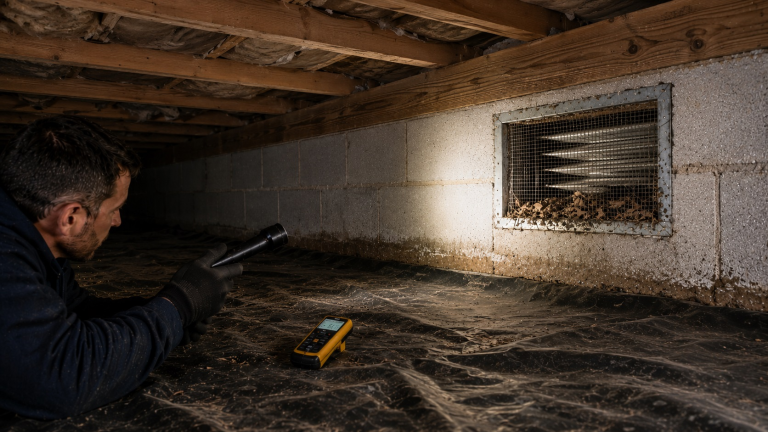
A moisture meter can help confirm whether wood is only surface-damp or holding elevated moisture internally. Persistently elevated readings in joists, beams, or subflooring are a stronger warning sign than surface appearance alone.
Foundation Materials Show Long-Term Moisture Effects
Concrete and masonry foundation walls can tolerate moisture to a degree, but repeated water exposure gradually causes surface deterioration. Moisture movement through concrete leaves visible signs that indicate long-term drainage failure.
- Efflorescence forming on foundation surfaces
- Persistent damp areas along walls
- Surface staining near floor level
- Cracking or flaking in older materials
- Water trails forming after rainfall
These signs often appear alongside the visible warning patterns described in signs crawl space drainage needs repair, which helps identify when conditions have moved beyond early-stage failure.
What Happens If Drainage Failure Continues
Ignoring drainage failure allows moisture conditions to worsen over time. Because crawl spaces are enclosed areas with limited airflow, water tends to remain trapped once it enters.
Progressive Mold Growth
Persistent moisture supports mold development on wood, insulation, and stored materials. Mold growth may begin as small patches but can spread rapidly when humidity remains high.
- Mold forming along joists and beams
- Insulation becoming contaminated
- Odors spreading into living areas
- Recurring mold despite cleaning attempts
- Reduced indoor air quality
Mold growth increases the urgency of drainage repairs and often requires specialized cleanup.
Increased Pest and Insect Activity
Damp crawl spaces create favorable environments for insects and pests. Moist conditions attract termites, ants, and rodents seeking water and shelter.
- Termite presence near structural wood
- Rodents nesting in damp insulation
- Increased insect populations beneath the home
- Burrowing activity near foundation walls
- Visible damage to wood surfaces
Moisture-related pest activity often signals long-standing drainage failure that requires corrective action.
Frequently Asked Questions About Crawl Space Drainage Failure
Can a new crawl space drainage system fail?
Yes. Newly installed systems can fail if installation errors occur, materials are used incorrectly, or site conditions were not properly evaluated. Many early failures are linked to improper slope, missing filtration materials, or incomplete coverage.
How long should crawl space drainage systems last?
A properly installed crawl space drainage system can last many years, but there is no single lifespan for every home. Soil conditions, sediment load, root pressure, pump use, discharge location, and maintenance access all affect how long the system performs well.
Why does my drainage system fail during heavy rain?
A drainage system may fail during heavy rain because water reaches the crawl space faster than the system can collect, move, or discharge it. Poor grading, short downspouts, undersized pipes, partial clogs, saturated soil, or a weak sump pump can all become obvious during storms.
Do sump pumps fix all crawl space drainage problems?
No. Sump pumps remove collected water, but they do not prevent water from reaching the crawl space. Exterior grading, proper drainage channels, and system design all influence overall performance.
What should I do if my drainage system keeps failing?
Repeated failure usually indicates an underlying issue such as improper installation, insufficient system capacity, or persistent external water pressure. In these cases, repair strategies discussed in how to fix persistent crawl space drainage problems may be required.
Conclusion
Crawl space drainage systems usually fail because one part of the water path stops working: water is directed toward the foundation, the drain cannot collect it, the pipe cannot move it, the pump cannot discharge it, or the outlet sends it back toward the home.
If the problem keeps returning after small repairs, the issue is usually not just one clogged pipe or one wet area. It may involve grading, pipe slope, sediment, pump reliability, discharge placement, or system capacity. For broader structural moisture context, review structural moisture problems in homes: causes, risks, and repair guide.
One Comment
Comments are closed.