When to Repair vs Replace a Slate Roof
Deciding whether to repair or replace a slate roof is different from making the same decision for asphalt shingles, metal roofing, or rubber roofing. Individual slate tiles can often be replaced without removing the whole roof, but the visible slate is only one part of the system. Failed underlayment, deteriorated fasteners, worn flashing, moisture-damaged decking, or weak roof framing can make the decision much bigger than replacing a few tiles.
The main question is not simply whether a few slates are broken. A few cracked, missing, or slipped slate tiles may be repairable. Replacement becomes more likely when the slate is deteriorating across large areas, leaks keep returning, the underlayment has failed, fasteners are no longer holding, or the roof structure is no longer sound enough to support the system.
This guide focuses only on slate roofs. For the broader roof-level decision across all roof types, see the guide on how to decide whether to repair or replace a roof. For slate specifically, the key question is whether the roof needs a small slate repair, a partial restoration, or a full replacement.
The Main Question: Are Individual Slates Damaged or Is the Slate Roof System Failing?
The first step is to separate individual slate damage from slate roof system failure. This distinction is critical because slate roofs can often be repaired when the damage is isolated, but they may need restoration or replacement when the roof components below the slate are failing.
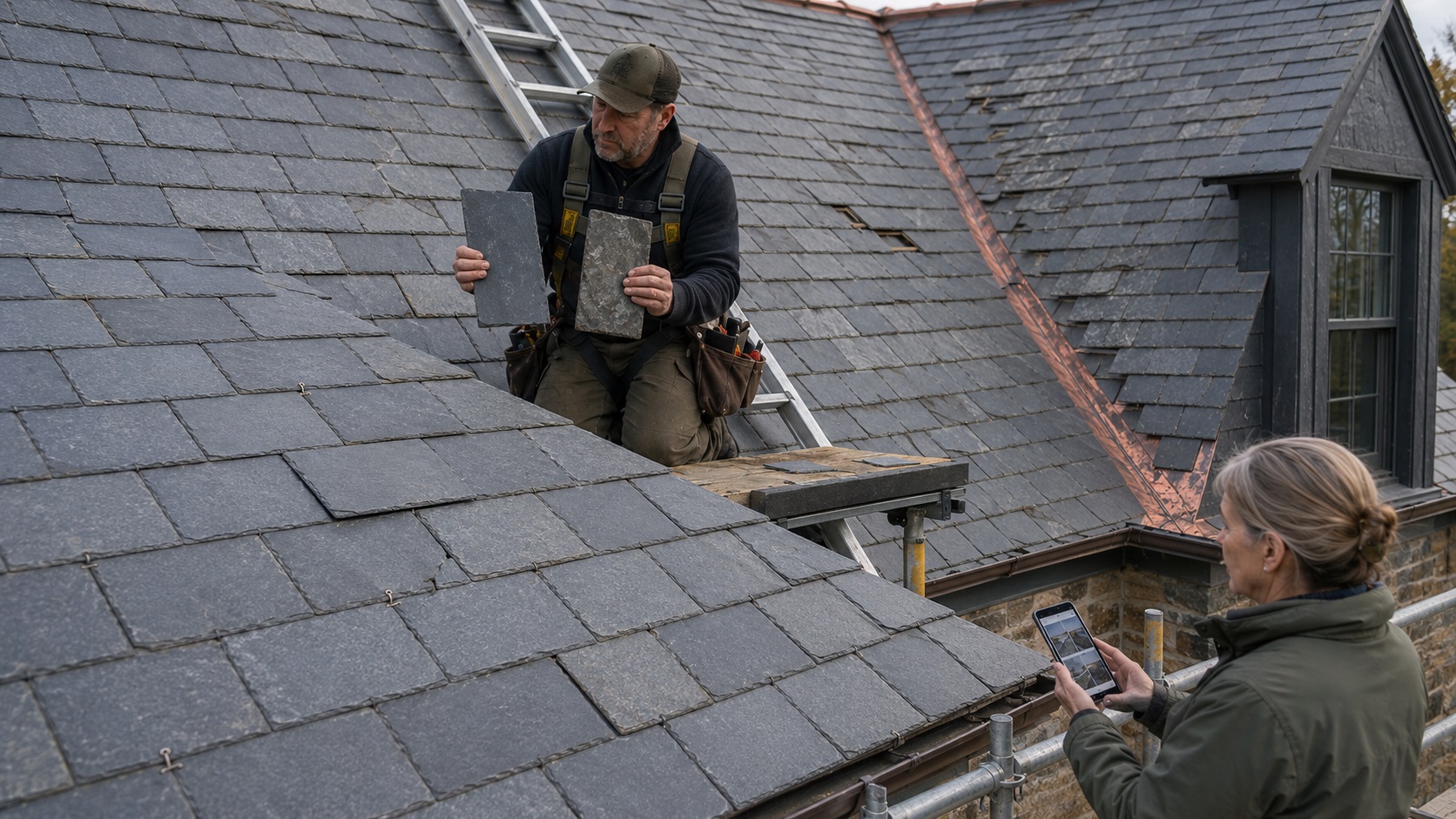
Individual slate damage means a limited number of tiles are cracked, missing, slipped, or broken. This can happen from impact, foot traffic, storm damage, aging fasteners, or freeze-thaw stress. If the surrounding slate is still sound and the roof structure is stable, individual slate replacement may be enough.
Slate roof system failure is different. That means the problem is not limited to one or two visible tiles. The roof may have widespread slate deterioration, many slipped tiles, failing flashings, rusted or failing fasteners, underlayment that no longer protects the roof deck, or recurring leaks in different areas. In that situation, replacing a few visible slates may not solve the deeper problem.
This is why slate roofs should not be evaluated like ordinary shingle roofs. Slate tiles can last a very long time, but the other parts of the roof may not last as long. Flashing, nails, underlayment, valleys, and roof decking can fail while many of the slate tiles still look usable. A leak in a slate roof does not always mean the slate itself has failed.
Use this simple starting point:
- Repair is more likely when only a few slates are damaged and the surrounding roof system is still sound.
- Partial restoration is more likely when many slates are still usable but flashing, fasteners, valleys, or certain sections need deeper work.
- Replacement is more likely when the slate, underlayment, fasteners, or structure are failing broadly.
Slate roofs are part of the broader group of most common roofing material failures, but their repair logic is different. A few broken pieces may not justify replacement, while hidden underlayment or structural failure may make a roof more serious than it looks from the ground.
When Slate Roof Repair Usually Makes Sense
Slate roof repair usually makes sense when the damage is limited, the surrounding slate is still sound, and the roof structure below the slate is stable. In those cases, replacing individual tiles or correcting one flashing detail may preserve the roof without full replacement.
One common repair-friendly situation is a small number of broken or missing slates. If a branch impact, storm event, or localized foot traffic damaged a few tiles, those slates may be replaceable. The repair should also check whether water entered below the missing or cracked tiles and whether the surrounding fasteners are still holding properly.
A good repair should also match the slate thickness and exposure as closely as possible, not just cover the opening with any available tile.
Another repairable situation is a slipped slate. A slate tile may slide out of position if a fastener fails or corrodes. If the slate itself is still usable and the surrounding roof field is intact, the repair may involve refastening or replacing that individual piece using slate-appropriate methods.
Leaks around flashing, valleys, chimneys, dormers, or roof penetrations may also be repairable without replacing the entire slate roof. In many cases, the leak source is not the slate tile field itself. It may be a worn flashing detail, failed valley metal, or a transition that has aged faster than the slate.
In general, slate roof repair is more reasonable when:
- Only a few slate tiles are cracked, missing, broken, or slipped.
- The surrounding slate is not soft, delaminating, or breaking easily.
- The leak source is limited to one area.
- Flashing or valley damage is localized.
- The underlayment is not failing across the roof.
- The roof deck and framing are stable.
- Moisture damage below the roof is limited or absent.
- The repair can be done by someone experienced with slate roofing.
The last point matters. Slate can be damaged by improper walking, fastening, cutting, or handling. A repair that would be simple on another roof type can create more broken tiles on slate if the person doing the work is not familiar with the material. A good slate repair should preserve as much sound slate as possible while correcting the actual leak or damage source.
A repair is strongest when the contractor can explain whether the issue is a broken slate, slipped slate, flashing failure, fastener problem, or underlayment concern. “A few slates are broken and the surrounding roof is sound” is a very different diagnosis from “the roof is leaking in several places and the underlayment has failed.”
When Slate Roof Replacement Usually Makes More Sense
Slate roof replacement usually makes more sense when the roof problem is no longer limited to a few tiles or one flashing detail. A slate roof with isolated damage may be repairable, but a slate roof with widespread tile deterioration, failing fasteners, major underlayment failure, repeated leaks, or structural support problems may need larger restoration or full replacement.
One of the strongest replacement indicators is widespread slate deterioration. Good slate can last for a very long time, but not all slate ages the same way. Some slate becomes soft, flaky, delaminated, or brittle over time. If many tiles are breaking, shedding layers, absorbing water, or crumbling at the edges, replacing individual pieces may no longer be practical.
Repeated leaks are another warning sign. A slate roof can leak from one flashing area or one broken tile, but repeated leaks in different areas suggest a broader system issue. The roof may have failing underlayment, deteriorated nails, worn valleys, poor past repairs, or many small openings that are hard to correct one at a time.
Replacement becomes more likely when the roof components below the slate have failed across large areas. Slate tiles may still look acceptable from the ground while the underlayment has aged beyond usefulness. If water is reaching the roof deck in several places, replacing only the visible broken slates may not stop the roof from leaking.
In general, replacement deserves serious consideration when:
- Slate tiles are deteriorating across large areas.
- Many slates are cracked, missing, soft, delaminating, or breaking apart.
- Leaks have returned after previous slate repairs.
- Fasteners or nails are failing across the roof.
- Underlayment failure is widespread.
- Flashings, valleys, or transitions are failing in several areas.
- The roof deck or framing shows moisture damage.
- The structure is sagging or no longer suitable for the weight of slate.
- Past repairs created patchwork that no longer performs reliably.
These conditions are different from a few broken slate tiles. If several of them appear together, the roof may also match broader signs a roof needs replacement. The decision should be based on the whole slate roof system, not only the number of damaged tiles visible from the ground.
How Broken, Missing, and Slipped Slates Affect the Decision
Broken, missing, and slipped slates are among the most common reasons homeowners question whether a slate roof can still be repaired. In many cases, individual slate replacement is possible. The key is whether the damage is isolated or part of a wider pattern.
A few broken slates often point toward repair. Slate tiles can break from impact, falling branches, hail, improper foot traffic, or localized stress. If the surrounding tiles are still sound and the roof is not leaking in multiple areas, replacing the damaged pieces may be enough.
Missing slates should be evaluated quickly because the opening can allow water to reach the underlayment or decking. One missing tile may be repairable, but the repair should include checking the material below it. If the underlayment has been exposed for a long time or water has entered repeatedly, the project may be larger than simply installing a replacement slate.
Slipped slates often suggest a fastening issue. A tile may slide because the nail failed, corroded, pulled through, or was installed incorrectly. One slipped slate may be repaired with slate-appropriate fastening or a proper slate hook. Many slipped slates may point to widespread fastener failure, aging underlayment, or improper previous work.
Matching replacement slate is a practical issue. New or salvaged slate may vary in color, thickness, size, and texture. A small visual difference may be acceptable if the repair is functional and watertight. However, if many tiles need replacement, matching becomes more important because patchwork repairs can affect both appearance and performance.
When evaluating broken, missing, or slipped slates, ask:
- How many slate tiles are affected?
- Are the damaged tiles concentrated in one area or spread across the roof?
- Are surrounding slates still hard, solid, and intact?
- Did the damage come from impact, foot traffic, age, or fastener failure?
- Has water reached the underlayment or decking?
- Have similar repairs been made before?
Broken slate does not automatically mean replacement. But a pattern of broken, slipped, or missing slates across the roof may mean the system is aging beyond spot repair.
How Underlayment and Flashing Affect Slate Roof Decisions
Slate tiles may last longer than the materials underneath and around them. This is one of the most important differences between slate roof repair and ordinary roof repair. The visible slate may still look strong while the underlayment, flashing, nails, valleys, or roof transitions are failing.
Underlayment is hidden below the slate. It provides secondary protection when wind-driven rain, melting snow, or minor water entry gets past the tile layer. Over time, underlayment can dry out, tear, become brittle, or lose effectiveness. If the slate is still good but the underlayment has failed broadly, the roof may need major restoration rather than simple tile replacement.
Flashing is another common leak source. Chimneys, valleys, dormers, sidewalls, skylights, hips, ridges, and roof penetrations are all vulnerable areas. A leaking slate roof may have a flashing problem rather than a slate problem. In that case, replacing tiles alone may not solve the leak.
Localized flashing failure may be repairable. For example, one chimney flashing problem or one valley issue may be corrected while preserving much of the slate roof. But widespread flashing failure across several transitions may signal a larger restoration need.
Underlayment and flashing problems point more strongly toward restoration or replacement when:
- Leaks occur in several areas despite individual slate repairs.
- Valleys, chimneys, and transitions show repeated staining or water entry.
- Underlayment is brittle, torn, exposed, or failing in multiple sections.
- Flashings are rusted, loose, poorly integrated, or patched repeatedly.
- Many slates must be removed to access the failing components below.
- Interior stains return even after replacing broken slates.
This is where partial restoration often becomes the middle option. If much of the slate is still usable but the flashing, fasteners, or underlayment in one section has failed, it may be possible to remove and save good slate, correct the hidden components, and reinstall or replace slate as needed. That is different from full replacement, and it is also different from a simple spot repair.
Because slate roofs can last much longer than some surrounding components, age should be considered carefully. For broader lifespan context, compare the roof condition with realistic expectations for how long slate roofs usually last. A slate roof may be worth preserving if the tile quality and structure are still sound, even when certain supporting components need work.
How Roof Structure and Weight Affect Replacement Decisions
Slate is heavier than many other roofing materials, so the condition of the roof structure matters in the repair-or-replace decision. A slate roof is not only a surface covering. It is a heavy roof system that depends on sound decking, rafters, framing, and support below the tiles.
If the structure is stable, individual slate repair or partial restoration may be realistic. A few broken slates can often be replaced when the roof deck is sound and the framing shows no signs of movement or moisture damage. In that situation, the slate roof may still be worth preserving.
If the structure is sagging, weakened, rotted, or moisture-damaged, the decision becomes more serious. Replacing individual tiles will not solve a roof that is no longer properly supported. A heavy slate roof on compromised framing may need structural evaluation before any repair or replacement decision is finalized.
Structural concerns may show up as sagging roof planes, uneven ridges, dipping areas, cracked interior plaster near rooflines, attic framing stains, soft decking, or repeated leaks that have affected wood over time. These signs do not always mean the slate must be removed permanently, but they do mean the roof should not be treated as a simple tile-replacement job.
Slate roof structure is especially important when a homeowner is considering replacing slate with another material or reinstalling slate after major work. Some homes were built or reinforced for slate. Others may have old framing that needs evaluation before major restoration. If the structure is questionable, a roofer may need to coordinate with a structural professional before recommending full replacement, partial restoration, or a material change.
Replacement becomes more likely when:
- The roof deck is soft, deteriorated, or moisture-damaged.
- Rafters or framing show rot, sagging, or movement.
- The slate roof has leaked for a long time in several areas.
- The roof plane is uneven or visibly sagging.
- The structure cannot safely support continued slate roofing without correction.
- Repairing the surface tiles would leave structural problems unresolved.
Structural issues should not be guessed from the ground. A slate roof with suspected support problems should be inspected carefully from safe access points and from the attic when possible.
Avoid walking on a slate roof to inspect it unless you have the right equipment and real slate-roof experience. Slate can crack under improper foot traffic, and steep or fragile roof areas can be dangerous.
Repair, Partial Restoration, or Full Replacement: How to Tell the Difference
Slate roofs often have three possible paths: repair, partial restoration, or full replacement. This is different from many lower-cost roof systems where the decision is often framed as simple repair or replacement.
A repair is the smallest option. It usually involves replacing a few damaged slates, correcting one slipped tile, repairing one flashing detail, or addressing one isolated leak. Repair makes sense when the rest of the slate roof is still performing well and the hidden components below the slate are not failing broadly.
Partial restoration is the middle option. It may involve removing and saving usable slate from one area, replacing underlayment or flashing, correcting fastener problems, rebuilding valleys, or restoring a section of the roof while preserving sound slate. This can make sense when the roof has more than one small defect but does not need full replacement.
Full replacement is the largest option. It usually becomes more reasonable when the slate is broadly deteriorated, the underlayment has failed across large areas, fasteners are failing widely, moisture damage is significant, or the structure below the roof needs major correction. Full replacement may also be considered when prior repairs have left the roof too patched, unreliable, or difficult to maintain.
The right option depends on how much of the existing roof is still worth saving. A high-quality slate roof with many sound tiles should not automatically be torn off because of a few leaks. At the same time, preserving slate at all costs does not make sense if the tiles are failing, the deck is damaged, or the roof structure is compromised.
Use this basic distinction:
- Repair fits isolated broken slates, slipped tiles, or one local flashing issue.
- Partial restoration fits usable slate with failing flashings, underlayment, fasteners, valleys, or sections.
- Full replacement fits widespread slate failure, structural damage, broad underlayment failure, or repeated leaks across the roof.
Cost also matters, but slate decisions should not be based only on the cheapest immediate option. A cheap repair that leaves failed underlayment or flashing untouched may leak again. A full replacement that discards sound slate may be unnecessary. The best decision is the one that matches the actual condition of the tile, hidden components, and structure.
If a homeowner is considering replacing slate with another material, the decision may also involve appearance, weight, resale value, historic character, and long-term durability. A comparison of slate roof vs asphalt shingles can help frame that material decision, but the repair-or-replace decision should still begin with the condition of the existing slate roof.
How Moisture Below a Slate Roof Changes the Decision
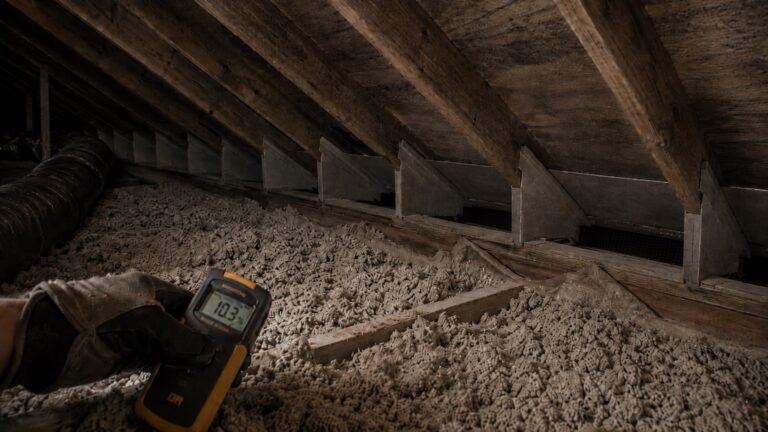
Moisture below a slate roof can turn a small visible problem into a larger repair or restoration decision. A few broken slates may be simple to replace if the roof below is dry. But if water has been entering for a long time, the underlayment, decking, attic insulation, or framing may already be affected.
Slate roofs can sometimes hide moisture problems because the visible tiles may still look strong while water enters around flashing, valleys, slipped tiles, or failed underlayment. This is why interior and attic signs matter. The roof should be evaluated from below as well as from the exterior.
Signs that moisture may have moved below the slate include:
- Water stains on the underside of roof decking
- Damp or compressed attic insulation
- Recurring ceiling stains after rain
- Darkened or softened roof sheathing
- Musty attic odors
- Staining below valleys, chimneys, dormers, or roof penetrations
- Leaks that return after individual slate replacement
These signs do not automatically mean the slate roof needs full replacement. They do mean the repair should look beyond the visible tile. If moisture is limited to one area, targeted repair or partial restoration may be enough. If moisture is widespread, or if leaks are returning after several repairs, replacement becomes more likely.
Moisture damage also affects whether saving and reusing slate is practical. If the slate is sound but the underlayment and deck below need work, a contractor may be able to remove, save, and reinstall usable slate in certain areas. If the tiles are brittle, delaminating, or breaking during removal, replacement may become more practical.
When water has entered below the roof surface, the goal is not only to stop the next leak. The goal is to prevent recurring moisture damage. That decision fits into the larger process of how to find, fix, and prevent moisture problems in a home, especially when attic materials, roof decking, or ceilings have already been affected.
A slate repair is strongest when it corrects the visible damage and confirms the materials below the roof are still sound. Partial restoration or replacement becomes more logical when the leak has exposed deeper roof system failure.
Questions to Ask Before Repairing a Slate Roof
Before approving a slate roof repair, ask questions that clarify whether the problem is limited to a few damaged tiles or whether the roof needs deeper restoration. Slate repairs can be very effective when the diagnosis is accurate, but they can also fail if the real problem is hidden underlayment, flashing, fasteners, or structural movement.
Start with the condition of the slate itself. If the surrounding tiles are still hard, solid, and intact, individual slate replacement may be practical. If many tiles are soft, flaky, cracked, or delaminating, the roof may not be a good candidate for repeated small repairs.
Ask these questions before approving the repair:
- How many slate tiles are broken, missing, slipped, or cracked?
- Is the damage limited to one area or spread across the roof?
- Are the surrounding slates still sound enough to preserve?
- Is the leak coming from slate tiles, flashing, valleys, fasteners, or underlayment?
- Are the fasteners failing in one area or across the roof?
- Is the underlayment still functional?
- Are the roof deck and framing dry and structurally sound?
- Can matching or compatible replacement slate be sourced?
- Has this area been repaired before?
- Would partial restoration make more sense than repeated spot repairs?
These questions help protect a homeowner from two common mistakes. The first mistake is replacing too much of a slate roof when only a few tiles or one flashing detail needs attention. The second mistake is replacing a few visible tiles when the real problem is a failing roof system below them.
Cost should be evaluated carefully because slate work can vary widely depending on access, material, roof pitch, tile matching, and hidden work below the slate. If the estimate is large or the leak source is unclear, compare the repair scope with general roof leak repair cost factors so you can tell whether the project is a small repair, a partial restoration, or the beginning of a replacement decision.
When a Slate Roofing Specialist Should Inspect the Roof
A slate roof should usually be inspected and repaired by someone with slate roofing experience. A general roofing approach that works on asphalt shingles may crack slate, disturb sound tiles, or create new leak points.
You should call a slate roofing specialist when the roof has repeated leaks, several missing or slipped slates, visible flashing deterioration, suspected underlayment failure, or signs of moisture below the roof. A specialist can help determine whether the roof needs simple tile replacement, flashing work, partial restoration, or full replacement.
Specialist evaluation is also important if the roof is steep, fragile, historic, or difficult to access. Slate roofs often require roof hooks, ladders, staging, or other careful access methods. Walking directly on slate can crack tiles and turn a small repair into a larger problem.
A good slate roof inspection should evaluate more than the broken tiles. It should consider slate quality, fastener condition, flashing, valleys, hips, ridges, underlayment condition where visible, roof deck condition, structural support, and interior moisture signs. The contractor should be able to explain whether the slate itself is failing or whether the supporting components around it are the main issue.
If water has reached attic materials, roof decking, or ceilings, review guidance on when to hire a roofing contractor for moisture problems. If you are comparing estimates or deciding who should handle the work, it also helps to know how to choose a roofing contractor for leak repairs, especially when the roof material requires specialized skill.
FAQ: Repairing or Replacing a Slate Roof
Can individual slate roof tiles be replaced?
Yes. Individual slate roof tiles can often be replaced when the surrounding slate is sound, the roof structure is stable, and the damage is limited. The repair should also check the underlayment, fasteners, and decking below the damaged area to make sure water has not caused hidden damage.
Does a leaking slate roof always need replacement?
No. A leaking slate roof may have a repairable issue such as a broken slate, slipped tile, failed flashing, worn valley, or localized underlayment problem. Replacement becomes more likely when leaks are recurring, widespread, or tied to broad slate deterioration, failed underlayment, or structural damage.
When is slate roof restoration better than replacement?
Restoration may be better when much of the slate is still usable but flashings, fasteners, valleys, underlayment, or certain sections need deeper work. This can preserve valuable slate while correcting hidden roof system problems. Full replacement is more likely when the slate itself is broadly deteriorated or the structure is compromised.
Can underlayment failure require slate roof replacement?
Yes, but not always full replacement. If underlayment failure is localized, partial restoration may be enough. If underlayment failure is widespread and many slates must be removed to access it, the project may become a major restoration or full replacement depending on tile condition and cost.
Should a general roofer repair a slate roof?
Slate roofs are best handled by roofers with slate experience. Improper walking, fastening, removal, or tile matching can break more slate and create new leak risks. A general roofer may be qualified if they have real slate experience, but slate should not be treated like asphalt shingles.
Is it worth keeping an old slate roof?
Often, yes, if the slate is high-quality, the structure is sound, and the roof can be repaired or restored properly. Keeping an old slate roof may not be practical if many tiles are soft, delaminating, leaking repeatedly, or if the roof deck and framing have serious moisture damage.
Final Decision: Repair, Restore, or Replace?
A slate roof should usually be repaired when the damage is limited to a few tiles, one flashing detail, or one local problem, and the surrounding slate and structure are still sound. Partial restoration may be the better middle option when much of the slate is worth saving but flashing, fasteners, valleys, or underlayment need deeper work.
Full replacement becomes more reasonable when slate deterioration is widespread, underlayment has failed broadly, fasteners are no longer reliable, leaks keep returning, or the roof structure has moisture damage. The goal is not to save slate at all costs or replace it too quickly. The goal is to protect the value of the slate roof while fixing the hidden components that keep water out of the home.