Are Burst-Proof Washing Machine Hoses Worth It for Leak Prevention?
Burst-proof washing machine hoses are usually worth it when the washer is in a finished laundry room, upstairs laundry area, closet, condo, apartment, or any location where a hose failure could damage floors, ceilings, cabinets, drywall, or framing. The cost of upgrading hoses is usually small compared with the cost of cleaning up a sudden washing machine leak.
That does not mean burst-proof hoses are truly impossible to fail. In most cases, “burst-proof” or “burst-resistant” means the hose is reinforced to reduce the risk of the hose wall rupturing under pressure. The hose can still leak at the coupling, washer, valve, connection point, or appliance fitting. The washer itself can also leak from other parts that the hose does not protect.
The best way to think about burst-proof washing machine hoses is as one layer of leak prevention. They reduce one major failure risk, especially compared with old rubber hoses, but they work best with regular inspection, accessible shutoff valves, a leak pan, and water sensors. This matters because washing machine leaks can cause structural damage when water reaches subflooring, wall cavities, ceiling drywall, trim, or framing.
What “Burst-Proof” Washing Machine Hoses Really Mean
The phrase “burst-proof” sounds absolute, but homeowners should be careful with that wording. A better term is usually burst-resistant. These hoses are designed to be stronger than standard rubber washing machine hoses, especially against swelling, bulging, and sudden hose-wall rupture.
Many upgraded washer hoses use stainless steel braiding or reinforced construction around an inner hose. The reinforcement helps the hose resist expansion under pressure. That can reduce the chance of a sudden burst, especially when compared with an aging plain rubber hose that has been under pressure for years.
However, the outer reinforcement does not make every part of the connection failure-proof. A burst-resistant washer hose can still leak from:
- A worn rubber washer inside the coupling
- A loose connection at the shutoff valve
- Corrosion on the coupling or valve
- A kinked or stressed hose
- Improper installation
- Damage from being pushed tightly against a wall
- A failing valve, fitting, or washer inlet connection
This is why burst-proof hoses should not be treated as a permanent, install-and-forget solution. They are an upgrade, not a guarantee. The hose body may be stronger, but the connection points still need attention.
The wording also varies by manufacturer. Some hoses are simply stainless steel braided hoses. Others are labeled burst-resistant, burst-proof, or heavy-duty. Some may include additional shutoff-style features. Before buying, look at the construction, pressure rating, connection quality, washer type, warranty language, and manufacturer instructions instead of relying only on the label.
Why Washing Machine Hoses Fail
Washing machine hoses fail because they sit under pressure, often for years, while being exposed to movement, vibration, temperature changes, mineral buildup, and aging materials. The hose may look fine from the outside while the inside is weakening.
Standard rubber hoses are especially vulnerable over time. Rubber can harden, crack, bulge, or lose flexibility. If the washer is pushed too close to the wall, the hose can kink or bend sharply. If the shutoff valves are left open all the time, the hoses remain under constant pressure even when the washing machine is not running.
Common causes of washing machine hose failure include:
- Age-related rubber deterioration
- Constant water pressure
- High household water pressure
- Kinks or sharp bends behind the washer
- Washer vibration during spin cycles
- Corrosion at the hose couplings
- Worn rubber washers inside the hose ends
- Mineral buildup around valves and fittings
- Hoses rubbing against the wall or appliance
- Improper tightening or cross-threaded connections
Some hose failures are sudden. A weakened hose wall can rupture and release water quickly. Other failures start slowly, with seepage around the coupling or dampness behind the machine. Both matter. A slow leak can still damage flooring or framing if it happens where water is hidden.
Hose condition also matters more in rooms where a leak would be hard to see. A washing machine in a closet may hide early seepage behind the appliance. A washer upstairs can leak into the ceiling below before the homeowner realizes what happened. A washer near finished flooring or cabinets can send water under materials that do not dry quickly.
Even if you upgrade to better hoses, you still need to know when washing machine hoses should be replaced. Reinforced hoses are stronger than plain rubber hoses, but they are not permanent plumbing components.
Rubber vs. Stainless Braided vs. Burst-Resistant Washer Hoses
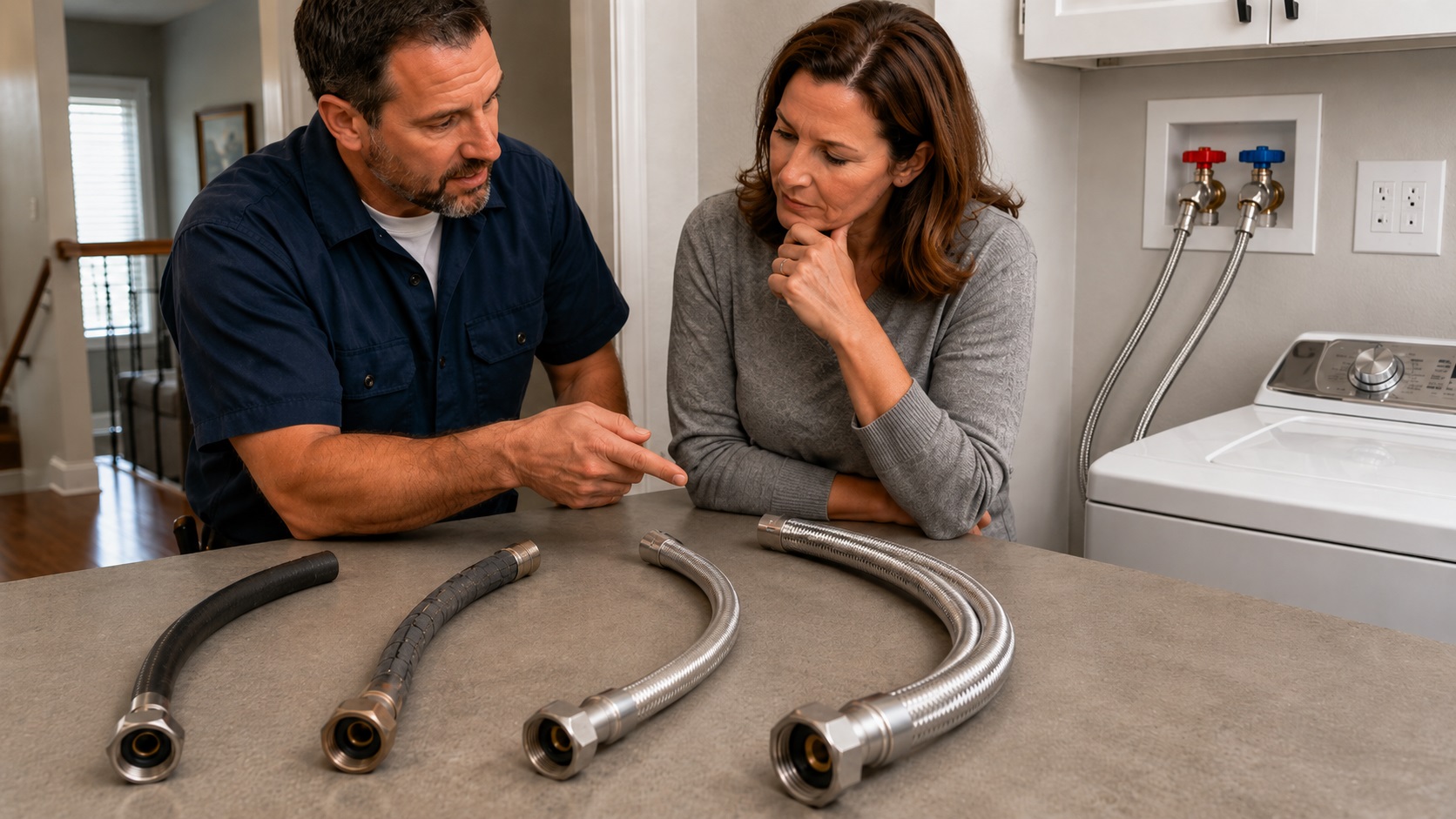
Not all washing machine hoses provide the same level of protection. The main differences are material strength, resistance to pressure, coupling quality, and how well the hose handles age, movement, and bending. The right choice depends on the washer location, water damage risk, and how much protection you want beyond the minimum. For product-level comparisons, use the separate guide to the best washing machine hoses for leak prevention.
Standard Rubber Washing Machine Hoses
Standard rubber hoses are usually the least expensive option. They can work when they are new, properly installed, easy to inspect, and used in a low-risk location. The problem is that rubber hoses age. Over time, they can harden, crack, bulge, or weaken internally.
Standard rubber hoses are usually not the best choice for high-risk laundry locations. If the washer is upstairs, in a finished basement, inside a closet, or near materials that can absorb water, the lower upfront cost may not be worth the added risk.
Rubber hoses may be acceptable when:
- They are new and high quality.
- The washer is in an unfinished area.
- The hoses are visible and easy to inspect.
- The floor has a working drain nearby.
- The homeowner replaces hoses proactively.
Old rubber hoses are different. Once the age is unknown or the rubber feels stiff, cracked, swollen, or kinked, replacement is the safer choice.
Stainless Steel Braided Washing Machine Hoses
Stainless steel braided hoses are a common upgrade from plain rubber hoses. They usually have an inner hose surrounded by a braided stainless steel outer jacket. The outer braid helps resist expansion and can reduce the chance of bulging or sudden rupture.
For many homeowners, stainless braided hoses are the practical middle ground. They are usually more durable than standard rubber hoses, widely available, and not extremely expensive. They are especially useful when the washer is in a finished area or when the existing hoses are older rubber hoses.
However, braided hoses still need inspection. The inner hose can age, the couplings can corrode, the rubber washers can wear, and the connection can leak if the hose is kinked, stressed, or poorly installed. If the hose is damp at the coupling or has mineral buildup near the end, the issue may involve the washer or gasket rather than the braided jacket itself. That is where it helps to understand when rubber gaskets in plumbing systems should be replaced.
Burst-Resistant or Auto-Shutoff Washer Hoses
Some washing machine hoses are marketed as burst-resistant, burst-proof, heavy-duty, or auto-shutoff hoses. These hoses are designed to reduce the chance of a major hose failure, and some include features intended to restrict flow if a sudden burst occurs. For a deeper explanation of that shutoff mechanism, see how washing machine hose burst protection works.
These hoses are usually more expensive than standard rubber hoses and may cost more than basic stainless braided hoses. They make the most sense where the cost of water damage would be high. That includes upstairs laundry rooms, finished basements, laundry closets, multi-level homes, condos, apartments, and homes where the washer may run while no one is nearby.
Burst-resistant hoses can be a smart upgrade, but they still do not protect against every leak. They do not stop the washer pump from leaking, prevent a drain hose problem, fix a bad shutoff valve, or catch water from an internal appliance failure. They reduce one major risk: a supply hose failure.
When Burst-Proof Washing Machine Hoses Are Worth It
Burst-proof washing machine hoses are usually worth it when a washer leak would cause expensive or hidden damage. The more vulnerable the surrounding materials are, the stronger the case for upgrading from standard rubber hoses.
They are especially worth considering when:
- The laundry room is upstairs.
- The washer is above a finished ceiling.
- The washer is in a laundry closet.
- The washer is in a finished basement.
- The washer is near cabinets, drywall, trim, or wood flooring.
- The current hoses are rubber.
- The hose age is unknown.
- The washer connections are hard to see.
- The shutoff valves are usually left open.
- The homeowner travels often.
In these situations, the cost of upgraded hoses is usually small compared with the cost of water damage, especially if a rupture or slow connection leak stays hidden behind the washer.
Burst-resistant hoses are also worth considering when you are already replacing or moving the washer. If the hoses must be disconnected anyway, it is often a good time to upgrade instead of reinstalling old rubber hoses.
The value is highest when the hose upgrade is part of a larger plumbing leak prevention plan. Better hoses reduce one failure risk, but leak pans, sensors, shutoff valves, and regular inspection reduce the chance that any leak becomes serious.
When Standard Hoses May Be Enough
Standard hoses may be enough in lower-risk situations if they are new, high quality, installed correctly, and easy to inspect. For example, a washer in an unfinished basement or garage on open concrete with a nearby floor drain presents less damage risk than a washer above a finished ceiling.
Standard hoses may be reasonable when:
- The washer is in an unfinished area.
- The floor is concrete and slopes toward a drain.
- The hoses are new and in good condition.
- The hoses are easy to inspect regularly.
- Water would be noticed quickly if a leak occurred.
- There are no finished materials directly below or nearby.
Even then, standard rubber hoses should not be ignored. They still age, weaken, and fail over time. If the hoses are old, stiff, cracked, bulging, kinked, or corroded at the couplings, replacing them is wise regardless of where the washer is located.
The real question is whether the small savings are worth the risk in that specific laundry location. In many finished homes, braided or burst-resistant hoses are a low-cost upgrade compared with the potential damage from a hose failure.
What Burst-Proof Hoses Do Not Protect Against
Burst-proof washing machine hoses reduce the risk of one major problem: the supply hose wall rupturing under pressure. They do not protect against every possible washing machine leak. This distinction matters because homeowners sometimes upgrade the hoses and assume the laundry area is fully protected.
Even with burst-resistant hoses, water can still leak from:
- Loose hose couplings
- Worn rubber washers inside the hose ends
- Corroded shutoff valves
- Leaking valve stems
- Washer inlet valve problems
- Drain hose leaks or overflow
- Washer pump leaks
- Door boot or door seal leaks on front-load washers
- Internal appliance failures
- Water that escapes outside the area protected by a pan
This is why upgraded hoses should not replace inspection. The hose body may be stronger, but the washer connections still rely on couplings, washers, valves, and appliance fittings. A small leak at any of those points can still wet flooring, drywall, trim, or subflooring if it goes unnoticed.
When checking washer connections, look for dampness, rust, mineral buildup, black rubber residue, flattened washers, or seepage around the fittings. If the leak appears to be coming from a washer or seal rather than the hose body, the issue may relate to when rubber gaskets in plumbing systems should be replaced.
Are Burst-Proof Hoses Worth It for Upstairs Laundry Rooms?
Burst-proof washing machine hoses are especially worth it for upstairs laundry rooms. This is one of the highest-risk washer locations because water can travel through flooring seams, soak the subfloor, drip into ceiling drywall, wet insulation, and spread along framing before the leak is fully visible.
In an upstairs laundry room, the cost of a hose upgrade is usually small compared with the cost of repairing ceiling damage, flooring damage, drywall stains, trim swelling, or hidden moisture below the washer. Even a small supply connection leak can become expensive if it runs while no one is home.
Upgraded hoses are strongly worth considering when an upstairs laundry room has:
- A washer above bedrooms, hallways, kitchens, or living areas
- Wood-framed flooring under the laundry area
- Finished ceiling drywall below
- A washer inside a closet or tight alcove
- Hard-to-reach shutoff valves
- Older or unknown hose age
- No leak pan or water sensor
In this setting, burst-resistant hoses should be treated as one part of a stronger prevention system. They reduce the chance of a supply hose rupture, but they do not catch water from every leak source or shut the water off automatically.
Should You Still Use a Leak Pan?
In high-risk laundry areas, yes. A leak pan is still useful even if you upgrade to burst-resistant hoses. The hose upgrade reduces supply hose failure risk, but a washer can still leak from the drain hose, pump, door seal, supply connection, internal valve, or other appliance parts.
A washer pan can catch water from multiple leak sources, not just the supply hoses. This is especially valuable in upstairs laundry rooms, finished basements, laundry closets, condos, apartments, and laundry areas near finished floors or cabinets.
The pan must be sized and placed correctly. A pan that is too small, poorly drained, or inaccessible may give a false sense of protection. If you are adding a pan as part of the hose upgrade, start with choosing the right leak pan size and then confirm where leak pans should be installed based on the laundry room’s risk level.
A leak pan is most helpful when it does not block the shutoff valves, hose connections, drain hose, appliance feet, or future inspection. If the pan makes it harder to see the hoses, it may reduce the maintenance value of the hose upgrade.
Should You Still Use Water Leak Sensors or Smart Shutoff Systems?
Water leak sensors are still useful with burst-proof hoses because they alert you when water appears. A sensor can catch leaks from the washer, hose connections, pan, drain area, or nearby plumbing. This is especially important behind washers, inside laundry closets, and in upstairs laundry rooms where water may not be seen right away.
Leak sensors are a good addition when:
- The washer is upstairs.
- The laundry area is inside a closet.
- The washer is near finished flooring or cabinets.
- The shutoff valves are hard to reach.
- The washer is used when no one is nearby.
- The home has had previous laundry leaks.
If you want alerts before a leak spreads, compare water leak sensors for early detection. Sensors do not prevent the hose from failing, but they can reduce the time water sits unnoticed.
Smart shutoff systems provide another layer by limiting water flow when abnormal conditions are detected. These systems are most valuable when a leak could release a large amount of water before anyone responds. They may be especially useful for frequent travelers, second homes, upstairs laundry rooms, finished basements, or homes with older plumbing. To understand that layer, review how smart water shutoff systems work.
The strongest laundry leak-prevention setup uses several layers together: upgraded hoses, accessible shutoff valves, a properly placed pan, leak sensors, and regular inspection.
Buyer Checklist Before Upgrading Washer Hoses
Before buying burst-proof or burst-resistant washing machine hoses, look at the full laundry setup. The value of the upgrade depends on the condition of the current hoses, the risk level of the room, and what would happen if water escaped behind the washer.
Before disconnecting washer hoses, turn off both hot and cold shutoff valves, relieve pressure carefully, and avoid forcing corroded or stuck valves. If a valve will not close smoothly or starts leaking at the stem, have the valve inspected before relying on a hose upgrade.
- Are the current hoses plain rubber?
- Is the hose age unknown?
- Are the hoses stiff, cracked, kinked, bulging, or hard to move?
- Do the couplings show rust, corrosion, or mineral buildup?
- Are the shutoff valves usually left open?
- Is the washer upstairs or above finished space?
- Is the washer in a closet or tight laundry alcove?
- Is the washer near drywall, cabinets, trim, wood flooring, or finished materials?
- Would a leak be noticed quickly?
- Can the shutoff valves be reached easily?
- Is there a leak pan under the washer?
- Is there a water sensor near the washer or pan?
If several of these questions point to higher risk, upgrading to burst-resistant hoses is usually a smart decision. For the strongest upgrade, choose hoses with solid metal couplings, clear pressure-rating information, replaceable rubber washers, enough length to avoid kinks, and installation instructions that match your washer and shutoff valves.
Final Verdict: Are Burst-Proof Washing Machine Hoses Worth It?
Burst-proof washing machine hoses are worth it for most homeowners with finished laundry rooms, upstairs laundry areas, laundry closets, condos, apartments, or older rubber hoses. They reduce the risk of a sudden supply hose rupture, which is one of the more damaging washer-related leak scenarios.
They are especially worth it when the washer is above finished space or near materials that absorb water. In those locations, the cost difference between standard hoses and reinforced hoses is usually small compared with the damage a hose failure can cause.
Standard hoses may be acceptable in lower-risk areas if they are new, high quality, visible, easy to inspect, and installed on unfinished concrete near a working drain. Even then, old rubber hoses should not be stretched beyond their useful life just to save money.
The best answer is balanced: burst-resistant hoses are a worthwhile upgrade, but they are not complete protection. They should be paired with regular inspection, functional shutoff valves, a washer pan where appropriate, leak sensors in high-risk areas, and proactive replacement when the hoses show age or wear.
Quick Washer Hose Upgrade Checklist
- Choose burst-resistant hoses when the washer is upstairs, in a closet, near finished materials, or connected to old rubber hoses.
- Do not treat “burst-proof” as failure-proof; couplings, washers, valves, and appliance fittings can still leak.
- Use a washer pan, leak sensor, accessible shutoff valves, and regular inspection in higher-risk laundry areas.
- Replace any hose that is stiff, kinked, bulging, corroded, damp at the coupling, or past the manufacturer’s recommended service life.
Frequently Asked Questions
Do burst-proof washing machine hoses really work?
They can reduce the risk of hose-wall rupture, especially compared with aging rubber hoses. However, they are not impossible to leak or fail. Couplings, washers, valves, fittings, and installation conditions still matter.
Can burst-proof washer hoses still leak?
Yes. Burst-proof or burst-resistant hoses can still leak at the couplings, rubber washers, shutoff valves, washer inlet connections, or damaged fittings. They can also be affected by corrosion, kinks, stress, or poor installation.
Are burst-proof hoses worth it for upstairs laundry?
Yes. Upstairs laundry rooms are one of the strongest reasons to upgrade. A washer leak upstairs can damage subflooring, ceiling drywall, insulation, trim, and framing below. Burst-resistant hoses reduce one major risk, but they should still be paired with other protection layers.
How often should burst-resistant washing machine hoses be replaced?
Burst-resistant hoses should still be inspected regularly and replaced when they show stiffness, corrosion, kinks, bulging, damaged couplings, worn washers, seepage, or other signs of age. Follow the hose manufacturer’s guidance and do not treat upgraded hoses as permanent.
Do I still need a washer pan with burst-proof hoses?
In high-risk locations, yes. Burst-resistant hoses reduce supply hose rupture risk, but a washer can still leak from the drain hose, pump, door seal, internal valve, or connection points. A properly placed pan can catch water from more than one leak source.
Should I turn off washer valves when not using the machine?
Turning off washer valves can reduce pressure on the hoses when the washer is not in use, especially during travel. However, the valves must be functional and easy to operate. If the valves are stuck, leaking, or corroded, they should be inspected or replaced.
What is the safest setup if my washer is upstairs or in a closet?
For an upstairs washer or laundry closet, use burst-resistant hoses, accessible shutoff valves, a properly sized washer pan, a water leak sensor near the pan or hose connections, and regular hose inspection. In higher-risk homes, a smart shutoff system can add another layer of protection.