Best Roof Repair Tools for Homeowners: A Roofer’s Practical Tool List
Introduction
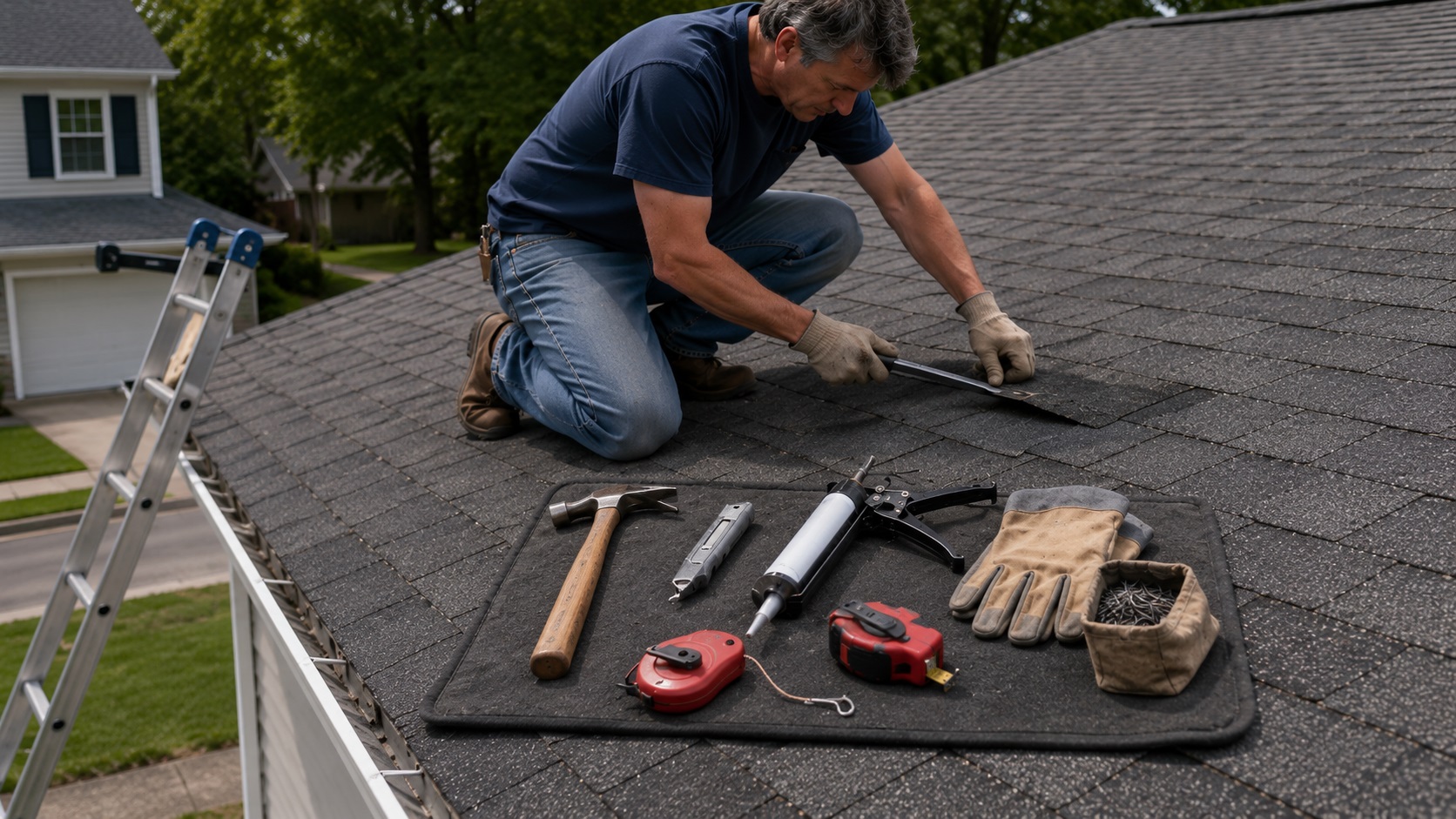
Small roof repairs are easier when you have the right tools before you climb onto the roof. A loose shingle, cracked flashing edge, exposed nail, torn underlayment, or small leak-prone area can turn into a bigger moisture problem if the repair is rushed with the wrong knife, the wrong pry bar, or the wrong safety setup. The goal of this guide is to help you choose practical, homeowner-usable tools for minor roof repair, sealing, cutting, fastening, and safe access.
After 10 years of working as a roofer, I’m recommending some of the best tools based on my experience. The essentials include a good caulk gun, a flat bar, hook blade and straight blade utility knives, a safe way to work, soft but durable non-marring knee pads, a reliable hammer, shears for flashing, and a pouch that keeps the important tools close. For roof leak diagnosis tools such as moisture meters and thermal cameras, see my separate guide to roof leak detection tools.
Roof repair is only one part of a larger moisture-control strategy. If you are still trying to understand where moisture starts, how it spreads, and how to prevent it from returning, see the full guide to how to find, fix, and prevent moisture problems in homes.
As an Amazon Associate, this site earns from qualifying purchases. This does not affect the price you pay. Our recommendations are based on research, product reliability, and real-world usability in moisture-prone environments.
Quick Picks Summary
| Category | Recommended Product | Why It Belongs in a Roof Repair Kit | Amazon Link |
|---|---|---|---|
| Best Overall Caulk Gun | WORKPRO Adjustable Caulking Gun | Good all-around choice for roofing sealants, exterior caulks, and repair cartridges. | View on Amazon |
| Best Caulk Gun for Thick Roof Sealants | Newborn 250 Super Smooth Rod Caulking Gun | Better leverage for thicker roof sealants and adhesive-style repair products. | View on Amazon |
| Best Flat Bar for Shingle Repairs | Crescent 15″ Flat Pry Bar with Grip – FB15-06 | A flat bar allows for removing nails and loosening shingles and flashing without damaging the parts we want to keep. | View on Amazon |
| Best Roof Nail Puller for Stubborn Fasteners | ESTWING PB-18 I-Beam Nail Puller | Useful when framing nails need extra leverage. | View on Amazon |
| Best Roof Safety Kit for Homeowners | Malta Dynamics 50’ Roofer’s Safety Bucket Kit | A safety-focused kit for roof access situations where fall protection is appropriate and properly used. | View on Amazon |
| Best Hook Knife for Regular Roof Work | Crain Hook Handle Utility Knife 189 | A better hook-knife style for repeated shingle cutting than cheap straight utility handles. | View on Amazon |
| Best Roofing Hammer | ESTWING 16 oz Straight Rip Claw Hammer – E3-16S | An all-steel hammer is durable and dependable for roofing and exterior repair work. | View on Amazon |
| Best Roofing Work Gloves | G & F Products 3100L-DZ Rubber Latex Double Coated Work Gloves | A practical roofing glove choice when grip, dexterity, and durability all matter. | View on Amazon |
| Best Non-Marring Knee Pads for Roofing | ToughBuilt FoamFit Non-Marring Knee Pads – TB-KP-203R | Soft non-marring rubber pads are better for shingles than hard-shell pads that can slip or mark the roof, or cheap foam pads that quickly fall apart. | View on Amazon |
| Best Roofing Tool Pouch | Graintex ST2870 10-Pocket Nail & Tool Pouch | A compact pouch for knives, hammer, shears, nails, and a tape measure without being oversized. | View on Amazon |
Roofer’s Notes on the Core Roof Repair Tools
Best Overall Caulk Gun: WORKPRO Adjustable Caulking Gun
The WORKPRO Adjustable Caulking Gun is the best caulk gun in this lineup because small roof repairs often involve more than one type of cartridge. Some products flow easily, while thicker roof sealants and exterior adhesives need more trigger force. A cheap caulk gun can work for indoor latex caulk, but roof sealant is less forgiving. If the gun flexes, drips badly, or is hard to squeeze, the homeowner is more likely to leave a messy bead or give up halfway through the job.
This is the kind of tool I would recommend for homeowners sealing exposed fasteners, small flashing edges, roof-to-wall transitions, vent boot edges, and other minor repair areas after the actual leak source has already been identified. It fits well under the parent topic Most Common Roofing Material Failures because many small roof failures become moisture problems when old sealant, cracked caulk, or minor flashing gaps are ignored.
It’s important to note that with roofing, caulk should be treated as either an emergency measure or a secondary barrier. Caulk can be used to seal loose shingles, prevent water from running under shingles and flashing in critical areas, and seal pin holes left from loose nails or where flashing joins at the bottom corner of a chimney.
Severely damaged shingles or flashing should be replaced, not just caulked. But when you replace a damaged shingle, you should used dabs of caulk to seal the older shingles to it. When you replace a bad vent pipe cover, run a bead of caulk around the top and sides of the flashing before you place a shingle over it, in order to prevent water from working its way between the flashing and the shingles.
Why This Caulking Gun Works for Roof Sealants
- Adjustable thrust setting for different sealant thicknesses.
- Smooth rod design for controlled pressure.
- Rotating barrel for easier bead direction around awkward roof details.
- Drip-control design to reduce wasted sealant.
- Works with common 10 oz sealant cartridges.
Where It Helps Most
- ✔ More versatile than a basic bargain caulk gun.
- ✔ Useful for both thinner exterior caulks and thicker repair sealants.
- ✔ Good choice for homeowners who only want one sealant gun.
- ✔ Rotating barrel helps around flashing and roof penetrations.
What to Know Before Buying
- ✖ Still requires the right sealant for the roof material.
- ✖ Caulk is not a primary water barrier for roofing
Best Fit for Homeowners
- Homeowners who want one practical caulking gun for roof sealant, flashing sealant, exterior caulk, and minor waterproofing repairs.
Check the WORKPRO Adjustable Caulking Gun on Amazon to see current availability.
Best for Thick Roof Sealants: Newborn 250 Super Smooth Rod Caulking Gun
The Newborn 250 Super Smooth Rod Caulking Gun is a better choice when you know you will be applying thicker roof sealants. Many roof repair products are heavier than normal household caulk, especially in cooler weather. When a weak caulk gun is used with a thick cartridge, it can make the job harder than it needs to be. You may squeeze unevenly, stop too often, or leave a bead that does not press firmly into the repair area.
I would not tell every homeowner to buy an upgraded caulk gun, but if you plan to use roof sealants more than once, this type of tool is worth considering. It belongs in this article because it supports the repair process, not leak detection. For actual product choices in roof caulks and sealants, this article should link out to guides such as Best Roofing Caulks for Leak Prevention and Best Roof Sealants for Emergency Repairs instead of trying to own those product categories.
Why This Works Better With Thick Sealants
- Higher thrust ratio for thicker materials.
- Smooth rod design for controlled pressure release.
- Revolving frame for better positioning while applying a bead.
- Built for standard 1/10 gallon cartridges.
- Better suited to repeated exterior sealant use than a flimsy budget gun.
Where It Helps Most
- ✔ Stronger choice for thick roof repair sealants.
- ✔ More comfortable for repeated bead application.
- ✔ Rotating frame helps when working around roof edges and penetrations.
- ✔ Good upgrade for homeowners who do several exterior repairs.
What to Know Before Buying
- ✖ More tool than some one-time users need.
- ✖ You may still need to leave caulk tubes in a warm place before use if the weather is cold.
Best Fit for Homeowners
- Homeowners using heavier roof sealants, polyurethane sealants, construction adhesives, or repeated exterior repair cartridges.
Check the Newborn 250 Super Smooth Rod Caulking Gun on Amazon to see current availability.
Best Flat Bar for Shingle Repairs: Crescent 15″ Flat Pry Bar with Grip – FB15-06
This is one of the most important corrections in the whole lineup. For shingle repairs, a flat bar is usually more useful than a bulky nail puller or odd specialty pry tool. Roofers use flat bars because when used carefully they can slide under shingles, break the seal strip, lift tabs, access nails, and work around flashing without destroying the good pieces of flashing or shingles that are not being replaced.
The Crescent 15″ Flat Pry Bar with Grip is a good homeowner-friendly option because it gives you a practical shape and useful leverage without being too large. A homeowner replacing a damaged shingle, lifting a tab near a vent boot, or loosening a small flashing edge needs control more than brute force. This is an essential repair-prep tool.
Where the Flat Bar Helps Most
- Flat pry shape for sliding under shingles and trim.
- 15-inch size gives useful leverage without becoming oversized.
- Grip handle for better control than bare steel in some situations.
- Nail-pulling slot for repair fasteners.
- Useful for shingles, light flashing work, siding edges, and exterior trim repair.
Why I Prefer a Flat Bar for Shingle Work
- ✔ Better roofing choice than many generic nail pullers.
- ✔ Thin flat shape helps lift shingles and remove nails without damaging shingles.
- ✔ Good size for homeowner repairs.
- ✔ Useful beyond roofing for siding and exterior trim work.
What to Watch Out For
- ✖ Can still damage shingles and flashing if not careful or if they are extremely brittle. Use the hammer with the flat bar to make sure it gets under the nail itself, not only the flashing or shingle, before prying.
- ✖ Designed for targeted replacements of damaged shingles and flashing, not full roof tear-off work.
Best Fit for Homeowners
- Replacing a small number of shingles or flashing pieces, lifting and separating shingles, and removing nails during targeted roof repairs.
Check the Crescent 15″ Flat Pry Bar with Grip on Amazon to see current availability.
Best Roof Nail Puller for Stubborn Fasteners: ESTWING PB-18 I-Beam Nail Puller
The ESTWING PB-18 I-Beam Nail Puller is better when you need stronger leverage on stubborn nails, old trim fasteners, decking edges, or repair areas where a lighter flat bar is not enough. This is especially helpful when plywood or OSB roof decking need replacement.
Where This Nail Puller Fits in a Roofing Kit
- I-beam style pry bar design for strength and leverage.
- Forged steel construction for demanding fastener removal.
- Longer 18-inch size for more pulling power.
- Useful for nails, trim, old fasteners, and exterior repair prep.
- Durable enough for repeated homeowner and contractor-style use.
Where It Helps Most
- ✔ Strong leverage for stubborn fasteners.
- ✔ More durable than many light-duty pry tools.
- ✔ Useful for roof-adjacent exterior repairs.
- ✔ Good secondary tool after a flat bar.
What to Know Before Buying
- ✖ Not the best first-choice tool for lifting shingles.
- ✖ Too heavy to be convenient for light flashing and shingle replacement or repairs.
Best Fit for Homeowners
- Pulling stubborn roofing nails, old exterior fasteners, trim nails, and damaged repair-area hardware.
Check the ESTWING PB-18 I-Beam Nail Puller on Amazon to see current availability.
Best Roof Safety Kit for Homeowners: Malta Dynamics 50’ Roofer’s Safety Bucket Kit
Roof safety is not optional. A roof safety kit does not make every roof safe, and it does not replace training, judgment, or professional help. But if a homeowner is going to access a roof for appropriate minor work, safety equipment needs to be considered part of the tool list, not an afterthought.
The Malta Dynamics 50’ Roofer’s Safety Bucket Kit is the safety pick in this article because it is designed around roof work rather than general household use. It includes the main components a roof safety setup normally requires, but the user still has to follow the manufacturer’s instructions and understand anchoring, harness fit, lifeline use, and fall-clearance issues. Homeowners should not work on steep, wet, icy, damaged, high, or complicated roofs. In those cases, the better tool is a phone call to a roofing professional. For decision help, see When to Hire a Roofing Contractor for Moisture Problems.
What This Roof Safety Kit Includes
- Roofing safety kit format with harness, lifeline, and anchor components.
- 50-foot vertical lifeline for roof access setups where appropriate.
- Reusable roof anchor included.
- Bucket storage helps keep components together.
- Designed for fall-protection use when installed and worn correctly.
Why Safety Gear Belongs in This Tool List
- ✔ Helps make safety part of the roof repair plan.
- ✔ More complete than buying random safety pieces separately.
- ✔ Useful for homeowners who understand the instructions and limitations.
- ✔ Supports this article’s safety-tool focus.
Important Safety Limits
- ✖ Requires correct anchoring, fit, and use.
- ✖ Does not make dangerous roofs safe for DIY work.
- ✖ Does not replace the need for caution. Be careful not to step on loose shingles or tar paper.
- ✖ Homeowners may still need professional help for many roof situations.
Best Fit for Homeowners
- Homeowners who are doing limited roof work on appropriate roof conditions and want a roof-specific safety kit rather than ignoring fall protection.
Check the Malta Dynamics 50’ Roofer’s Safety Bucket Kit on Amazon to see current availability.
Best Hook Knife for Regular Roof Work: Crain Hook Handle Utility Knife 189
A roofer normally uses both a hook blade and a straight blade. A hook blade is useful for cutting shingles because the blade shape helps pull through the material without cutting into everything underneath the same way a straight blade might. Cheap hook-blade knives can work for one small job, but for regular use, the handle matters.
The Crain Hook Handle Utility Knife 189 is a better regular-use pick because the hook-style handle gives more pulling control. A homeowner doing one tiny repair may not need it, but anyone who expects to cut shingles, rolled roofing, underlayment, or patch material more than once will appreciate a handle that feels more secure. Poor knife control can waste material and increase injury risk, especially on a roof.
Why This Hook Knife Is More Roof-Specific
- Hook-handle shape for better pulling control.
- Designed for utility blade cutting work.
- Longer handle profile than many small pocket utility knives.
- Useful for shingle cutting and roofing material trimming.
- Better suited to repeated use than very cheap disposable-style cutters.
Where It Helps Most
- ✔ Better grip and pulling angle for hook-blade work.
- ✔ Good upgrade for regular shingle cutting.
- ✔ More roof-specific than a generic utility knife.
- ✔ Helps make cleaner cuts with the right blade installed.
What to Know Before Buying
- ✖ More specialized than a basic utility knife.
- ✖ Most roofers also use straight blade knives for some cuts.
Best Fit for Homeowners
- Homeowners or frequent DIYers who expect to cut shingles, roofing felt, patch products, or repair materials more than once.
Check the Crain Hook Handle Utility Knife 189 on Amazon to see current availability.
Best Roofing Hammer: ESTWING 16 oz Straight Rip Claw Hammer – E3-16S
A hammer sounds basic, but roof work is hard on tools. Wood handles can loosen or break, and very light hammers are frustrating when you need controlled driving force. For roofing and exterior repair, an all-steel hammer is a practical recommendation because it holds up well and can handle repeated use around shingles, flashing, nails, trim, and small repairs.
The ESTWING 16 oz Straight Rip Claw Hammer is a good homeowner choice because it is not oversized, but it is still durable. The straight claw is useful for prying and pulling in small repair situations, while the smooth face is practical for general fastening. It is not a dedicated roofing hatchet, and most homeowners do not need a specialty roofing hammer for small repairs. A solid all-steel hammer is more versatile.
Why I Like an All-Steel Hammer for Roofing
- One-piece steel construction.
- 16 oz size balances control and usefulness.
- Straight rip claw for pulling and light prying.
- Smooth face for general fastening work.
- Shock-reduction grip for comfort during repeated strikes.
Where It Helps Most
- ✔ Durable all-steel design.
- ✔ Good size for homeowner roofing and exterior repair.
- ✔ Straight claw is useful around trim and fasteners.
- ✔ More versatile than a specialty roofing hatchet for most homeowners.
What to Know Before Buying
- ✖ Not a dedicated shingle gauge/hatchet tool.
- ✖ Heavier-duty roofers may prefer different trade-specific hammers.
Best Fit for Homeowners
- Homeowners who want one durable hammer for roof repair, exterior trim, siding, flashing, and general home repair tasks.
Check the ESTWING 16 oz Straight Rip Claw Hammer on Amazon to see current availability.
Best Roofing Work Gloves: G & F Products 3100L-DZ Rubber Latex Double Coated Work Gloves
With roofing, I am particular about gloves because dexterity and durability both matter. Gloves that are too bulky make it hard to handle nails, shingles, blades, flashing, and small tools. Gloves that are too thin may feel good at first, but they can wear holes in the fingers quickly on rough shingles, sharp edges, and abrasive roofing materials.
The G & F Products 3100L-DZ Rubber Latex Double Coated Work Gloves are a practical roofing choice because they give better grip than plain cotton gloves while still allowing enough hand movement for normal repair work. They are a strong everyday option for protection against small cuts and abrasions during roofing work.
Why These Gloves Fit Roof Repair Work
- Rubber latex coating helps improve grip on tools, shingles, and rough materials.
- Cotton-blend base gives more flexibility than bulky leather work gloves.
- Double-coated design adds durability for abrasive roofing work.
- Useful for handling shingles, nails, flashing, tools, and debris.
- Multi-pair pack is practical because roofing gloves get dirty and wear out.
Why I Like Them for Roofing
- ✔ Better dexterity than many thick work gloves.
- ✔ Better grip and durability than plain cotton gloves.
- ✔ More practical for roofing than gloves that are too bulky to work in comfortably.
- ✔ Multi-pair pack makes sense because gloves get worn, dirty, or damaged during roof work.
What to Know Before Buying
- ✖ Latex-coated gloves are not cut-proof. It’s still important to be careful with knives!
- ✖ All gloves will eventually wear through with heavy shingle abrasion and repeated roof work.
Best Fit for Homeowners
- Homeowners who want practical roofing gloves with a good balance of grip, dexterity, and durability for roof repairs.
Check the G & F Products 3100L-DZ Work Gloves on Amazon to see current availability.
Best Non-Marring Knee Pads for Roofing: ToughBuilt FoamFit Non-Marring Knee Pads – TB-KP-203R
Most knee pads are not good for roofing. Hard-shell knee pads easily slip on shingles and may mar the shingle surface. Cheap foam pads may feel fine at first, but they can tear up quickly on rough roofing material. For roofing, I want a soft, non-marring pad that spreads pressure, grips reasonably well, and does not dig into the roof surface.
The ToughBuilt FoamFit Non-Marring Knee Pads are the best Amazon option I found for roofing. This is one of those categories where roofing experience matters more than simply picking the knee pad with the most reviews. Many knee pads are designed for flooring, concrete, or general work. Roofing is different because the pad touches a finished weather surface that can be scratched, marked, or made slippery by the wrong shell.
Why These Knee Pads Are Different for Roofing
- Non-marring design for surfaces where hard caps are a problem.
- FoamFit style support for kneeling comfort.
- Soft contact surface compared with hard-shell knee pads.
- Adjustable straps for fit.
- Better suited to shingle work than many hard plastic cap knee pads.
Why I Prefer Them Over Most Other Pads
- ✔ Soft non-marring surface helps protect shingles from scuffing or marking.
- ✔ Should improve grip compared with slick hard-shell pads on most roof surfaces.
- ✔ More durable and supportive than flimsy disposable foam pads.
- ✔ Better fit for careful roof repair work where both traction and shingle protection matter.
What to Know Before Buying
- ✖ No knee pad makes roof work risk-free.
- ✖ They help with grip and shingle protection, but they do not replace safe footing or proper roof access
Best Fit for Homeowners
- Homeowners or roofers who want soft, non-marring knee protection for asphalt shingle work and do not want hard caps scraping or slipping on the roof.
Check the ToughBuilt FoamFit Non-Marring Knee Pads on Amazon to see current availability.
Best Roofing Tool Pouch: Graintex ST2870 10-Pocket Nail & Tool Pouch
A roofing tool pouch should not be too large or too heavy. For small repair work, you do not need a huge framing rig. You need a pouch that can hold two knives, a hammer, shears, a tape measure, a few fasteners, and maybe small accessories without dragging you down or making roof movement awkward.
The Graintex ST2870 10-Pocket Nail & Tool Pouch fits the type of setup I would want for roofing and siding repair. It is not trying to replace a full contractor belt system. It is a compact working pouch that can keep the key tools within reach so you are not constantly climbing up and down. That matters because roof work becomes more dangerous when you are distracted, overloaded, or reaching too far for tools.
Why This Pouch Fits Small Roof Repairs
- 10-pocket pouch layout for small tools and fasteners.
- Compact format compared with large contractor tool belts.
- Room for common repair tools such as knives, nails, tape measure, and hand tools.
- Useful for roofing, siding, exterior repair, and handyman tasks.
- Leather construction for a more traditional work-pouch feel.
Where It Helps Most
- ✔ Better size for roof repair than a bulky full rig.
- ✔ Helps keep knives, fasteners, and tape measure close.
- ✔ Practical for roofing and siding crossover work.
- ✔ Good fit for homeowner or small-job use.
What to Know Before Buying
- ✖ Leather pouches can feel stiff at first until they break in.
- ✖ A simple pouch doesn’t have the capacity of a framing tool belt, but it makes movement on roofs easier.
Best Fit for Homeowners
- Homeowners and small-repair users who need a compact pouch for roof repair essentials without wearing a large contractor belt.
Check the Graintex ST2870 10-Pocket Nail & Tool Pouch on Amazon to see current availability.
Core Roof Repair Tool Comparison Table
| Product | Category | Best Use Case | Key Strengths | Main Limitation | Amazon Link |
|---|---|---|---|---|---|
| WORKPRO Adjustable Caulking Gun | Best Overall Caulk Gun | General roof sealant and exterior caulk application | Adjustable thrust, rotating barrel, good all-around control | Caulk is usually a secondary barrier or emergency measure on roofs | View on Amazon |
| Newborn 250 Super Smooth Rod Caulking Gun | Best Caulk Gun for Thick Roof Sealants | Heavy sealants and adhesive-style cartridges | Higher leverage, smoother application, revolving frame | More than some one-time users need | View on Amazon |
| Crescent 15″ Flat Pry Bar with Grip | Best Flat Bar for Shingle Repairs | Lifting shingles, separating shingles, and removing repair-area nails | Proper flat shape, controlled leverage, repair-friendly size | Can damage shingles or flashing if forced under the wrong layer | View on Amazon |
| ESTWING PB-18 I-Beam Nail Puller | Best Roof Nail Puller for Stubborn Fasteners | Fastener removal, decking work, and heavier exterior repair prep | Strong leverage, durable steel, useful for stubborn nails | Too heavy to be the first choice for light shingle or flashing work | View on Amazon |
| Malta Dynamics 50’ Roofer’s Safety Bucket Kit | Best Roof Safety Kit for Homeowners | Roof access safety when used correctly | Roof-specific kit with harness, lifeline, and anchor components | Requires correct setup and does not make dangerous roofs safe | View on Amazon |
| Crain Hook Handle Utility Knife 189 | Best Hook Knife for Regular Roof Work | Repeated shingle and roofing material cutting | Better pulling angle and grip than many basic knives | Most roofers still need a straight-blade knife for some cuts | View on Amazon |
| ESTWING 16 oz Straight Rip Claw Hammer | Best Roofing Hammer | General fastening, pulling, and exterior repair | All-steel construction, straight claw, durable design | Not a dedicated shingle gauge or roofing hatchet | View on Amazon |
| G & F Products 3100L-DZ Work Gloves | Best Roofing Work Gloves | Handling shingles, nails, tools, flashing, and rough roofing materials | Good grip, practical dexterity, multi-pair value, useful durability for abrasive work | Not cut-proof and can still wear with heavy shingle abrasion | View on Amazon |
| ToughBuilt FoamFit Non-Marring Knee Pads | Best Non-Marring Knee Pads for Roofing | Kneeling on shingles without hard shells | Soft contact surface, non-marring design, better than hard caps for roofing | They help with grip and shingle protection, but do not replace safe footing | View on Amazon |
| Graintex ST2870 Tool Pouch | Best Roofing Tool Pouch | Carrying repair tools without a bulky full rig | Compact layout, tool pockets, fastener storage | Less capacity than a framing belt, but easier to move with on roofs | View on Amazon |
Roofer-Recommended Add-On Tools for Bigger Repairs
The tools below are useful, but I would not give each one a full review in a homeowner-focused roof repair article. Some are accessories, some are consumables, and some are better for larger repairs or contractor-style work. They still belong in the article because they help homeowners understand what a more complete roof repair setup can include.
| Category | Product | Roofer’s Note | Amazon Link |
|---|---|---|---|
| Best Hook Blade Knife for One-Time Work | Heavy-Duty Hook Blade Utility Knife | A cheaper option for a single job, but not my first choice for regular roofing use. | View on Amazon |
| Best Hook Blade Refills | 10 Pack of Hook Blades | Useful because dull blades make shingle cutting harder and less controlled. | View on Amazon |
| Best Two-Knife Convenience Kit | Lizenoz 2-Pack Heavy Duty Roofing Knife With Holsters and Thumb Wheel | Convenient because roofers often use both a hook-blade knife and a straight-blade knife. | View on Amazon |
| Best Straight Blade Refills | Stanley Tools 11-921A Heavy Duty Utility Blades | Straight blades are still needed for underlayment, packaging, trimming, and general repair work. | View on Amazon |
| Best Sheet Metal Snips for Flashing | Malco Andy Snips Classic, 12 Inch | Good snips matter when cutting aluminum, copper, or light sheet-metal flashing. | View on Amazon |
| Best Hand Seamer for Flashing Bends | Malco S9R 9″ Hand Seamer | A small hand seamer helps make cleaner bends in flashing, fascia, and coil stock. | View on Amazon |
| Best Budget Roofing Tool Pouch | Universal Tool 10 Pocket Tool Belt | Use only if it has enough room for knives, hammer, shears, nails, and tape without being bulky. | View on Amazon |
| Best Shingle Removal Shovel for Tear-Off Work | 14-Gauge Heavy Duty Shingle Shovel | Better for tear-off work than small repairs; useful if removing old shingles from the side and stacking as you go. | View on Amazon |
| Best Hammer Tacker for Roofing Felt and Underlayment | Arrow HT50 Heavy Duty Hammer Tacker | A heavier hammer tacker is useful for felt, underlayment, and temporary fastening work. | View on Amazon |
| Best Roofing Staples | Arrow Fastener 506IP Heavy Duty T50 Staples | Use with compatible tackers and only where staples are appropriate for the material and local practice. | View on Amazon |
| Best Coil Roofing Nails | BOSTITCH CR3DGAL 1-1/4-Inch Coil Roofing Nails | For roofing nailers, not hand-nailing. Match nail size and shank to the job and local requirements. | View on Amazon |
| Best Loose Roofing Nails | Grip Rite 1-1/4-inch Electro Galvanized Smooth Shank Roof Nails | Useful for small hand-nailed repairs where loose roofing nails are more practical than coil nails. | View on Amazon |
| Best 50-Foot Air Hose for Roofing Nailers | Flexzilla 3/8 in. x 50 ft. Air Hose | A good hose matters if using a pneumatic roofing nailer, but this belongs to larger repair work. | View on Amazon |
| Best Pro-Grade Roofing Nailer | BOSTITCH RN46 Coil Roofing Nailer | My preferred roofing nailer brand, but it is a pro-grade add-on rather than a basic homeowner necessity. | View on Amazon |
| Best Tape Measure for Roof Layout | STANLEY FATMAX 25-Foot Tape Measure | A durable 25-foot tape is useful for layout, flashing measurements, and material planning. | View on Amazon |
How to Build the Right Roof Repair Kit for the Job
Start with the repair you are actually doing. If you are sealing a small flashing gap, you need a good caulk gun and the right roof sealant. If you are replacing a few shingles, you need a flat bar, hook blade, hammer, and nails. If you are bending or trimming flashing, snips and a hand seamer become more important. If you are working at height, safety equipment and professional judgment matter more than any repair tool.
For sealant-based repairs
Choose the WORKPRO Adjustable Caulking Gun if you want one practical tool for different sealants. Choose the Newborn 250 if you expect to work with thicker roof sealants or do repeated exterior repairs. The caulking gun is only part of the repair. You still need clean surfaces, compatible materials, and realistic expectations. Sealant should not be used to hide major flashing failure, rotten decking, or roof damage that really needs replacement.
For shingle repairs
Prioritize the Crescent flat bar, a hook-blade knife, a hammer, and the correct roofing nails. A flat bar lets you lift shingles more carefully than a bulky pry tool. The hook blade helps cut shingles more cleanly. The hammer and nails finish the repair. For larger shingle work, the BOSTITCH nailer, air hose, and coil nails may make sense, but they are not necessary for every homeowner.
For flashing repairs
Flashing work often needs snips, a hand seamer, a flat bar, and sealant. The Malco Andy Snips and Malco S9R Hand Seamer are table-only picks here because they are supporting tools, but they are very useful for anyone repairing roof-to-wall metal, fascia, or small flashing sections. If the flashing failure is severe, refer to guides such as Signs Roof Flashing Is Failing before assuming a small tool-based repair is enough.
For safety and comfort
Do not treat safety tools as optional. The Malta Dynamics kit belongs in the article because roof repair tools and roof safety tools go together. The ToughBuilt knee pads also matter because roof work is done on a finished surface. Hard knee pads can slip and mar shingles. Cheap foam can tear up quickly. A soft, non-marring pad is a better roofing-specific choice.
Setup and Usage Advice for Roof Repair Tools
Before using any roof repair tool, decide whether the roof should be accessed at all. Stay off wet, icy, steep, brittle, damaged, or high roofs. If the leak source is uncertain, diagnose from the attic or ground first when possible. If you need help deciding whether the roof is repairable or needs more serious work, see How to Decide Whether to Repair or Replace a Roof.
These tools are meant for small, accessible roof repairs. They are not a recommendation to climb onto steep, wet, icy, high, brittle, or structurally damaged roofs. If the repair involves major flashing failure, rotten decking, repeated leaks, storm damage, or unsafe access, hiring a roofer is the safer choice.
When using a caulk gun, cut the nozzle smaller than you think you need at first. You can always enlarge the opening. Puncture the inner seal, test the flow, and keep steady pressure. Tool the sealant only if the product instructions allow it. Do not smear sealant over dirt, loose granules, wet algae, or failing old caulk and expect a long-lasting repair.
When using a flat bar, work slowly. Lift shingles only as much as needed. Old shingles can crack, especially in cold weather or after years of sun exposure. Slide the flat bar under the tab gently, break the seal strip carefully, and avoid tearing surrounding shingles. A small repair can become a larger repair if you force the tool.
Keep knives sharp and controlled. A dull hook blade is more dangerous because it requires extra force. Use hook blades for shingles and straight blades for underlayment, packaging, trimming, and general cuts. Store extra blades safely in your pouch so they are not loose on the roof.
If using pneumatic tools, match the nailer, hose, compressor, and nail type correctly. The BOSTITCH RN46 is a pro-grade add-on, not a basic homeowner requirement. If you only need to replace a few shingles, hand-nailing may be more practical.
Roof Repair Tool Mistakes I Would Avoid
- Buying a nail puller instead of a flat bar: For shingle work, a flat bar is usually the tool you want first.
- Using hard-shell knee pads on shingles: Hard pads often slip and may mar the shingle surface.
- Relying on cheap foam knee pads: They can tear up quickly on rough roofing surfaces.
- Using caulk as a substitute for replacing damaged shingles or flashing. Caulk may be used for emergency repairs, small holes, critical flashing points, and as a sealant or secondary water barrier. It is not appropriate as a primary water barrier for roofing.
- Using a tool belt that is too big (like a framer’s tool belt) or overloaded: Too much weight on a roof can make movement awkward and unsafe.
- Doing roof work in unsafe conditions: No tool makes a wet, steep, icy, damaged, or high roof safe for casual DIY work.
FAQ About the Best Roof Repair Tools for Homeowners
What roof repair tools should a homeowner buy first?
For basic small repairs, start with a good caulk gun, a flat bar, a hook-blade knife, a straight utility knife, a hammer, roofing nails, non-marring knee pads, and appropriate safety equipment. Add snips, a hand seamer, or pneumatic tools only if the repair requires them.
Is a flat bar better than a nail puller for shingle repair?
Yes, in most shingle repair situations. A flat bar can slide under shingles, break seal strips, and access nails with more control. A heavier nail puller is useful for stubborn fasteners, but it should not replace the flat bar.
Do homeowners need a roofing nailer?
Usually not for small repairs. A roofing nailer is helpful for larger jobs, but it also requires an air hose, compressor setup, compatible coil nails, and proper technique. For a few shingles, hand-nailing is often simpler.
Why are most knee pads bad for roofing?
Many knee pads are made for flooring, concrete, or general work. Hard-shell pads can slip on shingles and may mar the roof surface. Cheap foam pads can tear up quickly. For roofing, soft non-marring knee pads are usually a better choice.
Can I use roof sealant to stop any leak?
No. Roof sealant can help with certain small gaps, exposed fasteners, minor flashing edges, and compatible repair areas. A line of caulk is often used as a secondary water barrier under shingles and flashing at critical points. It should not be used as a cure-all for missing or severely damaged flashing or roof components.
What tools are better for roof leak detection?
Moisture meters, thermal cameras, borescopes, and water leak monitoring tools are better covered in a separate leak-detection guide. This article focuses on repair execution and roof safety tools after the likely repair area has been identified.
When should I hire a roofer instead of buying tools?
Hire a roofer if the roof is steep, high, wet, icy, structurally damaged, or if the leak keeps returning after repairs. You should also hire a professional if flashing, decking, valleys, roof penetrations, or multiple roof areas are failing.
Final Recommendation: Start With the Core Repair Kit
The best roof repair tools for homeowners are practical choices that help you work carefully and safely. For sealant work, start with the WORKPRO Adjustable Caulking Gun, or choose the Newborn 250 if you expect to use thicker roof sealants. For shingle repairs, the Crescent 15″ Flat Pry Bar is the most important hand tool in the lineup, with the ESTWING PB-18 as a stronger nail-pulling backup.
For cutting, the Crain Hook Handle Utility Knife is the best regular-use hook knife, while hook blade refills and straight-blade refills belong in the add-on kit. For hand protection, the G & F Products 3100L-DZ Work Gloves are a practical choice because roofing gloves need grip, dexterity, and durability. For safety and comfort, the Malta Dynamics Roofer’s Safety Bucket Kit and ToughBuilt FoamFit Non-Marring Knee Pads are important because roof work is not just about making the repair; it is about getting on and off the roof without creating more damage or risk.
If you are building a small homeowner roof repair kit, buy the core tools first and add the contractor-style tools only when the repair truly calls for them. A roofing nailer, air hose, coil nails, hammer tacker, and shingle shovel are useful tools, but they belong more to larger repair work than basic homeowner patching.