Repair vs Replace a Roof After Storm Damage
After storm damage, stabilize the roof before deciding whether to repair or replace it. Missing shingles, hail impacts, lifted tabs, exposed decking, tree damage, and active leaks can all worsen if rain enters the roof system before a permanent decision is made.
A storm-damaged roof can often be repaired when the damage is localized, the roof is otherwise in good condition, matching materials are available, and the decking, underlayment, flashing, and roof penetrations are still sound. Replacement becomes more likely when damage is widespread, multiple slopes are affected, shingles are old or brittle, hail or wind damage is severe, or water has reached the attic or roof decking.
The right decision depends on whether repairs would restore reliable protection, not just whether the roof can be patched. Storm damage is one of the most common roofing material failures because wind, hail, debris, and heavy rain can damage both the roof surface and the hidden layers beneath it.
First: Stabilize the Roof Before Deciding
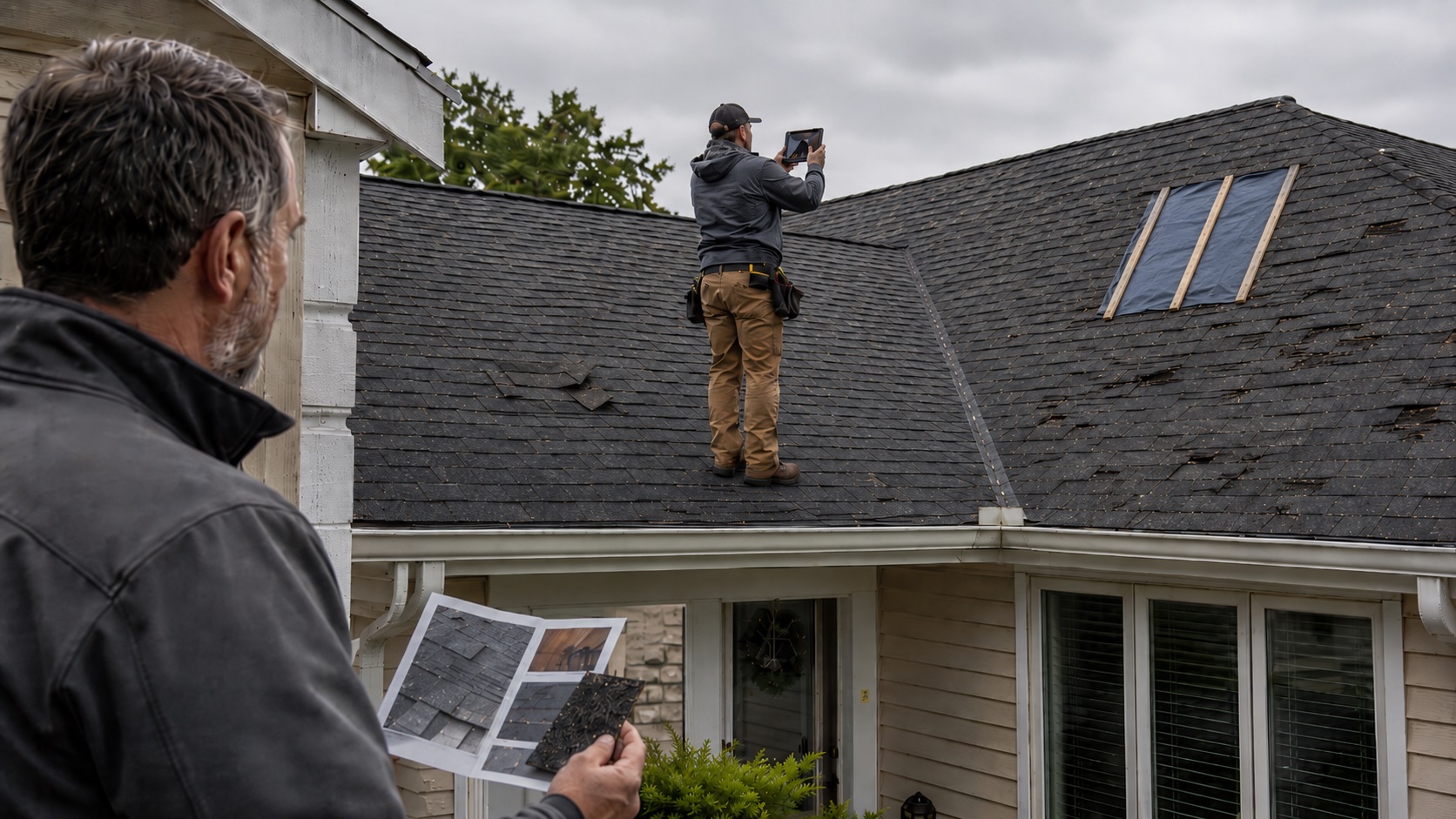
Before making a repair or replacement decision, make sure the roof is stable enough to protect the home. Storm damage can create immediate water-entry points even if the final repair decision has not been made yet. A temporary dry-in, tarp, or emergency repair may be needed before the roof can be fully inspected.
Do not climb onto a storm-damaged roof to inspect it yourself. Wet shingles, loose materials, broken decking, fallen branches, and hidden structural damage can make the roof unsafe. Most homeowners should inspect from the ground, from inside the attic if it is safe, or from interior rooms where leaks are visible. A roofing contractor should handle roof-level inspection and emergency covering.
Active leaks need immediate attention
If water is entering the home, the priority is to limit interior damage without creating a safety hazard. Move belongings away from the leak, place containers under drips, protect flooring, and avoid standing water near electrical fixtures. If water is coming through light fixtures, electrical outlets, or ceiling fans, stay away from the area and avoid using those circuits until the area is evaluated.
Active leaks do not automatically mean the entire roof needs replacement. A leak may come from one damaged area, one missing shingle section, a displaced vent boot, or a flashing failure. But active water entry does mean the roof needs prompt attention before moisture spreads into insulation, decking, ceilings, and walls.
Storm leaks can create hidden moisture that continues affecting the home after the rain stops. If water reached the attic, ceiling, or roof framing, the roof decision should also account for hidden moisture, wet insulation, and possible structural roof damage.
Temporary tarping is not a permanent repair
A tarp or emergency dry-in can help reduce additional rain damage, but it is not a permanent roofing solution. Temporary covering is used to protect exposed decking, missing shingle areas, punctures, or openings until a contractor can inspect the roof and complete permanent repairs.
Temporary tarping is especially important when decking is exposed, a tree limb punctured the roof, a large shingle section is missing, or water is entering the attic. However, temporary protection should not be confused with a finished repair. A tarp can shift, leak, tear, or fail in another storm.
If insurance may be involved, document the damage before temporary work when it is safe to do so. Take photos from the ground, photos of interior leaks, and photos of damaged belongings or ceiling stains. Keep receipts for emergency tarping or temporary repairs.
Tree impacts and structural damage need urgent evaluation
If a tree or large branch hit the roof, do not judge the roof only by the shingles you can see. Impact damage can affect decking, rafters, trusses, framing connections, gutters, fascia, and interior ceilings. A puncture or sagging area can indicate structural damage that needs immediate professional evaluation.
Large impacts are more likely to move the decision toward replacement or major repair because the damage may extend below the roof covering. Even if the visible opening is small, the surrounding roof structure may be cracked, displaced, or weakened.
From inside the attic, warning signs may include fresh daylight through the roof, split decking, wet insulation, sagging sheathing, displaced framing, or new cracks around rafters or trusses. Do not enter the attic if the ceiling, framing, or electrical areas appear unsafe.
Emergency stabilization comes before the final decision
After a storm, treat stabilization and the permanent roof decision as two separate steps. Emergency work may include tarping, covering exposed decking, temporarily sealing an opening, removing loose debris safely, or protecting interior areas from water. The repair-or-replacement decision should wait until the roof has been inspected for shingle damage, flashing damage, underlayment exposure, decking condition, attic moisture, and the overall spread of the storm damage.
How to Decide Whether Storm Damage Can Be Repaired
Storm damage is more likely repairable when it is localized, the roof is otherwise in good condition, and the damaged area can be restored without leaving the roof unreliable. A repair should not simply cover the visible damage. It should restore the roof’s ability to shed water through future storms.
Repairs are usually most reasonable when the roof still has useful life left, the damaged materials can be matched, and the storm did not compromise multiple roof slopes or hidden layers.
Localized missing shingles may be repairable
If only a few shingles are missing or torn, repair may be enough. This is especially true when the roof is relatively new, surrounding shingles are flexible and well adhered, and there is no evidence of widespread wind uplift or water intrusion.
A localized repair may include replacing missing shingles, resecuring ridge caps, repairing a small flashing section, replacing a damaged vent boot, or addressing a limited area where debris caused damage. The contractor should also check whether nearby shingles were lifted or creased, because wind damage can extend beyond the missing pieces.
The roof should still have useful life left
Repair makes more sense when the roof was in good condition before the storm. If the shingles were not brittle, curled, heavily worn, or already losing granules, a localized repair may restore protection effectively. If the roof was already near the end of its service life, a repair may stop the immediate leak but still leave an old, vulnerable roof in place.
For the broader non-storm version of this decision, see this guide on how to decide whether to repair or replace a roof.
Matching materials should be available
Repair is easier when matching shingles or roofing materials are available. If the current shingles are discontinued, badly faded, or difficult to match, a small repair may be more visible. Appearance alone does not always require replacement, but matching problems can matter when the repair area is large or located on a highly visible slope.
Material matching also matters for performance. Replacement shingles, ridge caps, flashing, or vent components should be compatible with the existing roof system. Poorly matched or poorly installed repair materials may create weak points that fail during later storms.
Decking and underlayment should be intact
A roof surface repair is more likely to succeed when the decking and underlayment below the shingles are still sound. If storm damage exposed the underlayment briefly but water did not reach the decking, repair may still be possible. If the decking is soft, punctured, saturated, or visibly damaged, the repair becomes more involved.
Damaged decking does not always mean the whole roof needs replacement, but it does mean the repair must go deeper than replacing surface shingles. The affected section may need to be opened, dried, repaired, and rebuilt correctly.
When Storm Damage Usually Points Toward Replacement
Storm damage usually points toward roof replacement when the damage is widespread, affects multiple roof slopes, compromises the roof’s water-shedding ability, or exposes deeper layers of the roof system. A roof does not need replacement just because a storm occurred. But if the storm damaged the roof across large areas, repairs may not restore reliable protection.
The replacement decision should be based on the amount of functional damage, not only on appearance. A few missing shingles may be repairable. Scattered hail bruises across multiple slopes, widespread wind-lifted shingles, damaged decking, and repeated leaks are more serious.
Multiple slopes are damaged
Replacement becomes more likely when storm damage appears on more than one roof slope. Multiple damaged slopes suggest the roof system was affected broadly rather than in one isolated spot. This is common after severe wind, large hail, or storms that hit the home from more than one direction.
If only one small area is damaged, a repair may restore the roof. If the roof has damage across front, rear, side, ridge, valley, and edge areas, a patchwork repair may leave too many weak points behind.
Large sections of shingles are missing or lifted
Large missing shingle sections are serious because they expose the underlayment and possibly the decking to water. Even if the storm has passed, the roof remains vulnerable until it is repaired or temporarily covered.
Lifted shingles can also be serious. A shingle may settle back down after wind passes, but the adhesive seal may be broken. If many shingles have lifted, creased, or lost their seal, the roof may be more vulnerable to future wind-driven rain.
Decking or underlayment is exposed
Exposed underlayment or decking raises the urgency level. Underlayment is a secondary water-shedding layer, not a permanent exterior roof surface. Decking is even more vulnerable because it can absorb water, swell, soften, or begin to deteriorate if exposed to repeated rain.
If storm damage exposed decking or allowed water into the attic, the contractor should inspect below the shingle surface. Replacement may be needed if the damage is broad or if the roof system can no longer be restored with limited repairs.
The roof was already old or worn before the storm
An older roof is more likely to need replacement after storm damage because the remaining shingles may not tolerate repair well. Brittle shingles can crack during repair. Worn shingles may not seal properly. Heavy granule loss before the storm may mean the roof was already near the end of its service life.
Storm damage on a newer roof may be a repair problem. Storm damage on an older roof may become a replacement decision because the repair will not add much reliable life to the system.
Repair vs Replace After Wind Damage
Wind damage can range from a few missing shingles to widespread roof system failure. The decision depends on how many shingles were affected, whether the shingles are lifted or creased, whether seals are broken, and whether wind-driven rain entered the roof system.
Wind damage is not limited to missing shingles. Some wind-damaged shingles remain on the roof but no longer seal correctly. Others may be creased, loosened, displaced, or damaged along the edges.
Wind damage is more likely repairable when it is localized
Wind damage is more likely repairable when only a small number of shingles are missing or damaged, the surrounding shingles are still sealed, and the roof is not near the end of its life. A contractor may be able to replace the affected shingles and restore the damaged area.
Localized repair is also more reasonable when ridge caps, flashing, valleys, vents, and roof edges are still intact. If the damage is limited and no water entered the attic, repair may be enough.
Wind damage points toward replacement when it is widespread
Wind damage points toward replacement when many shingles are lifted, creased, missing, or no longer sealed across multiple slopes. Widespread seal failure is a serious problem because the roof may not resist the next storm even if the shingles appear to lie flat from the ground.
Replacement becomes more likely when wind damage appears along roof edges, ridge caps, valleys, and field shingles at the same time. These patterns suggest the storm affected the roof broadly, not just one vulnerable corner.
If you need a deeper symptom-focused guide, review the signs of wind damage on roofs. If the question is specifically whether the wind damage crosses the replacement threshold, see when wind damage requires roof replacement.
Hidden wind damage can cause delayed leaks
Wind damage can create delayed leak risk. A lifted shingle may settle back into place after the storm, but the adhesive seal may be weakened. A creased shingle may still cover the roof visually, but the crease can become a future crack or water-entry point.
This is why a roof should be inspected after strong winds even if there is no active leak. No leak today does not always mean there was no functional storm damage.
Repair vs Replace After Hail Damage
Hail damage decisions depend on whether the impacts are isolated and cosmetic or widespread and functional. Small dents on gutters or vents do not automatically mean the entire roof needs replacement. But widespread hail bruising, granule loss, or fractured shingles can shorten roof life and increase leak risk.
Hail damage can be difficult to judge from the ground. Some impact marks are subtle, especially on asphalt shingles. A professional inspection is usually needed to determine whether hail caused functional damage to the roofing material.
Hail damage is more likely repairable when it is isolated
Hail damage may be repairable when only a small area is affected, the shingles remain functional, and the roof has no widespread granule loss or bruising. Damage to a few accessories, vents, or isolated shingles may not require full roof replacement.
Localized hail repairs may also make sense when the roof is newer, the shingles are otherwise in good condition, and a contractor confirms that the damage has not compromised multiple slopes.
Hail damage points toward replacement when it is widespread
Hail damage points toward replacement when impacts are spread across large areas of the roof, especially if shingles are bruised, fractured, or losing granules down to the asphalt mat. Widespread granule loss matters because granules protect asphalt shingles from sun exposure and weathering.
Replacement is also more likely when soft metals such as vents, flashing, gutters, or downspouts show heavy impact damage and the shingles show matching patterns. This does not automatically prove replacement is required, but it supports the need for a professional inspection.
If hail is the main concern, use the guide on how to inspect a roof for hail damage for inspection context, and the guide on when hail damage requires roof replacement for the deeper hail-specific replacement decision.
Hail damage may not leak immediately
Hail damage can weaken shingles before water enters the home. Bruised shingles, exposed asphalt, damaged granules, and fractured mats may not leak during the first storm after impact. Over time, sun, rain, and temperature changes can turn hail damage into a leak path.
This is why homeowners should not ignore suspected hail damage just because the ceiling is dry. The repair vs replacement decision should consider the roof’s future water-shedding ability, not only whether water is dripping today.
How Roof Age Changes the Storm Damage Decision
Roof age changes how storm damage should be judged. The same missing shingles, hail impacts, or lifted tabs may be repairable on a newer roof but point toward replacement on an older roof with brittle, worn, or poorly sealing shingles.
Newer roofs are more likely to be repairable
If the roof is relatively new and was in good condition before the storm, localized damage is more likely to be repairable. A few missing shingles, a damaged vent boot, or one small impact area may be corrected without replacing the entire roof.
The key is whether the repair can restore the roof’s water-shedding ability without creating weak spots. Matching shingles, sound decking, intact underlayment, and flexible surrounding materials all make repair more realistic.
Mid-life roofs need closer judgment
A mid-life roof can go either way after storm damage. If the damage is limited and the roof was otherwise performing well, repair may still be a good option. If the damage is scattered across several slopes or the roof already had wear, replacement may be more practical.
Mid-life roofs often create the hardest decision because the roof still has some useful life left, but storm damage can reduce that life significantly. In this situation, a contractor should evaluate how much of the roof is affected and whether repaired areas would blend and perform well with the remaining roof.
Older roofs often lean toward replacement after storm damage
An older roof near the end of its life often leans toward replacement after storm damage, especially if shingles are brittle, curled, losing granules, or already showing wear before the storm. Repairing a few storm-damaged areas may not solve the larger problem if the rest of the roof is close to failing.
Older shingles can also be harder to repair without causing more damage. They may crack when lifted, fail to reseal, or be difficult to match. In some cases, storm damage simply reveals that the roof was already close to needing replacement.
Insurance Considerations After Storm Roof Damage
Insurance can affect the repair vs replacement decision after storm damage, but it should be handled carefully. Insurance coverage depends on the policy, deductible, cause of damage, roof condition, exclusions, adjuster findings, and local rules. A roof may physically need repair or replacement, but that does not automatically mean the insurance company will approve the full scope.
The safest approach is to document the damage, protect the home from further water intrusion, and contact the insurance company if the damage may be claim-related. Avoid assuming coverage, and avoid making unnecessary permanent repairs before the damage has been documented.
Document damage before cleanup when safe
Take photos and videos of visible storm damage from safe locations. Photograph missing shingles, damaged gutters, hail-dented vents, fallen branches, interior ceiling stains, wet insulation, and any temporary protection that was installed. Do not climb onto the roof to take photos, especially if the surface is wet, damaged, steep, or covered with debris.
Documentation helps show what happened and when. It can also help the contractor, adjuster, and homeowner compare visible damage with the repair or replacement scope later.
Temporary protection may still be needed
If water is entering the home, temporary protection may be needed before the insurance process is complete. A tarp, emergency dry-in, or temporary patch can reduce additional damage while the claim or inspection is pending.
Keep receipts for emergency work and take photos before and after temporary protection when possible. Temporary repairs are different from permanent replacement. The goal is to limit further damage until the roof can be properly evaluated.
Do not assume insurance decides the physical roof need
An insurance adjuster evaluates coverage and claim scope under the policy. A roofing contractor evaluates the physical condition of the roof and what work is needed to restore performance. These roles are related, but they are not the same.
A contractor may identify damage that needs repair, while the insurer may evaluate whether that damage is covered. The homeowner should understand both the physical roof condition and the insurance scope before approving major work.
Deductibles and scope matter
Even if storm damage is covered, the deductible and approved scope affect the decision. A small repair may cost less than the deductible. A larger replacement may involve more documentation, adjuster review, and contractor estimates. The homeowner should understand the financial side before assuming replacement is automatically the best option.
For water-related damage inside the home, the broader process may overlap with insurance documentation. If interior water damage is involved, see this guide on how to file a water damage insurance claim for general documentation context.
Emergency Repair vs Full Replacement
Emergency repair and full replacement are not the same decision. Emergency work stops additional water entry until the roof can be inspected. Full replacement is a larger decision based on the spread of storm damage, roof age, material condition, hidden moisture risk, and whether limited repairs would restore reliable protection.
When emergency repair is enough for now
Emergency repair may be enough for the short term when the roof has an active leak, a small exposed area, missing shingles, or a puncture that needs immediate protection. This can include tarping, temporary sealing, or limited emergency patching.
Emergency work should be viewed as temporary unless the contractor confirms that the repair is permanent. A tarp should not be left in place as a long-term solution because it can loosen, tear, or allow water underneath.
When emergency repair should lead to replacement planning
Emergency repair should lead to replacement planning when the temporary work is covering large areas, multiple slopes are damaged, decking is exposed, or the roof is old and storm damage is widespread. In those cases, emergency stabilization buys time but does not solve the roof’s long-term performance problem.
Replacement planning is also more likely when water entered the attic, insulation, or ceiling because hidden moisture may need to be addressed along with the roof surface.
When a permanent repair may be enough
A permanent repair may be enough when the damage is truly localized and the rest of the roof is sound. This might include replacing a small shingle section, repairing flashing, replacing a damaged pipe boot, or fixing one storm-damaged area after confirming the surrounding roof is intact.
The repair should include checking adjacent shingles, underlayment, flashing, and decking. A repair that only replaces the obvious missing piece may miss the hidden damage that caused or followed the leak.
When full replacement is the safer long-term decision
Full replacement is usually safer when storm damage is widespread, roof age is high, shingles are brittle, multiple slopes are affected, or the roof has repeated leaks after storms. Replacement may also be more practical when repairs would leave too many patched areas or when matching materials are unavailable.
Cost also matters. If repair costs are high and the roof is already near the end of its life, replacement may offer better long-term value. For cost context, see this guide on how much roof leak repair costs.
When to Call a Roofing Contractor Immediately
Call a roofing contractor immediately after storm damage when the roof is leaking, exposed, structurally damaged, or unsafe to evaluate from the ground. Even a small visible problem can become a larger moisture issue if wind-driven rain reaches the underlayment, decking, attic insulation, ceilings, walls, or framing.
Call immediately if the roof is actively leaking
Active leaks need prompt attention. Water entering the home can damage ceilings, insulation, drywall, electrical fixtures, flooring, and wall cavities. Even if the leak appears small, the water path inside the roof system may be larger than what is visible indoors.
If water is dripping near light fixtures, outlets, ceiling fans, or electrical panels, avoid the area and treat it as a safety issue. The roofing decision can wait until the immediate hazard is controlled.
Call immediately if decking is exposed
Exposed roof decking is a serious post-storm condition. Decking is not designed to be the final weather surface. If it absorbs water, it can swell, soften, delaminate, or begin to decay.
A contractor may need to tarp the area, remove damaged materials, inspect the decking, and determine whether the roof can be repaired in that section or whether broader replacement is needed.
Call immediately after tree impact
Tree impact can damage more than shingles. It can crack decking, bend framing, damage rafters or trusses, loosen flashing, break gutters, and create hidden structural stress. Even if the roof opening looks small, the force of impact may have affected the surrounding roof structure.
Large tree impacts should be evaluated by a qualified professional before anyone walks on the roof or enters a damaged attic area.
Call immediately if the roof is sagging or unstable
Sagging roof areas, dipping decking, cracked framing, or ceiling movement after a storm should be treated as urgent. These signs may indicate structural damage, water saturation, or impact-related weakening.
Do not try to inspect a sagging roof from above. A contractor or structural professional should evaluate the roof safely.
Repair vs Replacement Decision Summary
The repair vs replacement decision after storm damage depends on severity, spread, roof age, hidden damage, and whether a repair can restore reliable water protection. The table below gives a practical summary, but storm-damaged roofs should still be inspected by a qualified roofing professional before major repair or replacement decisions are made.
| Situation | Repair More Likely | Replacement More Likely |
|---|---|---|
| Missing shingles | A few shingles missing in one area | Large sections missing across multiple slopes |
| Wind damage | Localized lifted or missing shingles | Widespread lifted, creased, or unsealed shingles |
| Hail damage | Isolated impacts with no functional shingle damage | Widespread bruising, fractures, or granule loss |
| Roof age | Newer or mid-life roof in otherwise good condition | Older roof with brittle, worn, or already deteriorated shingles |
| Decking condition | Decking is dry, firm, and protected | Decking is exposed, soft, punctured, or water-damaged |
| Leak history | No leak or one localized leak | Repeated leaks or water in attic/ceilings after storms |
| Repair feasibility | Matching materials available and damage is limited | Repairs would be patchy, unreliable, or too widespread |
When the decision is unclear, professional inspection is the safest next step. Storm damage can be visible, hidden, localized, or system-wide. A contractor should evaluate the shingle surface, roof slopes, flashing, penetrations, decking, attic moisture, and repair feasibility before a final decision is made.
FAQ: Repair vs Replace a Roof After Storm Damage
Can storm roof damage be repaired instead of replaced?
Yes, storm roof damage can often be repaired when it is localized and the rest of the roof is in good condition. A few missing shingles, a damaged vent boot, or a small flashing issue may not require full replacement. Replacement becomes more likely when damage is widespread or the roof is already old.
How much storm damage requires roof replacement?
Roof replacement is more likely when storm damage affects multiple slopes, exposes decking, causes widespread hail or wind damage, or compromises the roof’s ability to shed water. There is no single number of damaged shingles that applies to every roof because age, material condition, and hidden damage also matter.
Can a few missing shingles be repaired after a storm?
Yes, a few missing shingles can often be repaired if the surrounding shingles are still sealed, the underlayment and decking are intact, and the roof is not already brittle or near the end of its life. If missing shingles are spread across several slopes, the decision moves closer to replacement.
Should I file an insurance claim before repairing my roof?
If storm damage may be covered, document the damage and contact your insurance company before major permanent repairs when possible. Emergency tarping or temporary protection may still be needed to prevent further damage. Coverage depends on your policy, deductible, roof condition, and the insurer’s findings.
Can I tarp my roof before the insurance adjuster comes?
Yes, temporary tarping may be appropriate if the roof is actively leaking or exposed. Take photos before temporary work when safe, keep receipts, and avoid unnecessary permanent repairs before the damage is documented. A tarp is temporary protection, not a finished roof repair.
What if my roof has storm damage but no leak?
A roof can have storm damage without leaking immediately. Wind can break shingle seals, and hail can weaken shingles before water enters the home. If you see missing shingles, hail marks, lifted tabs, or damaged flashing, have the roof inspected even if the ceiling is dry.
Is a tarp enough after storm roof damage?
A tarp may be enough as temporary protection, but it is not a permanent repair. It can help limit rain entry until the roof is inspected, but the permanent decision still depends on shingle damage, decking condition, roof age, hidden moisture, and whether the damaged area can be restored reliably.
Should an old roof be replaced after storm damage?
An older roof is more likely to need replacement after storm damage, especially if shingles are brittle, curled, worn, or already losing granules. Repair may still be possible for limited damage, but replacement often makes more sense when repairs would not add much reliable life.
Final Decision: Repair, Replace, or Stabilize First?
Repairing or replacing a roof after storm damage depends on more than whether a few shingles are missing. The decision should consider the severity of the damage, how much of the roof is affected, whether wind or hail weakened the roof system, whether water entered the home, and how much useful life the roof had before the storm.
Repair is more likely when damage is localized, the roof is still in good condition, matching materials are available, and the decking and underlayment are sound. Replacement becomes more likely when multiple slopes are affected, shingles are widely lifted or bruised, decking is exposed, water has entered the attic, or the roof was already near the end of its life.
After a storm, stabilize the roof first, document the damage, avoid unsafe roof access, and get a professional inspection before making a final repair or replacement decision. A temporary tarp can protect the home, but the permanent solution should be based on the full roof condition, not just the damage visible from the ground.