
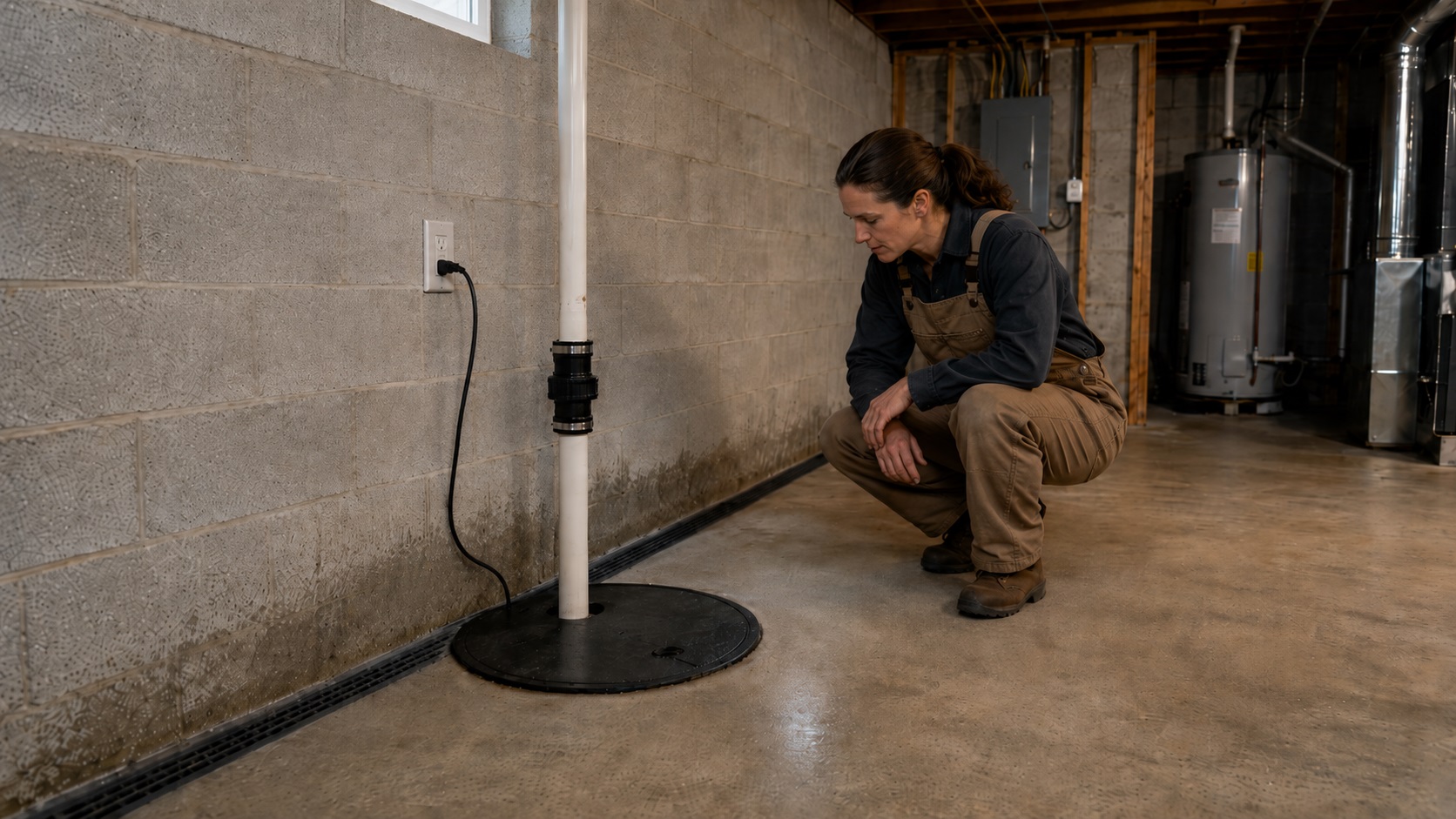
How to Waterproof Basements and Control Water Intrusion
Basement waterproofing is not one product, one coating, or one quick repair. A dry basement usually depends on a complete water-control system that manages where water comes from, how it moves through soil, how it reaches the foundation, and how it is drained or pumped away before it becomes a recurring problem.
The best way to waterproof a basement is to control water in layers. That may include improving surface drainage outside the home, managing soil water near the foundation, using interior or exterior drainage systems, maintaining sump pumps, sealing vulnerable foundation areas, controlling vapor movement, and monitoring the basement for early warning signs. In some homes, a simple drainage correction may solve the problem. In others, long-term water intrusion requires a more complete basement waterproofing system.
This guide explains the major basement waterproofing options, how they work together, and when a narrower drainage, sump pump, wall seepage, mold prevention, product, or contractor guide may be the best next step.
If you are still trying to understand the broader moisture patterns throughout your home, start with this guide to how to find, fix, and prevent moisture problems in homes. If your main issue is basement water pressure specifically, it also helps to understand why hydrostatic pressure causes basement leaks before choosing a waterproofing system.
Basement Waterproofing Is a Water-Control System, Not One Product
Many homeowners think basement waterproofing means painting a wall, sealing a crack, or buying a sump pump. Those things may help in the right situation, but none of them automatically waterproofs a basement by itself. A basement gets wet when water is allowed to collect, press against the foundation, seep through weak points, enter at floor edges, move through porous materials, or remain trapped indoors as humidity and vapor.
A true basement waterproofing plan looks at the whole path water follows:
- Where rainwater lands around the home
- How gutters and downspouts discharge water
- Whether soil slopes toward or away from the foundation
- How much water collects near the footing
- Whether drain tile or perimeter drainage exists
- Whether the sump pump can remove collected water
- Whether foundation walls, joints, or cracks allow seepage
- Whether vapor and humidity continue to affect the basement after liquid water is controlled
This is why the strongest basement waterproofing systems usually combine several layers of protection. Exterior drainage reduces how much water reaches the foundation. Foundation membranes or coatings help limit water contact with the wall. Drain tile collects water near the footing. Interior drainage can capture water that reaches the basement edge. A sump pump moves collected water out of the home. Vapor barriers and humidity control help reduce dampness that remains after bulk water is managed.
Why Water Gets Into Basements in the First Place
Before choosing a waterproofing system, it helps to understand why basement water intrusion happens. Basement water problems usually begin outside the finished living space, not inside it. Water collects near the home, builds up in soil, follows cracks or joints, and enters through the path of least resistance.
The most common basement water sources include surface runoff, poor grading, clogged gutters, downspouts that empty too close to the foundation, saturated soil, groundwater pressure, foundation cracks, porous masonry, cove joint seepage, failed drain tile, sump pump failure, and vapor movement through concrete. Some basements have one main problem. Others have several working together.
Surface Water Near the Foundation
Surface water is one of the most common and fixable contributors to basement moisture. When roof runoff, driveway runoff, patio runoff, or yard drainage flows toward the foundation, the soil near the basement wall can stay wet for long periods after rain.
This does not always create an immediate leak. At first, the basement may only feel damp or musty. Over time, repeated saturation can increase pressure against the foundation, expose cracks, overwhelm old drainage systems, or cause seepage along the wall-floor joint.
Basic surface water control may include cleaning gutters, extending downspouts, correcting low spots near the foundation, improving soil slope, and keeping water from pooling beside basement walls. These steps are often the first layer of basement waterproofing because they reduce the amount of water the foundation has to resist.
Soil Saturation and Foundation Pressure
When soil around a basement becomes saturated, water can press against foundation walls and the area below the slab. This pressure can force water through cracks, block walls, mortar joints, porous concrete, or the cove joint where the basement wall and floor meet.
This is where many homeowners misunderstand basement waterproofing. If water pressure is the main issue, simply coating the inside of the wall may not solve the problem. The pressure still exists outside the wall. A more complete solution may need drainage, pressure relief, sump pump capacity, exterior waterproofing, or a combination of systems.
For a deeper explanation of this pressure problem, read why hydrostatic pressure causes basement leaks.
Foundation Cracks, Porous Walls, and Wall-Floor Joints
Water does not need a large opening to enter a basement. Small cracks, porous masonry, utility penetrations, cold joints, mortar gaps, and the wall-floor joint can all become water entry points when moisture is allowed to collect outside the foundation.
Some cracks can be sealed directly, but crack sealing is not always a full waterproofing system. If the crack is only one symptom of larger drainage failure or soil pressure, sealing the visible opening may redirect water to another weak point. That is why basement waterproofing should look at both the entry point and the water source feeding it.
If your main issue is water moving through basement walls, see how to prevent water seepage through basement walls. That article focuses specifically on wall seepage, while this guide stays focused on the full waterproofing system.
Failed or Missing Drainage Systems
Many wet basements are not wet because the foundation wall is “bad.” They are wet because water has nowhere better to go. If footing drains are missing, clogged, crushed, disconnected, or overwhelmed, water can collect near the foundation until it finds a way inside.
Drainage systems are designed to give water a controlled path away from the basement. Exterior drain tile collects water near the footing before it builds pressure against the foundation. Interior perimeter drains collect water near the inside edge of the basement and direct it toward a sump pit. Both systems depend on clear drainage paths and a safe discharge location.
If a drainage system is already installed but the basement is still getting wet, the system may be clogged, undersized, poorly discharged, or poorly maintained. In that case, the issue may not be the concept of waterproofing itself, but the condition or design of the system. For more on long-term upkeep, see how to maintain basement drainage systems.
Sump Pump and Discharge Failures
A sump pump is one of the most important parts of many basement waterproofing systems, but it is not magic. It only removes water that reaches the sump pit. If the pump fails, the pit overflows, the discharge line freezes, the check valve fails, or the power goes out during a storm, basement flooding can happen even if the rest of the drainage system was designed well.
Sump pump problems often show up during heavy rain, snowmelt, or long wet periods. Warning signs may include unusual pump noise, constant cycling, no cycling during wet weather, water rising in the pit, discharge water returning toward the foundation, or dampness near the basement perimeter.
If you already have a sump system, it is worth learning the signs your basement sump pump is not working and how to detect sump pump problems early.
Interior Basement Waterproofing Systems
Interior basement waterproofing systems are designed to manage water after it reaches the inside edge of the foundation or the basement perimeter. They do not usually stop exterior soil from becoming wet. Instead, they capture water that enters or approaches the basement and move it toward a sump pit or drainage outlet.
Interior systems are common because they can often be installed without excavating the entire foundation exterior. They are especially useful when water enters at the cove joint, along the basement perimeter, through block wall cavities, or from below the slab. However, they should be understood as water management systems, not as proof that exterior water problems no longer exist.
What Interior Waterproofing Systems Are Designed to Do
An interior waterproofing system usually has one main job: keep water from spreading across the basement floor or soaking finished materials. Instead of allowing water to appear randomly along the perimeter, the system collects it and directs it to a controlled drainage path.
Interior systems may include:
- Interior perimeter drain channels
- Drain tile below or beside the slab edge
- Wall drainage panels or drainage board
- A sump pit
- A primary sump pump
- A discharge line to carry water away from the home
- Optional backup pump protection
In a block foundation, water can sometimes enter the hollow wall cores before draining down toward the basement edge. Interior wall drainage panels can help direct that moisture into a perimeter drain instead of allowing it to stain walls, wet insulation, or soak finished surfaces.
Interior Perimeter Drains
An interior perimeter drain is usually installed along the inside edge of the basement floor near the foundation wall. Its purpose is to collect water that enters at the wall-floor joint, below the slab edge, or through wall drainage materials. The water then flows toward a sump pit or other approved drainage outlet.
This type of system can be effective when the main issue is water entering at the basement perimeter. It can also be helpful in older homes where exterior excavation would be expensive, disruptive, or impractical.
However, interior perimeter drains do not stop water from reaching the outside of the foundation. They manage the water after it reaches the basement edge. That distinction matters because homeowners sometimes assume interior waterproofing makes the exterior foundation dry. It usually does not. It creates a controlled path for water that would otherwise enter the basement uncontrolled.
Wall Drainage Panels and Channels
Wall drainage panels or channels are often used with interior systems when water seeps through foundation walls. These materials guide water downward into the perimeter drain instead of allowing it to run across the visible wall surface or soak finished wall materials.
This can be especially important in finished basements. If water is allowed to collect behind drywall, insulation, trim, or flooring, the homeowner may not see the problem until odors, staining, mold, or material damage appear.
Wall drainage systems should not be confused with decorative wall coverings or simple plastic sheets. Their value depends on whether they are connected to a working drainage path. A wall panel without proper drainage below it may hide the problem instead of solving it.
When Interior Waterproofing Makes Sense
Interior waterproofing may make sense when water enters along the basement perimeter, when exterior excavation is not practical, when the home needs a controlled drainage path to a sump pump, or when an existing exterior system cannot fully manage water during heavy rain.
It may also be part of a larger waterproofing plan. For example, a home may need improved downspouts and grading outside, plus an interior drain and sump system inside. The outside work reduces water load. The inside system manages water that still reaches the foundation.
Interior systems are often more accessible than exterior excavation, but they still need proper design. A poorly installed interior drain can clog, fail to slope properly, miss the actual water entry path, or discharge water to a poor location.
What Interior Waterproofing Does Not Solve
Interior waterproofing does not automatically solve every basement water problem. It may not correct poor grading, clogged gutters, foundation wall deterioration, exterior membrane failure, or water collecting around the outside of the foundation.
It also does not remove the need for sump pump maintenance. If the interior system depends on a sump pump, the pump becomes a critical part of the waterproofing system. A failed pump can turn a working drain system into a flood risk.
If your basement keeps getting wet after previous work, the issue may be incomplete waterproofing, a failed system, or the wrong solution for the water source. In that case, review the signs of failed basement waterproofing and the common reasons why basement waterproofing systems fail.
Exterior Basement Waterproofing Systems
Exterior basement waterproofing systems are designed to reduce water contact and water pressure before moisture reaches the inside of the basement. Instead of waiting for water to enter and then redirecting it, exterior waterproofing attempts to control water at the outside face of the foundation.
Exterior waterproofing may involve excavation, foundation wall preparation, waterproofing membranes, drainage board, footing drains, gravel drainage layers, and backfill improvements. Because this work often requires digging around the home, it is usually more invasive than interior waterproofing. However, it can be the better solution when exterior water pressure, failed exterior drainage, or foundation-side water exposure is the main problem.
What Exterior Waterproofing Is Designed to Do
Exterior waterproofing is designed to reduce the amount of water that reaches or penetrates the foundation wall. A complete exterior approach may do several things at once:
- Keep bulk water from sitting directly against the foundation
- Protect the outside foundation wall with a membrane or coating
- Use drainage board or drainage mat to move water downward
- Collect water near the footing with exterior drain tile
- Move collected water away from the foundation
- Reduce pressure against basement walls
This approach is different from simply coating the inside of a basement wall. Exterior systems address water before it becomes an interior symptom.
Foundation Excavation and Exterior Membranes
Exterior waterproofing often requires exposing the foundation wall so the surface can be cleaned, repaired, sealed, or covered with a waterproofing membrane. The exact method depends on the foundation type, soil conditions, water severity, and condition of the existing wall.
Membranes can help block water from contacting or penetrating the foundation wall, but they work best as part of a drainage system. If water has nowhere to go, pressure can still build against the foundation. That is why exterior membranes are often paired with drainage board and footing drains.
If you are comparing membrane options, keep the system-level purpose in mind first. Product choice matters, but the membrane is only one part of the waterproofing assembly. For buying guidance, see best waterproofing membranes for basements.
Exterior Footing Drains and Drainage Board
Exterior footing drains collect water near the bottom of the foundation before it builds pressure around the basement. Drainage board or drainage mat helps water move down the exterior wall toward the drain instead of sitting against the foundation.
This system needs a reliable discharge path. Water collected by exterior drain tile must be carried to daylight, a sump system, a storm drainage connection where allowed, or another appropriate discharge point. If the drain cannot discharge properly, water can remain near the foundation and continue causing problems.
Exterior drainage can fail when pipes clog with sediment, collapse, become invaded by roots, lose slope, discharge to the wrong place, or are overwhelmed by surface water. That is why exterior waterproofing still depends on surface drainage, gutter control, and maintenance.
When Exterior Waterproofing May Be Necessary
Exterior waterproofing may be necessary when water pressure outside the foundation is severe, when exterior walls are repeatedly saturated, when interior-only methods would not address the main water source, or when a foundation needs exterior sealing and drainage restoration.
It may also be considered when a basement is being finished and the homeowner wants stronger protection before adding drywall, flooring, insulation, or built-in storage. Finished basements are less forgiving because hidden moisture can damage materials before obvious puddles appear.
Exterior waterproofing is not always required for every wet basement. Some problems can be improved with downspout extensions, grading corrections, sump pump repairs, or interior drainage. The right choice depends on the source, severity, and pattern of water intrusion.
Why Exterior Waterproofing Is Usually More Invasive
Exterior waterproofing is often more disruptive because it may require excavation around the foundation. Landscaping, patios, decks, sidewalks, driveways, porches, utilities, and limited access can all affect the work. This is why exterior waterproofing is often handled by professionals rather than as a simple DIY repair.
That does not mean exterior waterproofing is always the “best” choice. It means it should be matched to the problem. A homeowner with minor dampness from short downspouts may not need excavation. A homeowner with repeated water pressure against a below-grade wall may need more than interior paint or sealant.
When the project becomes expensive, invasive, or contractor-dependent, it is important to understand the proposed system before agreeing to work. Later in this guide, we will cover when to consider professional help and which contractor-related articles can help you compare options.
Drain Tile and Basement Drainage Systems
Drainage is one of the most important parts of basement waterproofing because it gives water a controlled path away from the foundation. Without drainage, water can collect in the soil, press against foundation walls, rise near the footing, seep through cracks, or enter along the wall-floor joint.
A basement drainage system does not simply “block” water. It moves water. That distinction matters. Sealants and membranes try to resist water movement, but drain tile and perimeter drains are designed to collect water and carry it somewhere safer. In many homes, waterproofing fails because water is being blocked in one location without being drained away from the foundation.
How Drain Tile Moves Water Away From the Foundation
Drain tile is a drainage pipe system installed near the foundation footing or basement perimeter. Despite the name, modern drain tile is usually perforated pipe surrounded by gravel or drainage material. Its job is to collect water from soil or from the basement perimeter and move it toward a discharge point.
Drain tile can be installed outside the foundation, inside the basement perimeter, or in some cases both. Exterior drain tile collects water before it builds pressure against the outside of the foundation. Interior drain tile collects water that reaches the inside edge of the basement and directs it to a sump pit or drainage outlet.
A drain tile system only works when water can reach the pipe, flow through the pipe, and discharge properly. If the pipe is clogged, crushed, filled with sediment, disconnected, or pitched incorrectly, water can continue to collect around the foundation even though a drainage system technically exists.
Interior vs. Exterior Drain Tile
Interior and exterior drain tile systems are related, but they solve water movement from different sides of the foundation.
Exterior drain tile is placed outside near the footing. It is meant to collect water before it enters the basement. When paired with exterior waterproofing membranes and drainage board, it helps reduce water pressure against the foundation wall.
Interior drain tile is placed along the inside basement perimeter. It collects water that reaches the wall-floor joint, slab edge, or interior drainage channel. It usually sends that water to a sump pit, where a sump pump removes it from the home.
Exterior drain tile is more preventive because it manages water outside the basement. Interior drain tile is more of a controlled water-management system because it handles water after it reaches the basement edge. Both can be legitimate solutions, but they should not be described as identical.
Why Drainage Needs a Discharge Path
A drainage system only helps if collected water has a safe discharge path. Short sump pump lines, frozen outlets, collapsed underground lines, blocked drains, or discharge points too close to the foundation can send water back toward the basement instead of away from it.
Signs Drainage May Be Blocked or Overwhelmed
Drainage systems often fail gradually. A homeowner may not notice a problem until a heavy storm exposes it. Warning signs can include water returning after rain, dampness along the basement perimeter, sump pump overload, water stains near the floor, efflorescence on walls, or moisture that appears even after previous waterproofing work.
If the basement already has a drainage system but water keeps returning, the system may be clogged, undersized, poorly connected, or discharging incorrectly. In that case, the next step is not always adding more sealant. It may be diagnosing why the existing drainage system is not moving water properly.
For a focused maintenance guide, see how to maintain basement drainage systems. If you suspect the waterproofing system itself is failing, review the signs of failed basement waterproofing.
Why Drainage Maintenance Matters
Basement drainage systems are often hidden, which makes them easy to ignore. But hidden systems still need monitoring. Sediment, mineral buildup, debris, root intrusion, pump issues, and discharge problems can all reduce performance over time.
Maintenance does not always mean opening the entire system. It can begin with simple observation: checking where sump pump water discharges, watching for recurring dampness, testing the sump pump before storm season, keeping discharge lines clear, and noticing whether water appears in the same basement area repeatedly.
A basement that stayed dry for years can become wet again when soil settles, gutters clog, pumps age, or landscaping redirects water toward the foundation.
Sump Pump Systems for Basement Water Control
A sump pump is a key part of many basement waterproofing systems because it removes water collected by interior drains, sump pits, or foundation drainage. In homes with high groundwater, perimeter drains, or flood-prone basements, the sump pump may be the final line of defense between controlled drainage and basement flooding.
However, a sump pump is not the same as a complete waterproofing system. It does not stop water from reaching the foundation. It does not fix grading. It does not seal foundation cracks. It does not replace drain tile. It simply pumps collected water out of the sump pit and away from the home.
How Sump Pumps Fit Into Basement Waterproofing
A sump pump works best as part of a drainage system. Water enters the sump pit from interior drains, exterior footing drains, under-slab drainage, or groundwater collection. When the water level rises high enough, the pump turns on and moves the water through a discharge pipe.
In a well-designed system, water should be collected before it spreads across the basement floor. The pump should activate before the sump pit overflows. The discharge line should carry water far enough away that it does not return to the foundation. The system should also have enough capacity for the amount of water the basement receives during heavy rain or snowmelt.
Primary Sump Pumps
The primary sump pump is the main pump responsible for removing water from the sump pit. It may be a submersible pump that sits inside the pit or a pedestal pump with the motor positioned above the pit. Either way, the pump needs to be sized and installed for the amount of water the system collects.
A primary pump should be tested regularly, especially before the wet season. Homeowners should know whether the float switch moves freely, whether the pump activates, whether the pit empties, and whether water discharges away from the foundation.
Because the pump often runs hardest during storms, it is most likely to reveal weaknesses when the basement most needs protection. That is why early warning signs matter. If your pump is acting unusual, start with the signs your basement sump pump is not working.
Check Valves and Discharge Lines
The discharge line is the path that carries pumped water out of the basement. A check valve helps prevent pumped water from flowing backward into the sump pit after the pump shuts off. Both parts matter.
If the check valve fails, water can fall back into the pit and cause the pump to cycle more often. If the discharge line is too short, water may be dumped near the foundation and eventually return to the drainage system. If the line freezes or clogs, the pump may run without actually moving water away from the house.
Many sump pump problems are not caused by the pump motor itself. They are caused by float switches, check valves, discharge line routing, outlet blockage, or power interruptions. For a deeper look at pump-related failures, see why basement sump pumps fail.
Backup Sump Pumps and Battery Systems
Backup protection is important because basement flooding often happens during storms, and storms can cause power outages. A primary electric sump pump cannot protect the basement during an outage unless there is a backup power source or a secondary pump system.
Backup systems may include battery backup pumps, backup pump controllers, water-powered backup systems where appropriate, or generator-supported pump setups. The right option depends on the home, local conditions, pump demand, and how much water the basement receives during severe weather.
A backup system is especially important if the basement has finished materials, stored belongings, frequent pump activity, a history of flooding, or high water volume during storms. To understand the role of backups more clearly, read why sump pump backup systems are important. For product-specific research, see best sump pump battery backup systems and best backup sump pumps for homes.
Common Sump Pump Failure Patterns
Sump pump failure does not always mean the pump suddenly dies. Sometimes the pump runs, but the system still fails to protect the basement. Common failure patterns include a stuck float switch, a clogged intake, a burned-out motor, an undersized pump, a missing check valve, a blocked discharge line, a frozen outlet, poor pit design, or no backup during a power outage.
The basement may give warning signs before a major failure. The pump may cycle constantly, run loudly, fail to activate, leave water standing in the pit, vibrate, discharge water too close to the foundation, or smell musty around the sump area.
If you want to catch these issues before a storm, see how to detect sump pump problems early and how to inspect basement sump pump systems.
Why Sump Pump Maintenance Matters
A sump pump is mechanical equipment, and mechanical equipment eventually wears out. Even a properly installed pump needs routine checks. The pit can collect debris, the float can stick, the pump can lose efficiency, the discharge line can clog, and the backup battery can weaken over time.
Basic sump pump maintenance includes testing the pump with water, checking the float switch, confirming discharge flow, cleaning visible debris from the pit, checking for unusual noise, and making sure the discharge outlet is clear. Homes with frequent pump cycling may need more frequent checks than homes where the pump only runs during major storms.
For a focused maintenance process, see how to maintain basement sump pumps. If your goal is flood prevention specifically, see how to prevent basement flooding with sump pumps.
Waterproofing Membranes, Sealants, and Foundation Sealing
Membranes, sealants, coatings, and foundation sealing products can all play a role in basement waterproofing, but they are often misunderstood. These materials are not all the same, and they do not all solve the same problem.
A waterproofing membrane is usually part of a larger wall protection and drainage assembly. A sealant may be used for cracks, joints, gaps, or surface protection. A coating may help resist dampness in limited conditions. But if water pressure is high or drainage is poor, surface products alone may not be enough.
What Membranes Do in a Waterproofing System
Waterproofing membranes are designed to protect foundation surfaces from water contact and penetration. Exterior membranes are often installed on the outside of the foundation wall after excavation and wall preparation. They may be paired with drainage board so water can move down to footing drains instead of sitting against the wall.
Membranes are strongest when they are part of a system. A membrane without drainage may still be exposed to constant water pressure. Drainage without wall protection may still allow moisture exposure at the foundation surface. The best approach depends on the basement’s water source, foundation type, and drainage conditions.
Because membranes vary by material, installation method, and intended use, product-specific comparison belongs in a separate buying guide. If you are researching materials, see best waterproofing membranes for basements.
What Sealants Can and Cannot Do
Basement waterproofing sealants can be useful for certain cracks, joints, gaps, and surface vulnerabilities. They may help reduce minor seepage, seal specific openings, or support a broader waterproofing plan. However, they should not be treated as a universal fix for every wet basement.
Sealants are most likely to disappoint when they are used to fight active water pressure without drainage. If water is pushing through a wall because the soil outside is saturated, sealing the inside surface may only hide the symptom temporarily or push water toward another weak point.
This does not mean sealants are useless. It means they need to be matched to the problem. They can be part of foundation sealing, crack repair, or surface moisture control, but they should not replace drainage, sump protection, or pressure relief when those systems are needed. For product-level research, see best basement waterproofing sealants.
Why Coatings Should Not Replace Drainage
Coatings may help in limited dampness situations, but they do not correct overflowing gutters, poor grading, clogged drain tile, or water pressure outside the foundation. If water still has nowhere to go, coating the interior surface is rarely a complete solution.
Where Foundation Cracks and Joints Fit Into the System
Foundation cracks, pipe penetrations, cold joints, and the cove joint can all become entry points for water. Sealing these points may be necessary, but the repair should be understood in context.
A single non-structural crack may be sealed successfully if the surrounding water issue is minor. But repeated leakage through multiple cracks, seepage at the wall-floor joint, or water returning after crack repair may point to a larger drainage or pressure problem.
This is especially important in basements where water appears after every heavy rain. The visible crack may be the opening, but the real issue may be water collecting outside the foundation. In that situation, crack sealing should be paired with drainage evaluation.
When Product Choice Matters
Product choice matters most after the water source and system need are understood. A basement wall coating, crack sealant, exterior membrane, sump pump backup, floor drain cover, or vapor barrier accessory should be chosen based on the role it plays in the waterproofing system.
For example, a sealant used for a small gap is not the same as an exterior waterproofing membrane. A floor drain cover is not the same as a sump pump backup. A vapor barrier tape is not the same as drain tile. Each product category has a different job.
If your basement water-control plan includes floor drains or drain accessories, see best basement floor drain covers. If your project involves vapor barrier materials in related spaces, you may also find best crawl space vapor barriers and best vapor barrier tape and sealants for crawl spaces useful for understanding material categories.
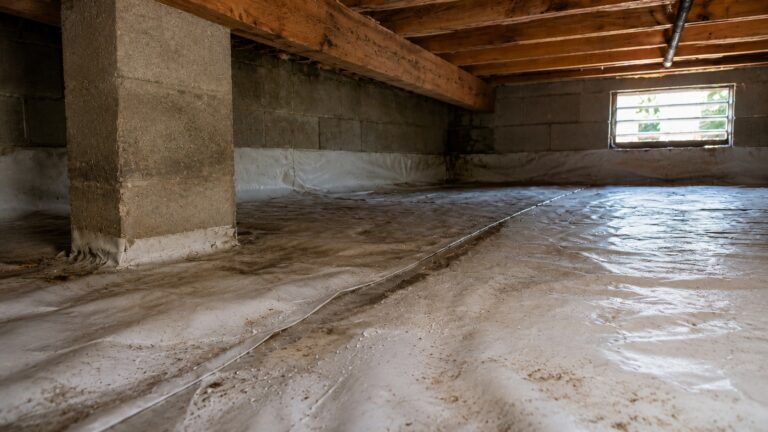
The same drainage principles also apply below homes with crawl spaces. If water collects under the house, start with how to prevent standing water in crawl spaces. For diagnosis and improvement, see signs of poor crawl space drainage, how to inspect crawl space drainage systems, and how to improve drainage around crawl spaces.
Basement Vapor Barriers and Moisture Control
Basement waterproofing is often focused on liquid water, but moisture can also affect basements as vapor and humidity. A basement can feel damp even when there is no visible puddle. Concrete, masonry, cool surfaces, stored materials, and limited airflow can all contribute to a damp basement environment.
Vapor barriers and moisture-control materials can support basement waterproofing, but they should not be confused with drainage systems. A vapor barrier helps limit vapor movement. It does not remove standing water, fix poor grading, replace a sump pump, or stop major wall seepage.
Liquid Water vs. Vapor Movement
Liquid water is the water you can see as puddles, seepage, dripping, or wet floor edges. Vapor is moisture moving through air or materials in a less visible form. Both can matter in a basement, but they require different control strategies.
Liquid water usually needs drainage, sealing, pumping, or exterior water management. Vapor and humidity may need vapor barriers, dehumidification, ventilation improvements, air sealing, or temperature control.
A homeowner may fix visible leakage but still have a basement that feels damp because humidity remains high. That does not always mean the waterproofing failed. It may mean the basement also needs vapor and humidity control.
Why Basements Can Feel Damp Even Without Visible Leaks
Basements are often cooler than the rest of the home. Cool surfaces can make moisture problems more noticeable because humid air may condense on cold materials. Concrete and masonry can also hold or transmit moisture, especially when the surrounding soil is damp.
Storage habits can make the problem worse. Cardboard boxes, fabric, wood shelving, and stored belongings can absorb moisture and develop musty odors. Finished basement materials can hide dampness behind walls or under flooring.
This is why basement waterproofing should not stop at visible puddles. A complete water-control plan also considers humidity, air movement, vapor, and whether the basement materials are staying dry over time.
How Vapor Control Supports Waterproofing
Vapor control supports waterproofing by reducing moisture movement after bulk water is addressed. It may involve vapor barriers, sealed wall systems, appropriate flooring choices, dehumidifiers, and moisture-resistant storage practices.
Vapor control is especially important in basements that are finished, partially finished, used for storage, or connected to indoor air quality concerns. Even small amounts of recurring dampness can affect materials over time if they are trapped behind walls, under floors, or inside storage areas.
However, vapor control should not be used to hide active water intrusion. If water is entering through the foundation, the water source must be addressed first. A vapor barrier over an active leak can trap moisture and make hidden damage harder to notice.
Why Waterproofing and Humidity Control Should Work Together
Basement waterproofing and humidity control are related, but they are not identical. Waterproofing controls water entry and drainage. Humidity control manages moisture in the air. A basement may need both.
For example, a sump pump and perimeter drain may keep the floor from flooding, but the basement may still need humidity monitoring during wet seasons. A dehumidifier may make the basement feel drier, but it cannot solve water pooling at the foundation wall. Each system has a different job.
If your concern is basement mold specifically, move from this waterproofing overview to how to prevent mold in basements. That article focuses on mold prevention, while this guide keeps the focus on basement waterproofing and water-control systems.
How to Choose the Right Basement Waterproofing Approach
The right basement waterproofing approach depends on where the water is coming from, how severe the intrusion is, how often it happens, and which parts of the current water-control system are missing or failing. A basement with minor dampness after poor downspout drainage does not need the same solution as a basement with repeated flooding, failed drain tile, and an overloaded sump pump.
The goal is not to choose the most expensive waterproofing method. The goal is to match the solution to the water source. That means looking at surface drainage, foundation conditions, wall seepage, floor seepage, sump pump performance, vapor issues, and whether previous repairs have failed.
Match the Solution to the Water Source
Basement waterproofing works best when the solution addresses the actual water path. If water is pooling beside the foundation because downspouts are too short, extending the downspouts may be the first priority. If water is entering at the cove joint during heavy rain, an interior perimeter drain and sump pump may be needed. If exterior soil pressure is severe, exterior waterproofing and footing drainage may be more appropriate.
A common mistake is treating the visible symptom as the full problem. A damp wall may be caused by exterior grading, a clogged footing drain, soil pressure, vapor movement, wall cracks, or repeated condensation. A puddle near the basement edge may be caused by wall seepage, floor seepage, sump pump backup, or discharge water returning to the foundation.
Before choosing a waterproofing method, ask these questions:
- When does the water appear: after rain, snowmelt, or during dry weather?
- Where does it show up first: walls, floor edges, cracks, the sump pit, or the wall-floor joint?
- Are gutters, downspouts, grading, sump pump discharge, and previous waterproofing work actually controlling water?
The answers help determine whether the first step is exterior drainage, interior drainage, sump pump repair, crack sealing, vapor control, or professional waterproofing evaluation. If you need a more focused next step, use how to prevent basement water intrusion for prevention planning and how to inspect basement waterproofing systems when you need to evaluate the condition of an existing system.
When Grading and Exterior Drainage May Be Enough
Some basement water problems begin with simple exterior drainage failures. Gutters may overflow, downspouts may discharge too close to the wall, soil may settle against the foundation, or landscaping may trap water near the basement. In these cases, improving exterior water movement may reduce the moisture load before more invasive waterproofing is needed.
Exterior drainage improvements may include extending downspouts, cleaning gutters, reshaping soil near the foundation, redirecting runoff, improving yard drainage, and preventing water from pooling beside basement walls.
These steps are especially important because even the best interior waterproofing system can be overwhelmed if the home keeps dumping roof runoff directly beside the foundation. Waterproofing should reduce the amount of water the basement has to manage, not simply collect more water after it enters.
When Interior Drainage May Be Needed
Interior drainage may be needed when water enters along the basement perimeter, at the wall-floor joint, through block walls, or from below the slab edge. Instead of allowing water to spread across the floor, an interior system collects it and directs it toward a sump pit or drainage outlet.
This approach is often considered when exterior excavation is not practical or when the basement needs a controlled path for water that already reaches the interior perimeter. It can also be useful when an older foundation allows seepage during heavy rain but the homeowner needs a manageable way to keep the basement floor dry.
Interior drainage should be planned carefully. It needs a proper channel, clear flow path, sump connection, pump capacity, and discharge route. If one piece is weak, water may continue to return.
When Sump Pump Improvements Are the Priority
If the basement already has an interior drainage system, the sump pump may be the most important part of the waterproofing plan. A drainage system without a reliable pump can collect water but fail to remove it. This is especially risky during storms, when water volume is high and power outages are more likely.
Sump pump improvements may include replacing an aging pump, cleaning the sump pit, correcting float switch issues, adding a check valve, improving the discharge line, adding a backup pump, or installing a battery backup system.
If the pump runs constantly, fails to activate, makes unusual noise, leaves water standing in the pit, or sends water back toward the foundation, the basement may be at risk even if the rest of the waterproofing system appears intact. For a focused flood-prevention guide, see how to prevent basement flooding with sump pumps.
When Exterior Waterproofing May Be Justified
Exterior waterproofing may be justified when the main problem is water collecting against the outside foundation wall, failed exterior drainage, recurring water pressure, or foundation-side seepage that interior surface treatments cannot control. It may also make sense when other exterior work is already exposing the foundation.
Exterior waterproofing can be more disruptive because it may involve excavation, wall preparation, membrane installation, drainage board, footing drains, and backfill correction. But in the right situation, it addresses water before it becomes an interior basement problem.
This approach may be especially important when a basement is being finished, when water intrusion is severe, when foundation materials are repeatedly saturated, or when interior methods would only manage water after it has already entered the basement edge.
Why Recurring Water Needs System-Level Diagnosis
If basement moisture keeps returning after repairs, the problem may not be the last product used. It may be that the full system was never addressed. A sealed crack may leak again if pressure remains high. A sump pump may fail if the discharge line sends water back to the foundation. A wall coating may peel if water continues moving through the masonry. A dehumidifier may reduce humidity without solving active seepage.
Recurring moisture should be treated as a system warning. It may point to an unresolved source, failed drainage, poor discharge, clogged drain tile, hidden seepage, sump pump weakness, or incomplete waterproofing.
If your basement keeps getting damp after cleanup or repair attempts, see how to fix persistent basement moisture problems. If the repeated issue is specifically tied to wall seepage, cracks, or water returning through the same basement wall area, see how to fix persistent basement wall leak problems. For broader moisture recurrence patterns, see why moisture problems keep returning.
Signs Your Basement Waterproofing System Is Not Working
A basement waterproofing system can fail slowly. It may not collapse all at once. Instead, small warning signs appear: a damp edge after storms, a musty smell near storage boxes, a sump pump that cycles more often, or moisture that returns in the same corner after every heavy rain.
These warning signs matter because waterproofing systems are often hidden behind walls, under slabs, outside the foundation, or inside sump pits. By the time visible flooding appears, the system may have been underperforming for months or years.
Recurring Puddles or Seepage
Recurring puddles are one of the clearest signs that water is not being controlled. The location of the puddle can provide clues. Water along the wall-floor joint may suggest perimeter seepage. Water near a crack may suggest a foundation opening. Water around the sump pit may suggest pump or discharge problems. Water in the middle of the floor may suggest floor drain, slab, or plumbing-related issues.
The timing also matters. Water that appears only after rain points toward exterior drainage, soil saturation, foundation pressure, or runoff problems. Water that appears during dry weather may require a different investigation, including plumbing, appliance leaks, condensation, or groundwater conditions.
The key is not just drying the puddle. The key is identifying why the water keeps reaching that location.
Musty Odor or Damp Storage Areas
A basement can have a waterproofing problem even without visible standing water. Musty odor, damp cardboard, soft stored materials, swollen shelving, or a damp feel near exterior walls can all suggest recurring moisture.
Storage areas often reveal basement moisture early because cardboard, fabric, paper, and wood absorb moisture from damp air or minor seepage. If the same storage area repeatedly smells musty, the basement may have a hidden water or humidity problem.
Moisture around stored belongings should not be ignored, especially in finished or partially finished basements. Hidden dampness can affect wall cavities, flooring, trim, insulation, and indoor air quality over time.
Efflorescence and Wall Staining
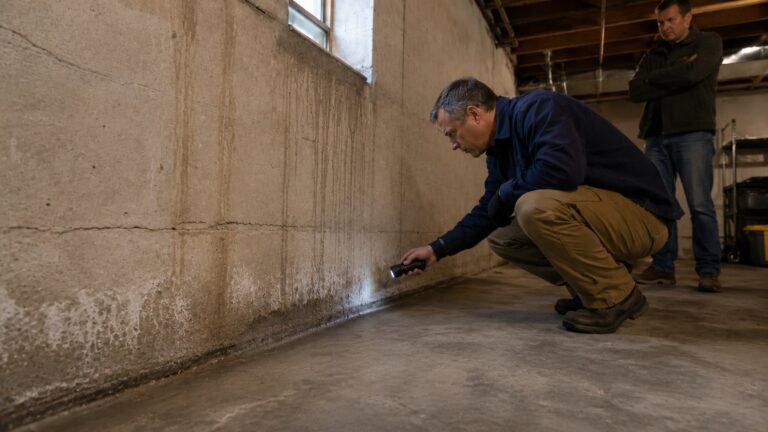
Efflorescence is the white, powdery mineral residue that can appear on masonry after moisture moves through the wall and evaporates. It does not automatically prove active leakage, but it is a sign that moisture has moved through the material.
Wall staining, peeling paint, bubbling coatings, mineral deposits, or damp block faces can suggest that the wall is still being exposed to moisture. If a wall coating repeatedly blisters or peels, the problem may be moisture movement behind the coating rather than poor paint quality.
These signs are especially important when they appear after waterproofing work. They may indicate that water is still reaching the wall, that drainage is incomplete, or that the wrong waterproofing method was used.
Sump Pump Cycling Problems
The sump pump can reveal a lot about the basement waterproofing system. A pump that cycles constantly may be dealing with high water volume, discharge water returning to the foundation, a faulty check valve, or a drainage system collecting more water than expected. A pump that never cycles during wet weather may be disconnected, stuck, failed, or not receiving water from the drainage system.
Short cycling, loud operation, vibration, delayed activation, or water remaining high in the pit can also indicate problems. The issue may be the pump itself, but it may also be the float switch, pit design, check valve, discharge route, or backup system.
Because sump pump failure can quickly lead to flooding, pump symptoms should be addressed early. For more detail, see why basement sump pumps fail and how to inspect basement sump pump systems.
Water Returning After Repairs
If water returns after crack sealing, wall coating, pump replacement, drain work, or cleanup, the repair may not have addressed the full water path. This does not always mean the repair was useless. It may mean it solved one opening while another source remained active.
For example, sealing a wall crack may reduce water at that crack, but if soil pressure remains high, water may appear along the cove joint. Replacing a sump pump may help remove water, but if the discharge line empties too close to the foundation, the system may keep recycling the same water. Coating a wall may hide dampness temporarily, but moisture may continue moving through the foundation.
Recurring water after repairs is one of the strongest signs that the basement needs system-level evaluation rather than another isolated patch.
When to Investigate Failed Waterproofing
You should investigate failed waterproofing when water keeps returning, when old systems stop performing, when a sump pump behaves differently, when the basement smells musty despite cleanup, or when visible signs appear after every storm.
A failed waterproofing system may involve clogged drainage, poor discharge, pump failure, membrane damage, wrong system design, skipped exterior drainage, poor installation, or lack of maintenance. The next step is to identify which part of the water-control chain is breaking down.
For a focused guide, read signs of failed basement waterproofing. To understand the causes behind those symptoms, see why basement waterproofing systems fail.
Maintenance for Long-Term Basement Water Control
Basement waterproofing is not finished the day a system is installed. Long-term water control depends on keeping drainage paths open, pumps working, discharge lines clear, and exterior water moving away from the foundation.
Maintenance matters because basement water conditions change. Gutters clog. Soil settles. Downspouts shift. Tree roots grow. Pump switches stick. Batteries weaken. Drainage lines collect sediment. Landscaping changes water flow. A basement that stayed dry for years can become wet again when one part of the system stops working.
Keep Gutters and Downspouts Working
Gutters and downspouts are part of basement waterproofing because roof water has to go somewhere. If gutters overflow or downspouts dump water near the foundation, the soil beside the basement can become saturated during every storm.
Clean gutters, secure downspouts, proper extensions, and safe discharge locations can reduce the amount of water that reaches the foundation. These are simple steps, but they often determine whether deeper waterproofing systems are constantly stressed.
Watch Grading and Surface Drainage
Soil around a foundation can settle over time. Even if grading was once correct, low spots can develop near the basement wall. Mulch beds, patios, walkways, driveways, and landscaping can also trap water or redirect runoff toward the house.
Homeowners should watch where water flows during rain. If water pools near the foundation, runs toward basement walls, or collects in window wells, exterior drainage should be corrected before assuming the solution is only inside the basement.
Test Sump Pumps Before Storms
A sump pump should be tested before it is urgently needed. A simple test can confirm whether the float moves, the pump activates, the pit empties, and water discharges properly. Testing is especially important before rainy seasons, snowmelt, hurricanes, or periods of repeated storms.
If the pump has a battery backup, the backup system also needs attention. Batteries age, chargers fail, alarms may be ignored, and backup pumps may not activate if they are not tested.
For a dedicated maintenance process, use how to maintain basement sump pumps.
Keep Discharge Lines Clear
A sump pump discharge line can make or break the system. If the line is blocked, frozen, crushed, disconnected, or too short, pumped water may not leave the foundation area. In some cases, the pump may remove water from the pit only to send it outside where it flows right back toward the basement.
Discharge water should be carried to a safe location away from the foundation, following local rules and site conditions. The outlet should stay clear of debris, ice, soil blockage, and landscaping changes.
Inspect Drainage Systems Periodically
Drainage systems are difficult to see, but their performance can still be monitored. Watch for recurring wet spots, slow drainage, sump pump overload, sediment in the sump pit, standing water near exterior drains, or dampness in the same basement area after rain.
If drainage problems appear repeatedly, maintenance may not be enough. The system may need inspection, cleaning, repair, redesign, or professional evaluation.
Monitor Humidity and Warning Signs
Even after liquid water is controlled, basement humidity should be watched. High humidity can make the basement feel damp, affect stored belongings, and support musty odors. Finished basements may hide early moisture signs behind trim, walls, and flooring.
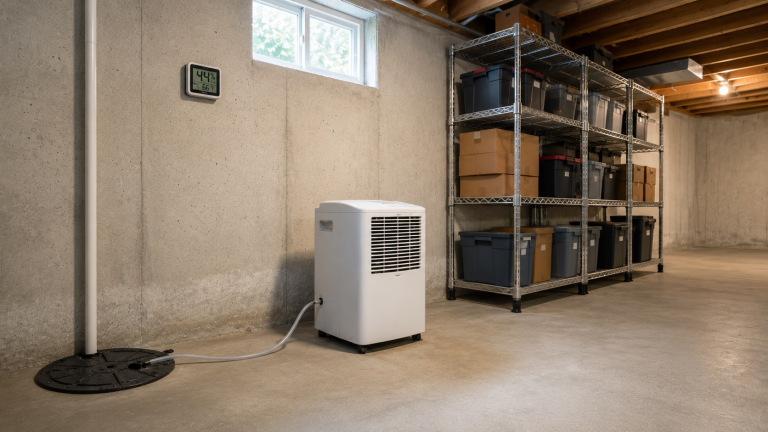
Monitoring does not need to be complicated. Pay attention to odors, damp storage, condensation, stains, sump pump behavior, and whether the basement feels different after storms. A hygrometer can also help reveal whether the basement is staying in a reasonable humidity range.
For broader long-term prevention, see how to prevent recurring moisture damage.
When Basement Waterproofing Requires a Professional
Some basement waterproofing steps are simple enough for homeowners to start with, such as cleaning gutters, extending downspouts, checking sump pump operation, or watching where water appears after rain. But not every basement water problem should be treated as a DIY project.
Professional evaluation may be needed when water intrusion is active, recurring, structural, hidden, or connected to drainage and foundation systems that require excavation, pump installation, drain tile work, or major waterproofing design.
Repeated Flooding or Active Seepage
Repeated basement flooding is a strong sign that the home needs more than cleanup. If water enters during every heavy rain, collects near the same wall, overwhelms the sump pump, or reaches finished materials, the waterproofing system should be evaluated.
Active seepage can also be difficult to diagnose from the inside only. The visible water may be entering at one point, while the source is exterior runoff, high groundwater, failed drainage, or pressure against the foundation.
If you are unsure whether professional help is necessary, see when to hire a basement waterproofing contractor.
Structural Cracks or Foundation Movement
Not every foundation crack is an emergency, but cracks with movement, widening, displacement, stair-step patterns, bowing walls, or repeated water entry deserve closer evaluation. Waterproofing should not ignore structural warning signs.
If moisture is affecting framing, joists, beams, sill plates, or other structural materials, the problem may extend beyond basement waterproofing. In that case, it may help to understand broader structural moisture problems in homes.
Failed Existing Waterproofing
If a basement has already been waterproofed but water is returning, the problem may involve failed drain tile, poor discharge, pump weakness, membrane damage, clogged drainage, or an incomplete original system. Adding another coating or sealant may not solve the underlying failure.
A contractor may need to evaluate how the existing system was installed, where it drains, whether the pump is sized correctly, and whether exterior water control was ever addressed.
Complex Drain Tile or Sump Pump Work
Drain tile installation, sump pit design, discharge routing, backup pump installation, and exterior footing drainage can be complex. Mistakes can leave the basement vulnerable or move water to the wrong place.
Professional work may be especially important when the basement is finished, when water volume is high, when excavation is needed, when code or discharge rules apply, or when a pump system must protect valuable stored belongings or living space.
Comparing Systems, Not Just Prices
Basement waterproofing quotes can vary because contractors may propose different systems. One quote may include interior drainage and a sump pump. Another may include exterior excavation and membranes. Another may focus on crack repair or surface sealing. These are not always equivalent solutions.
When comparing quotes, look at what water source each system addresses, what components are included, where water will discharge, what maintenance is required, and what is excluded from the proposal.
For help evaluating companies and proposals, see how to choose a basement waterproofing company and how to compare basement waterproofing quotes.
Questions to Ask Before Signing a Contract
Before hiring a basement waterproofing contractor, ask what problem the system is designed to solve. A good proposal should explain the source of water, the drainage path, the pump or discharge plan, the waterproofing materials, the warranty limitations, and the maintenance responsibilities.
Useful questions include:
- Where is the water coming from?
- Is the solution interior, exterior, or both?
- How will water be collected?
- Where will water discharge?
- Does the system include a sump pump backup?
- What happens during a power outage?
- What maintenance is required?
- What exactly is covered by the warranty?
For a complete preparation guide, see questions to ask before hiring a basement waterproofing contractor. To protect yourself from high-pressure or misleading proposals, read how to avoid basement waterproofing scams.
Basement Waterproofing FAQ
What is the best way to waterproof a basement?
The best way to waterproof a basement is to match the waterproofing system to the water source. Some basements need better gutters, downspouts, and grading. Others need interior perimeter drains, exterior drain tile, sump pumps, waterproofing membranes, foundation sealing, or backup pump protection. The strongest approach is usually a layered water-control system, not one product by itself.
Is interior or exterior basement waterproofing better?
Interior and exterior basement waterproofing solve different parts of the problem. Exterior waterproofing reduces water contact and pressure before water reaches the foundation. Interior waterproofing manages water after it reaches the basement edge and directs it to a drain or sump pump. Exterior systems are more preventive, but interior systems can be practical and effective when excavation is not realistic.
Can waterproofing paint stop basement leaks?
Waterproofing paint may help with minor dampness in limited situations, but it should not be treated as a complete solution for active leaks, hydrostatic pressure, poor drainage, or recurring seepage. If water is being pushed through the wall because the soil outside is saturated, the basement usually needs drainage, pressure relief, sump pump support, exterior water control, or a more complete waterproofing system.
Do I need a sump pump to waterproof my basement?
You may need a sump pump if water collects below the slab, enters through interior drainage, rises near the foundation, or needs to be pumped away from the basement. Not every basement needs a sump pump, but many wet basements depend on one. A sump pump works best as part of a drainage system, not as a stand-alone fix for every water problem.
How long does basement waterproofing last?
Basement waterproofing can last for many years when the right system is installed and maintained, but its lifespan depends on the materials, drainage design, soil conditions, pump performance, discharge routing, and maintenance. A waterproofing system can fail early if drains clog, sump pumps fail, discharge lines freeze, membranes are damaged, or water is repeatedly directed back toward the foundation.
Can I waterproof a basement myself?
Some parts of basement water control can be handled by homeowners, such as cleaning gutters, extending downspouts, correcting minor grading issues, testing sump pumps, monitoring humidity, and sealing small gaps in appropriate situations. Larger problems, such as repeated flooding, active seepage, exterior excavation, drain tile installation, foundation movement, or failed waterproofing systems, often require professional evaluation.
When should I call a basement waterproofing contractor?
You should consider calling a basement waterproofing contractor when water keeps returning, the basement floods, seepage appears during storms, the sump pump cannot keep up, existing waterproofing has failed, structural cracks are present, or the solution may require drain tile, excavation, sump system upgrades, or exterior waterproofing. A contractor should explain the water source, the proposed system, and where the water will go after the system is installed.
Final Thoughts on Basement Waterproofing and Water Intrusion Control
Basement waterproofing works best when the solution matches the water source. Start with roof runoff, grading, downspouts, drainage, sump pump performance, and where moisture appears first. From there, the right approach may involve exterior drainage, interior water capture, drain tile, sump pump upgrades, membranes, sealants, vapor control, or professional waterproofing design.
The main goal is not to cover the symptom. It is to give water a controlled path away from the basement and keep the foundation, floor edges, stored belongings, and finished materials dry over time.
3 Comments
Comments are closed.