
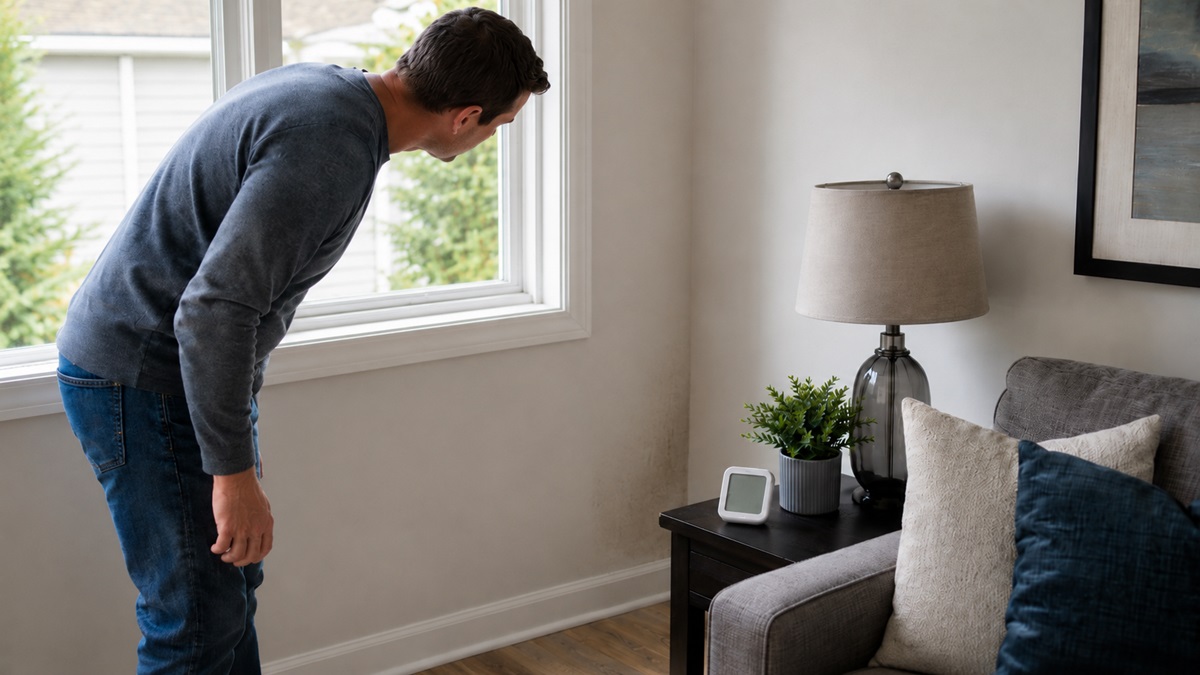
Mold Exposure and Indoor Air Quality: Complete Home Guide
Mold exposure and indoor air quality are closely connected because mold is rarely just a surface problem. In most homes, mold becomes an air quality concern when moisture allows mold growth to develop, spread, release musty odors, or affect the air people breathe in occupied rooms. Sometimes the mold is visible on walls, ceilings, window trim, bathroom surfaces, or stored items. Other times, the concern begins with a musty smell, allergy-like symptoms, damp rooms, or a history of leaks even when no obvious mold growth can be seen.
This guide explains how mold can affect indoor air, how exposure concerns usually begin, what signs homeowners should pay attention to, when symptoms may justify investigating the home, and how testing, moisture control, cleanup, air filtration, and professional help fit into the larger system.
The most important point is that mold exposure risk is usually a source-control problem before it is an air-treatment problem. Air purifiers, dehumidifiers, mold test kits, and ventilation changes can all have a place, but none of them replaces finding the moisture source, correcting the damp condition, and dealing with contaminated materials when mold is actually present.
This source-control approach matches public health guidance: the EPA emphasizes that moisture control is the key to mold control, while CDC and NIOSH guidance notes that damp and moldy environments may affect some people more than others and are associated with respiratory and allergy-related concerns. The practical takeaway for homeowners is to correct damp conditions first, then use testing, filtration, or professional inspection when those tools answer a specific question.
If you are trying to understand the broader moisture system behind mold growth, start with the full guide to home moisture problems. That guide explains how moisture starts, spreads, damages materials, and leads to mold throughout a house. This page focuses specifically on the indoor air quality side of that system.
How Mold Exposure and Indoor Air Quality Are Connected
Mold needs moisture to grow. That moisture may come from a roof leak, plumbing leak, wet crawl space, damp basement, bathroom humidity, condensation, poor ventilation, or water-damaged materials that were never fully dried. Once mold growth becomes active, it can affect indoor air through spores, microscopic fragments, musty odors, and air movement from contaminated or damp spaces into living areas.
That does not mean every mold situation has the same level of risk. A small patch of surface mildew in a bathroom is different from hidden mold inside wet wall cavities, mold-contaminated insulation, or a damp crawl space that communicates with the living area. The level of concern depends on several factors:
- How much mold or damp material is present
- Whether the moisture source is still active
- Whether the mold is visible or hidden
- Whether affected materials are porous, such as drywall, insulation, wood, carpet, or stored boxes
- Whether air from the affected area can move into occupied rooms
- Whether people in the home are sensitive, allergic, asthmatic, very young, elderly, or medically vulnerable
- Whether symptoms seem to worsen indoors or in certain rooms
Indoor air quality problems from mold are often misunderstood because the air itself is not the original cause. The air becomes the delivery path. The real problem usually starts with a damp material, an active leak, a humidity imbalance, condensation, or a hidden moisture reservoir. That is why mold exposure concerns should be handled as both an air quality issue and a moisture-source investigation.
Why Mold Exposure Concerns Often Start Before Mold Is Clearly Visible
Many homeowners first suspect a mold exposure problem before they can point to a clear patch of mold. They may notice a musty smell when they enter the house, feel worse in a certain room, see condensation on windows, find recurring stains, or remember a past leak that was cleaned up quickly but never fully investigated. In other cases, the first clue is not the building at all. It is a pattern of headaches, coughing, sinus irritation, breathing discomfort, eye irritation, skin irritation, or fatigue that seems worse at home than away from home.
Symptoms alone cannot prove that mold is the cause. Many mold-related concerns overlap with allergies, colds, dust, pet dander, asthma, chemical irritants, poor ventilation, dry air, high humidity, and unrelated medical conditions. But when physical building clues and symptom patterns appear together, it is reasonable to investigate whether mold, moisture, or damp materials are affecting the indoor environment.
For example, a single headache does not confirm mold exposure. But headaches that seem to appear repeatedly in a musty room with visible staining, past water damage, or damp materials deserve a closer look. Readers with that specific concern can review the more focused guide on whether mold can cause headaches.
The same principle applies to breathing symptoms. Breathing discomfort, wheezing, coughing, or chest tightness should be taken seriously, especially for people with asthma or respiratory sensitivity, but those symptoms should not be automatically blamed on mold without looking at the full home and health context. The more specific article on breathing problems from mold exposure covers that symptom pathway in more detail.
Common Ways Mold Can Affect Indoor Air
Mold can affect indoor air in several practical ways. A homeowner does not need to understand every biological detail to make good decisions, but it helps to understand the main pathways.
Visible Mold Growth on Indoor Surfaces
Visible mold is the most obvious air quality warning sign. Mold on drywall, ceilings, trim, cabinets, flooring, bathroom walls, window areas, or stored belongings means moisture has supported growth on or near a material. Even when the visible area looks small, the key question is whether it is only surface growth or the visible part of a larger moisture problem.
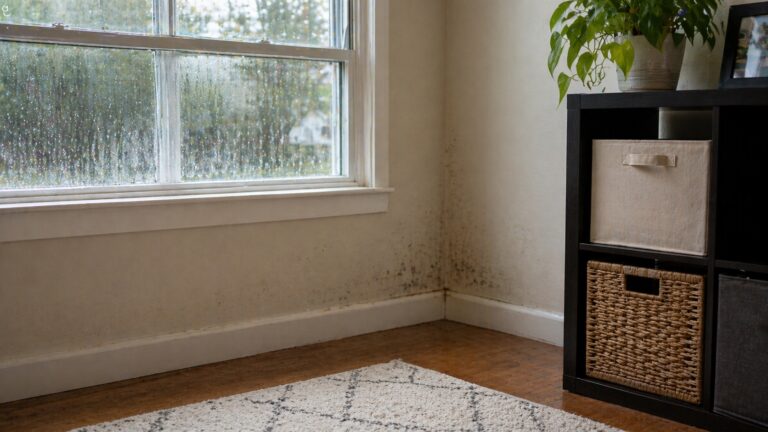
Surface mold in a bathroom may come from repeated humidity and poor ventilation. Mold along baseboards may point to lower-wall moisture, flooring moisture, or a past leak. Mold around windows may be connected to condensation, air leakage, flashing problems, or damp trim. Mold on ceilings may involve bathroom moisture, roof leakage, attic moisture, or condensation. The location matters because it often points toward the source.
Hidden Mold Behind Finished Materials
Hidden mold is harder to confirm because it can grow behind drywall, under flooring, inside cabinets, behind baseboards, above ceilings, in insulation, or within cavities affected by leaks. The air in a finished room may be affected even when the mold itself is not visible, especially if the hidden area is damp, disturbed, or connected to air movement.
Common clues include musty odor, staining that returns, soft or swollen materials, peeling paint, warped trim, recurring condensation, or moisture readings that stay elevated. If the concern is not just air quality but locating hidden moisture sources, the guide to finding hidden moisture in different areas of your home is the better next step.
Musty Odors From Damp Materials
A musty smell is one of the most common reasons homeowners suspect mold exposure. Odor does not prove the exact amount, type, or location of mold, but it often means that damp organic material, microbial growth, or poor drying conditions are present somewhere nearby. The source may be visible, hidden, or coming from a connected space such as a basement, crawl space, attic, wall cavity, cabinet, or poorly ventilated room.
Odor matters because people often dismiss it when no visible mold is present. A room can smell musty because air is moving from a damp crawl space, wet basement, contaminated storage area, or hidden wall/floor cavity. In those situations, cleaning surfaces or masking the smell does not solve the source problem.
Air Movement From Contaminated or Damp Spaces
Mold exposure risk is not limited to the room where mold grows. Air movement can carry odors, particles, and moisture-related contaminants from one area to another. Crawl spaces, basements, attics, wall cavities, and bathroom systems are common examples because they can connect to occupied spaces through gaps, framing cavities, duct openings, ceiling penetrations, flooring gaps, utility chases, or pressure differences inside the home.
This is why location-specific exposure risk matters. Mold in a crawl space is not the same as mold on a bathroom ceiling. Basement moisture is not the same as attic mold. Each location has its own airflow, humidity, material, and source-control issues. Later in this guide, those location risks are separated so readers can move into the correct detailed article instead of treating all mold exposure concerns as the same problem.
What Mold Exposure Symptoms Can and Cannot Tell You
Mold exposure symptoms are one of the most sensitive parts of this topic. Some people search because they are worried about headaches, breathing problems, fatigue, sinus issues, coughing, eye irritation, skin irritation, brain fog, asthma symptoms, or allergic reactions.
If you want a broad symptom overview before narrowing into one specific concern, start with the guide to common symptoms of mold exposure in homes. These concerns are real, but symptoms alone cannot identify the source with certainty.
A better way to think about symptoms is pattern recognition. Symptoms may justify a home investigation when they appear alongside building clues such as musty odor, visible mold, damp materials, recent water damage, high humidity, condensation, or symptoms that seem worse in certain rooms. The more overlap there is between health patterns and building evidence, the more reasonable it becomes to inspect the home for mold and moisture.
If your concern is whether symptoms are serious enough to investigate the home, use the guide to signs mold exposure is affecting your health. If the main question is whether the home itself may be contributing to symptoms, the guide on how to tell if mold is making you sick gives a more focused decision path.
It is also important to separate home investigation from medical diagnosis. A moisture inspection, mold inspection, or mold test may help identify indoor conditions, but it does not diagnose a person. Serious, persistent, worsening, or respiratory symptoms should be discussed with a qualified medical professional, especially for children, older adults, people with asthma, people with allergies, or anyone with immune or respiratory vulnerability.
When Mold Exposure Concerns Should Lead to a Home Investigation
A mold exposure concern should become a home investigation when symptoms, odors, visible clues, moisture history, or room-specific patterns begin to line up. One clue by itself may not prove much. A musty smell may have several causes. A cough may have several causes. A water stain may be old and inactive. But when several clues point in the same direction, it becomes more important to look for the moisture source behind the indoor air concern.
In most cases, the investigation should begin with the home itself rather than with a product. Before buying an air purifier, ordering a mold test kit, or trying to deodorize the room, look for the conditions that allow mold to affect indoor air: damp materials, leaks, condensation, high humidity, poor ventilation, or air movement from contaminated spaces.
Symptoms That Seem Worse Indoors
If symptoms seem worse inside the home and improve when the person leaves, that pattern may justify a closer look at indoor air conditions. This does not prove mold is the cause, but it does suggest that something inside the home may be contributing. Mold is one possible factor, especially when the home also has musty odor, visible growth, water damage, dampness, or high humidity.
This pattern is especially important when symptoms seem tied to one room, one floor, or one part of the house. For example, a bedroom over a damp crawl space, a basement office, a bathroom with repeated condensation, or a room near a roof leak may create a more obvious investigation path than the house as a whole.
Musty Odor With No Visible Mold
A musty odor without visible mold should not be ignored. It often means the source is hidden, intermittent, or located in a connected space rather than directly on the surface in front of you. The odor may come from behind baseboards, under flooring, inside cabinets, inside wall cavities, in insulation, in an attic, in a crawl space, or from a damp basement area.
The mistake many homeowners make is trying to cover the odor instead of tracing it. Candles, sprays, ozone treatments, and surface cleaning may change the smell temporarily, but they do not correct the wet material or contaminated source if one is present. A persistent musty smell should lead to source investigation, especially if it returns after cleaning or becomes stronger during humid weather.
For odor-specific next steps, see mold smell but no visible mold, what causes musty smells in homes, how to identify mold smells, how to trace the source of musty smells, why some rooms smell musty more than others, and how to eliminate persistent musty odors.
Visible Mold or Mildew That Keeps Returning
Recurring mold or mildew is a sign that the underlying conditions have not been corrected. If the problem looks more like surface mildew than deeper mold growth, the guide to what causes mildew on walls explains the humidity and surface conditions that usually create that pattern.
Cleaning may remove visible surface growth for a short time, but if moisture continues, the growth can return. This is common in bathrooms with weak ventilation, windows with repeated condensation, damp closets, basement corners, and areas around leaks.
Detailed cleanup belongs in a mold removal guide, but the principle is simple: repeated growth usually means repeated moisture. If mold keeps returning after cleaning, the next question is not only “What should I clean it with?” but “Why does this area keep supporting mold growth?” For broader cleanup and source-control guidance, use the main mold removal hub on how to remove mold permanently.
Past Water Damage That Was Never Fully Verified
Many mold exposure concerns trace back to old water damage. A leak may have been stopped, the surface may have dried visually, and the room may look normal again. But drywall cavities, insulation, subfloors, baseboards, cabinets, ceiling spaces, and framing can hold moisture longer than the visible surface suggests. If those materials stayed damp long enough, mold may develop in hidden areas.
This is why a past leak should not be judged only by whether the surface looks dry today. The better question is whether the affected materials were actually dried, inspected, and monitored. If moisture returned after repairs or mold concerns keep coming back, the guide to detect repeated moisture problems can help connect recurring symptoms to recurring building conditions.
Common Indoor Areas Where Mold Exposure Risks Start
Mold exposure risk depends heavily on location. Some areas are more likely to hold moisture, restrict airflow, collect organic dust, or connect contaminated air with living spaces. The same musty smell can mean different things depending on whether it comes from a crawl space, basement, attic, bathroom, closet, wall cavity, or window area.
The goal is not to inspect every square inch of the house at once. The goal is to follow the strongest clues. Start where moisture is most likely, where odors are strongest, where symptoms seem worse, or where past water damage occurred.
Crawl Spaces
Crawl spaces can affect indoor air because they often sit directly beneath occupied rooms. Moisture can enter through exposed soil, poor drainage, foundation vents, plumbing leaks, condensation, or standing water. If the crawl space contains damp wood, moldy insulation, wet debris, or exposed soil moisture, air movement can carry odors and contaminants upward through floor gaps, utility penetrations, duct leakage, or pressure differences.
A crawl space does not need to flood to become an air quality concern. If crawl space moisture is part of the pattern, the guide on how crawl space encapsulation improves indoor air quality explains why separating crawl space moisture from living-space air can matter.
Chronic dampness, musty odor, sagging insulation, condensation on pipes, or mold on joists can all point to a moisture system that needs attention. For the dedicated location guide, see mold exposure risks from crawl spaces.
Basements
Basements can contribute to mold exposure concerns because they are often cooler, more humid, and more vulnerable to seepage than upper living areas. Moisture may enter through foundation walls, floor cracks, rim joists, window wells, poor exterior drainage, plumbing leaks, or condensation. Stored cardboard, wood, carpet, drywall, and fabric items can become mold-supporting materials when basement humidity stays high or water intrusion repeats.
Basement air can also move upward into the rest of the home. If the basement smells musty, has visible staining, recurring dampness, or mold on stored items, the issue may not stay isolated. The location-specific guide on mold exposure risks from basements covers this pathway in more detail.
Attics
Attic mold often begins with roof leaks, ventilation problems, bathroom exhaust venting into the attic, condensation on roof sheathing, or warm indoor air leaking upward into cold attic spaces. Because attics are not living areas, homeowners may not notice the problem until a musty odor appears, insulation looks discolored, roof sheathing darkens, or a home inspection finds mold growth.
Attic mold can become an indoor air concern when air pathways connect the attic with living spaces or when contaminated materials are disturbed during repairs, storage access, insulation work, or renovations. For the dedicated attic pathway, see mold exposure risks from attics.
Bathrooms
Bathrooms are one of the most common places where mold and indoor air concerns begin because they combine moisture, warmth, organic dust, and repeated humidity. The source may be shower steam, poor exhaust ventilation, damp grout, leaky shower walls, wet drywall, failed caulk, condensation, or water escaping behind fixtures.
Bathroom mold is not always a major hidden contamination problem, but recurring mold is still a sign that moisture control is not working well enough. Mold that returns on ceilings, walls, caulk lines, window trim, or vanity areas should lead to better ventilation, drying habits, leak checks, and surface-specific cleanup.
Wall Cavities, Floors, and Ceilings
Hidden cavities can become mold sources when water enters and cannot dry quickly. Wall cavities may be affected by plumbing leaks, roof leaks, window leaks, siding failures, condensation, or shower wall leaks. Floors may hold moisture from appliance leaks, bathroom leaks, slab moisture, or wet subfloors. Ceilings may be affected by roof leaks, attic condensation, plumbing above, or bathroom exhaust problems.
These areas matter because mold may grow out of sight while the occupied room still receives odor or airborne particles. If the concern is hidden moisture rather than broad air quality, move from this hub into the location-based moisture guide on how to find moisture in different parts of your home.
How to Think Through the Source Before Testing the Air
Many homeowners jump straight to air testing because they want a clear answer. That is understandable, but air testing is not always the first or best step. Air samples can be affected by timing, airflow, outdoor conditions, recent cleaning, window use, HVAC operation, and whether hidden mold is actively releasing particles at the time of sampling. A test may provide information, but it does not automatically identify the moisture source or explain symptoms.
Before testing, ask more practical source questions:
- Is there visible mold anywhere in the home?
- Is there a musty smell in certain rooms or at certain times?
- Has there been a leak, flood, roof issue, appliance leak, or plumbing problem?
- Are any rooms regularly damp, humid, or poorly ventilated?
- Is condensation forming on windows, walls, ceilings, ducts, or pipes?
- Are symptoms worse in one room, level, or part of the home?
- Are crawl spaces, basements, attics, or bathrooms connected to the concern?
- Are porous materials such as drywall, carpet, insulation, cardboard, or wood affected?
If these questions point strongly toward a source, fixing the source may matter more than simply proving mold is present in the air. If you are still trying to connect symptoms, odors, or building clues back to the house itself, use the guides on signs mold exposure may be coming from your home, how to tell if mold exposure is coming from your house, whether mold exposure can happen without visible mold, and what to do if you suspect mold exposure in your home.
If the source is unclear, the situation involves health-sensitive occupants, there is a rental or real estate concern, or hidden contamination is suspected, testing or professional inspection may become more useful.
For a more focused decision path, use the guide on how to confirm mold exposure risks inside your home. If symptoms are the reason you are considering testing, the article on whether you should test your home after mold exposure symptoms is the better next step.
Should You Test for Mold Exposure Risk?
Mold testing can be useful in some situations, but it is often misunderstood. A mold test can sometimes help document indoor conditions, compare areas, support a professional inspection, or identify whether mold particles are elevated in a certain space. But a mold test does not diagnose a person, prove that a specific symptom came from mold, or fix the moisture source that allowed mold to grow.
The most useful question is not simply, “Is there mold in the air?” Mold spores are common in indoor and outdoor environments. The better question is whether the home has an active moisture condition, visible mold growth, hidden contamination, musty odor, damp materials, or an indoor mold pattern that needs correction.
Testing is usually more useful when the source is unclear, when hidden mold is suspected, when documentation matters, when there are sensitive occupants in the home, or when a professional needs data to support a broader inspection. Testing is less useful when there is already obvious visible mold and an obvious moisture source. In that case, the priority is usually correcting the source and addressing the contaminated material, not proving what is already visible.
When a Mold Test Kit May Help
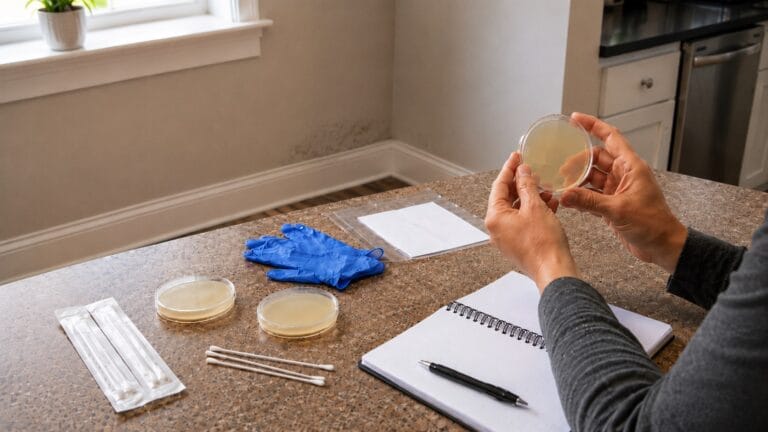
A mold test kit may help when a homeowner wants a basic screening tool, wants to compare one area with another, or wants a low-cost starting point before deciding whether to hire a professional. It may also be useful when there is a musty smell but no visible growth, or when the reader wants to understand whether further investigation is worth considering.
However, mold test kits have limits. They can be affected by where they are placed, how long they are exposed, how air is moving, whether windows were open, whether the room was recently cleaned, and what outdoor mold levels are like. A kit result should not be treated as a complete diagnosis of the home or the people living in it.
If you are deciding whether a kit is the right tool, start with the guide on whether mold test kits detect exposure risks. If you are already shopping for a kit, the comparison guide to the best mold test kits for homeowners is the better next step.
For individual product reviews, see the First Alert Mold Detection Kit review, Healthful Home Mold Test Kit review, Airthings Wave Plus review, Temtop Air Quality Monitor review, and Radon Eye RD200 review.
When Professional Mold Testing Makes More Sense
Professional testing or inspection makes more sense when the stakes are higher or the source is difficult to identify. This may include situations where symptoms are serious or persistent, a child or sensitive person is involved, mold is suspected inside walls or HVAC-adjacent areas, a musty odor keeps returning, a landlord or real estate issue requires documentation, or previous cleanup did not solve the problem.
A professional should not only collect samples. A good inspection should connect test results with building conditions: moisture readings, visible damage, airflow pathways, water history, material conditions, humidity, and likely source areas. Testing without source investigation can leave the homeowner with numbers but no clear solution.
If you are unsure whether the situation has reached that point, use the guide on when mold exposure requires professional testing. That article can help separate low-risk uncertainty from situations where a more formal inspection is justified.
Why Testing Should Not Replace Moisture Investigation
The biggest testing mistake is treating a sample result as the whole answer. Mold grows because moisture is present. If the moisture source remains active, the problem can continue even after cleaning, filtering, or testing. If the moisture source is corrected, the home is dried properly, and contaminated materials are handled correctly, the exposure pathway is much more likely to improve.
Testing should support the investigation, not replace it. A homeowner should still look for leaks, condensation, damp materials, poor ventilation, high humidity, musty rooms, and hidden moisture. If those conditions are present, the home is already giving useful information.
How to Reduce Mold Exposure Risk in a Home
Reducing mold exposure risk is not about doing one thing. It is a sequence of controls. The right order matters because air treatment alone cannot solve a source problem. The strongest approach is to stop moisture, address contaminated materials, improve drying and ventilation, control humidity, and then use filtration or monitoring tools as support.
Step 1: Stop the Moisture Source
The first priority is to stop the water or humidity condition that is allowing mold growth. That may mean repairing a leak, improving drainage, sealing an exterior water entry point, correcting bathroom ventilation, fixing a roof problem, managing crawl space moisture, reducing basement dampness, or addressing condensation.
If the source is not corrected, mold can keep returning. This is why recurring mold is usually not just a cleaning failure. It is often a moisture-control failure. For long-term prevention logic, the guide to prevent recurring moisture damage gives a broader framework.
Step 2: Dry Damp Materials Correctly
Damp materials should be dried quickly and thoroughly. Drywall, wood, insulation, carpet, cabinets, subfloors, and stored belongings can all hold moisture beyond the surface. A wall or floor may look dry while deeper materials remain damp. If those materials stay wet long enough, mold risk increases.
Drying should be matched to the material. Some materials can be dried if the moisture is limited and addressed quickly. Others may need removal if they are contaminated, damaged, porous, or unable to dry safely. This hub should not replace material-specific drying or repair guides, but the principle is clear: hidden dampness must be taken seriously because indoor air concerns often begin in materials people do not see.
Step 3: Remove or Remediate Mold-Contaminated Materials When Needed
Once mold is present, moisture control alone may not be enough. The contaminated material may need cleaning, removal, or professional remediation depending on the size of the affected area, the material involved, how long it has been wet, whether the source is hidden, and whether sensitive occupants are present.
Small surface-level problems may be handled differently from mold inside drywall, insulation, subfloors, ceiling cavities, or HVAC-adjacent spaces. The more hidden, widespread, porous, or recurring the problem is, the more caution is needed. For cleanup and remediation direction, use the main guide on how to remove mold permanently.
Step 4: Control Indoor Humidity
Humidity control matters because many mold and mildew problems are not caused by a single dramatic leak. They come from repeated dampness, condensation, poor ventilation, or rooms that stay above comfortable humidity levels for too long. Bathrooms, basements, crawl spaces, laundry areas, closets, and poorly ventilated rooms are common examples.
A hygrometer can help identify whether humidity is part of the problem. If the house feels damp, smells musty, has condensation, or develops recurring mildew, measuring indoor humidity is more useful than guessing. For the full measurement guide, see how to test indoor humidity levels.
When humidity is consistently high, a dehumidifier may help reduce conditions that support mold growth. But a dehumidifier does not remove existing mold, dry every hidden cavity, or fix leaks. It is a control tool, not a remediation tool. If you need help choosing and using one properly, use the guide on how to choose and use a dehumidifier effectively.
Step 5: Improve Ventilation Where Moisture Is Produced
Ventilation matters most in rooms where moisture is produced repeatedly. If ventilation equipment is part of the solution, compare the guides to the best ventilation fans for moisture control, best inline duct fans for moisture control, best whole-house ventilation systems, and best bathroom exhaust fans for mold prevention.
Bathrooms, laundry areas, kitchens, and poorly ventilated basements can hold damp air long enough to support condensation and surface growth. Improving ventilation may mean using an exhaust fan correctly, venting fans outdoors, increasing air movement, correcting blocked vents, or reducing moisture-producing habits.
Ventilation should not be confused with simply opening windows when there is an active mold problem. If the issue involves attached garages, stored moisture, odors, or poor air exchange near living spaces, see why garages have poor ventilation problems.
Outdoor air may help in some conditions, but it can also bring in humidity depending on the climate and season. The goal is controlled drying and moisture removal, not random air exchange that may make the house more humid.
Step 6: Use Air Filtration as Support
A HEPA air purifier may help reduce some airborne particles in a specific room, especially when used correctly and sized for the space. But an air purifier does not remove mold growing behind walls, under flooring, in a crawl space, in an attic, or on damp materials. It also does not fix the water problem that allowed mold to grow.
Air filtration should be treated as support after the source is being addressed, or as a temporary exposure-reduction measure while the source is being investigated or remediated. If you are trying to decide whether filtration is worth using, read the guide on whether air purifiers reduce mold exposure risks.
If you are ready to compare models, use the guide to the best HEPA air purifiers for mold. You can also compare the best air purifiers for mold spores or read individual reviews of the Levoit Core 300 air purifier, Coway Airmega AP-1512HH, and Honeywell HPA300.
Air Purifiers, Dehumidifiers, and Mold Test Kits: What They Can and Cannot Do
Products can help, but they are often oversold. The best product is useful only when it matches the actual problem. A mold test kit may help with screening or documentation. A dehumidifier may help reduce humidity. A HEPA air purifier may reduce airborne particles in a room. A hygrometer may help confirm whether humidity is high. A moisture meter may help identify damp materials. But none of these tools replaces source correction.
Mold Test Kits
Mold test kits can provide a starting point, but they cannot tell the whole story by themselves. They do not diagnose health symptoms, identify every hidden mold source, or prove that a home is safe or unsafe in every condition. They are best used as one part of a broader investigation.
HEPA Air Purifiers
HEPA air purifiers can be useful for reducing airborne particles in the room where they are used, but they do not remove the mold source. They should be viewed as a supporting tool, not the primary solution to active mold growth.
Dehumidifiers
Dehumidifiers help when excess humidity is part of the mold-supporting environment. They are especially relevant in basements, damp rooms, humid climates, and spaces where condensation or mildew keeps returning. They do not kill mold inside materials and should not be used as a substitute for cleanup or leak repair.
Hygrometers and Moisture Meters
Hygrometers help measure air humidity. Moisture meters help screen materials for elevated moisture. Both can support decision-making, but they must be interpreted in context. A number matters most when it is connected to a material, room, source, or recurring pattern.
The safest way to use tools is to let each tool answer the question it is designed for. Use a hygrometer to understand humidity. Use a moisture meter to investigate damp materials. Use a mold test kit cautiously when testing makes sense. Use air filtration to support air quality. Use a dehumidifier to control humidity. Then connect all of those findings back to the real question: where is the moisture source, and has it been corrected?
Who Is Most Sensitive to Mold Exposure?
People do not always respond to mold exposure concerns in the same way. One person may notice little or nothing in a damp room, while another person may experience irritation, allergy-like symptoms, coughing, headaches, or asthma-related discomfort. The difference may depend on allergies, asthma, respiratory health, immune status, age, exposure level, the amount of mold present, and how long the damp condition has been active.
This does not mean symptoms automatically prove mold exposure. It means the home should be evaluated more carefully when sensitive people live there and the building has moisture or mold warning signs. A musty basement, damp crawl space, moldy bathroom, or hidden leak deserves more urgency when children, people with asthma, people with allergies, older adults, or medically vulnerable occupants are regularly exposed.
If you need a focused guide to sensitivity differences, see who is most sensitive to mold exposure. For child-specific concerns, use the guide on whether children are more sensitive to mold exposure.
Children
Children may be more vulnerable to poor indoor air conditions because their respiratory systems are still developing, they spend more time close to floors and soft materials, and they may not describe symptoms clearly. A child with recurring coughing, congestion, eye irritation, headaches, fatigue, or asthma-like symptoms should not be diagnosed based on the home alone, but the home should be checked carefully if mold, dampness, or musty odor is present.
For a symptom-focused guide, see mold exposure symptoms in children.
Adults
Adults may notice mold exposure concerns as allergy-like symptoms, sinus irritation, coughing, headaches, breathing discomfort, skin irritation, fatigue, or symptoms that seem worse in certain areas of the home. Adults may also be more likely to connect symptoms with work schedules, sleep location, basement offices, home gyms, or specific rooms where air quality feels worse.
For the adult symptom pathway, see mold exposure symptoms in adults.
People With Allergies, Asthma, or Respiratory Sensitivity
People with allergies, asthma, or respiratory sensitivity may need to take mold and dampness concerns more seriously. Mold is not the only possible trigger for breathing symptoms, but damp indoor environments can worsen comfort for sensitive people. If coughing, wheezing, chest tightness, sinus irritation, or asthma symptoms seem connected to a damp or musty home, the building conditions should be investigated.
For more specific symptom guides, see whether mold can cause asthma symptoms, whether mold can cause persistent coughing, and whether mold can cause sinus problems.
Pets
Pets can also be affected by poor indoor air conditions, damp rooms, and mold-contaminated areas, especially because they spend time close to floors, rugs, bedding, crawl space openings, and lower-wall areas. Pet symptoms should be evaluated by a veterinarian, but mold and moisture conditions should still be corrected if the home shows signs of contamination.
For the dedicated guide, see whether pets are affected by mold exposure.
How Dangerous Is Mold Exposure?
The danger level of mold exposure depends on the situation. It is not accurate to treat every small mold spot as a severe emergency, but it is also not wise to ignore active mold, hidden damp materials, strong musty odors, recurring symptoms, or mold in areas connected to occupied rooms. The level of concern depends on how much mold is present, where it is growing, whether the moisture source is active, what materials are affected, how air moves through the home, and who lives there.
A small, limited surface problem caused by bathroom humidity may require better cleaning, drying, and ventilation. A larger hidden problem inside wet drywall, insulation, subflooring, attic sheathing, or crawl space framing may require a more serious investigation. Mold connected to ongoing water intrusion, persistent dampness, or sensitive occupants should be handled more carefully.
If you are trying to judge risk level, read the dedicated guide on how dangerous mold exposure is. If the concern is whether the situation has crossed from ordinary caution into a more urgent health-risk scenario, see when mold exposure becomes a serious health risk. If your concern is the amount or duration of exposure, see how much mold exposure is too much.
Short-Term Exposure Concerns
Short-term exposure concerns often begin after a leak, flood, musty room discovery, visible mold patch, or cleanup project. The most important question is whether the moisture source is still active and whether the affected materials can be dried, cleaned, or removed properly. A short-term problem can become a longer-term concern if damp materials are left in place or mold is disturbed without containment.
Long-Term Exposure Concerns
Long-term exposure concerns are more likely when mold or moisture problems continue for weeks, months, or years. This may happen in damp basements, crawl spaces, bathrooms with poor ventilation, attics with condensation, or hidden wall and flooring areas affected by recurring leaks. Long-term exposure concerns should be treated as a building-source problem that needs correction, not just an air-freshening problem.
For a deeper look at this topic, see long-term effects of mold exposure in homes. If you are worried about severe or lasting effects, see whether mold exposure can cause permanent health problems.
How Long Mold Spores Stay Active Indoors
Mold spores and particles can remain part of the indoor environment even after the original moisture event, especially if contaminated dust, porous materials, or hidden growth remain. But the practical question is not only how long spores exist. The practical question is whether the home still has an active source that keeps producing or releasing contamination.
If you are trying to understand persistence, see how long mold spores stay active indoors.
How to Match Your Concern to the Right Next Step
The fastest way to make progress is to match the concern to the right type of article. Mold exposure and indoor air quality can involve symptoms, risk, testing, moisture sources, location problems, product decisions, or cleanup. Each path has a different next step.
If Your Main Concern Is Symptoms
If your main concern is symptoms, start by identifying the strongest symptom pattern. Allergy-like symptoms, sinus irritation, headaches, coughing, breathing discomfort, eye irritation, skin irritation, fatigue, or asthma symptoms should be handled with caution. Look for building clues at the same time: musty odor, visible mold, damp rooms, condensation, water stains, or symptoms that seem worse in specific areas.
Helpful next steps include:
- Signs mold exposure is affecting your health
- How to tell if mold is making you sick
- Mold allergy symptoms vs cold symptoms
- How long mold exposure symptoms last
If Your Main Concern Is Breathing, Coughing, or Asthma
Respiratory concerns deserve extra caution, especially when symptoms are persistent, worsening, or connected to asthma. The home may be one possible contributor, but medical evaluation is important when breathing symptoms are serious or ongoing. From the building side, look for mold, dampness, odor, humidity, and room-specific patterns.
Helpful next steps include:
- Can mold cause breathing problems?
- Can mold cause persistent coughing?
- Can mold cause asthma symptoms?
- Can mold cause allergic reactions?
If Your Main Concern Is Headaches, Fatigue, or Brain Fog
Headaches, fatigue, brain fog, dizziness, and memory concerns can create anxiety because they are less visible than coughing or skin irritation. These symptoms can have many possible causes, so they should not be assigned to mold automatically. But if they appear alongside musty odor, dampness, visible mold, or a pattern of feeling worse indoors, it is reasonable to investigate the home environment.
Helpful next steps include:
- Can mold cause headaches?
- Can mold cause fatigue?
- Can mold cause brain fog?
- Can mold exposure cause dizziness?
- Can mold cause memory problems?
- Can mold cause chronic fatigue symptoms?
If Your Main Concern Is Skin, Eyes, or Sinuses
Skin, eye, and sinus irritation can overlap with allergies, dry air, dust, cleaning chemicals, pets, outdoor pollen, and mold. The more important question is whether these symptoms appear with indoor dampness, musty odor, visible mold, or specific rooms where irritation seems stronger.
Helpful next steps include:
- Can mold cause skin irritation or rashes?
- Can mold cause eye irritation?
- Can mold cause sinus problems?
If Your Main Concern Is Testing
If you are considering testing, first decide what question you are trying to answer. Are you trying to confirm a hidden source? Compare rooms? Document a rental or real estate concern? Decide whether professional help is needed? Choose a mold test kit? Testing is more useful when it is tied to a clear decision.
Helpful next steps include:
- How to confirm mold exposure risks inside your home
- Should you test your home after mold exposure symptoms?
- When mold exposure requires professional testing
- Do mold test kits detect exposure risks?
- Best mold test kits for homeowners
If Your Main Concern Is a Specific Area of the Home
If the concern is tied to a crawl space, basement, attic, or bathroom, follow the location. Each area has different moisture sources, airflow behavior, materials, and exposure pathways. Treating all areas the same can lead to the wrong solution.
Helpful next steps include:
- Mold exposure risks from crawl spaces
- Mold exposure risks from basements
- Mold exposure risks from attics
If your concern is bathroom-related, see mold exposure risks from bathrooms. If the concern involves air movement through ductwork, air handlers, condensation, or contaminated HVAC-adjacent areas, see mold exposure risks from HVAC systems.
If Your Main Concern Is Reducing Exposure Risk
If you already suspect mold is affecting indoor air, the next step is not only to filter the air. The next step is to reduce the source. That may mean stopping moisture, drying materials, cleaning or removing contaminated items, improving ventilation, controlling humidity, or hiring a professional when the problem is hidden, widespread, or recurring.
Helpful next steps include:
- How to reduce mold exposure risks in your home
- Do air purifiers reduce mold exposure risks?
- Can dehumidifiers reduce mold exposure risk?
- Best HEPA air purifiers for mold
How This Guide Fits Into the Bigger Mold and Moisture System
Mold exposure and indoor air quality should not be treated as isolated problems. In most homes, they are part of a larger moisture system. Mold grows because moisture is present. Indoor air becomes affected when mold, damp materials, musty odors, or contaminated spaces interact with the air people breathe. Long-term control depends on finding the source, correcting the moisture condition, addressing contaminated materials, and preventing the same pattern from returning.
This is why the best next step depends on what you are actually trying to solve. If the issue is visible mold, you need cleanup and source correction. If the issue is hidden moisture, you need detection. If the issue is high humidity, you need measurement and control. If the issue is recurring mold, you need to find out why the area keeps getting damp. If the issue is a symptom concern, you need both medical caution and a practical investigation of the home environment.
If You Need Mold Cleanup Guidance
If mold is already visible or confirmed, indoor air quality is only part of the problem. The mold source itself has to be handled. Surface cleaning may be enough for some limited problems, but hidden, porous, widespread, recurring, or moisture-driven mold may need deeper cleanup, material removal, or professional remediation.
For cleanup strategy, use the main guide on how to remove mold permanently.
If You Need Humidity Measurement
If the home feels damp, smells musty, has condensation, or develops recurring mildew, humidity should be measured instead of guessed. A hygrometer can help show whether indoor humidity is staying high enough to support mold and mildew conditions.
For measurement guidance, see how to test indoor humidity levels.
If You Need Dehumidifier Help
If humidity is part of the problem, a dehumidifier may help control the conditions that allow mold to return. But a dehumidifier should be used as part of a larger moisture-control plan. It does not remove existing mold, repair leaks, dry every hidden cavity, or replace cleanup.
For dehumidifier selection and use, see how to choose and use a dehumidifier effectively.
If You Need Hidden Moisture Detection
If you suspect mold exposure but cannot find visible mold, the next step may be hidden moisture detection. Look for the strongest clues first: musty odor, staining, swollen materials, soft drywall, damp baseboards, recurring condensation, flooring changes, or symptoms that seem worse in one area.
For area-specific moisture investigation, use the guide to find hidden moisture in different areas of your home.
If You Need Long-Term Prevention
If mold or moisture keeps coming back, the issue is usually not just cleaning. It may be recurring humidity, repeated condensation, an unresolved leak, incomplete drying, poor ventilation, or a hidden source that was never corrected. Long-term prevention means stopping the repeated moisture pattern.
For the broader prevention framework, see how to prevent recurring moisture damage.
Frequently Asked Questions About Mold Exposure and Indoor Air Quality
Can mold affect indoor air without visible mold?
Yes. Mold exposure concerns can happen even when mold is not clearly visible. The source may be behind walls, under flooring, inside cabinets, in insulation, in an attic, in a crawl space, or in a damp basement area. A musty smell, recurring dampness, past water damage, or symptoms that seem worse indoors may justify looking for hidden moisture or mold sources.
Does a musty smell mean there is mold?
A musty smell does not prove exactly where mold is or how severe the problem is, but it often points to damp materials, microbial activity, poor drying, or hidden moisture. The smell should be treated as a source-investigation clue, especially if it persists, returns after cleaning, or is strongest in certain rooms.
Can mold exposure symptoms prove my house has mold?
No. Symptoms alone cannot prove that a house has mold or that mold is causing the symptoms. Many symptoms overlap with allergies, colds, asthma, dust, pets, chemicals, dry air, humidity, and unrelated medical issues. Symptoms become more useful as an investigation clue when they appear alongside musty odor, visible mold, damp materials, water damage, condensation, or room-specific patterns.
Should I test the air or look for moisture first?
In many cases, it is better to look for moisture clues first. Mold grows because moisture is present, so visible mold, musty odor, water stains, leaks, condensation, damp materials, and high humidity can tell you a lot before testing. Mold testing may still be useful when the source is unclear, documentation is needed, symptoms are serious, or professional inspection is appropriate.
Do air purifiers help with mold exposure?
HEPA air purifiers may help reduce some airborne particles in the room where they are used, but they do not remove the mold source. They should be treated as support, not as the main solution. If mold is growing on damp materials, the source still needs to be found and corrected.
Can a dehumidifier fix mold exposure risk?
A dehumidifier can help reduce humidity that supports mold growth, especially in damp rooms, basements, and humid climates. But it does not remove existing mold, repair leaks, clean contaminated materials, or dry every hidden cavity. It works best as part of a source-control and prevention plan.
When should mold exposure concerns be handled professionally?
Professional help is more appropriate when mold is widespread, hidden, recurring, connected to ongoing water intrusion, affecting porous materials, involving sensitive occupants, or causing serious concern because of persistent symptoms. Professional testing or inspection may also be useful for rentals, real estate transactions, unclear sources, or situations where documentation matters.
Is bathroom mold as serious as mold from a crawl space or basement?
Not always. A small amount of surface mold from bathroom humidity is different from hidden mold in a crawl space, basement, attic, or wall cavity. The concern depends on the size of the problem, the moisture source, whether materials are porous, whether the problem keeps returning, and how air moves from that area into occupied rooms.
Final Thoughts on Mold Exposure and Indoor Air Quality
Mold exposure and indoor air quality problems are easiest to understand when you follow the moisture. Mold usually becomes an indoor air concern because some part of the home is damp, contaminated, poorly ventilated, or connected to air movement from a problem area. The solution is rarely just one product, one test, or one cleaning step.
Start with the strongest clue. If you see mold, identify why it grew. If you smell mold, trace the source. If symptoms seem worse indoors, compare the symptom pattern with building clues. If humidity is high, measure and control it. If a crawl space, basement, attic, or bathroom is suspicious, follow that location. If the source is hidden, recurring, widespread, or connected to sensitive occupants, consider professional inspection or testing.
The safest long-term approach is to correct the moisture source, dry affected materials, remove or remediate mold when needed, improve ventilation and humidity control, and use air filtration or testing as support rather than substitutes for source control.
From here, the best next step is to choose the article that matches your main concern: symptoms, testing, location risk, product support, mold cleanup, hidden moisture, humidity control, or long-term prevention. That is how mold exposure and indoor air quality problems become manageable instead of confusing.

6 Comments
Comments are closed.